The Coach Who Never Yells
The Coach Who Never Yells:
Why Fear-Based Coaching Produces Worse Fighters, Not Tougher Ones
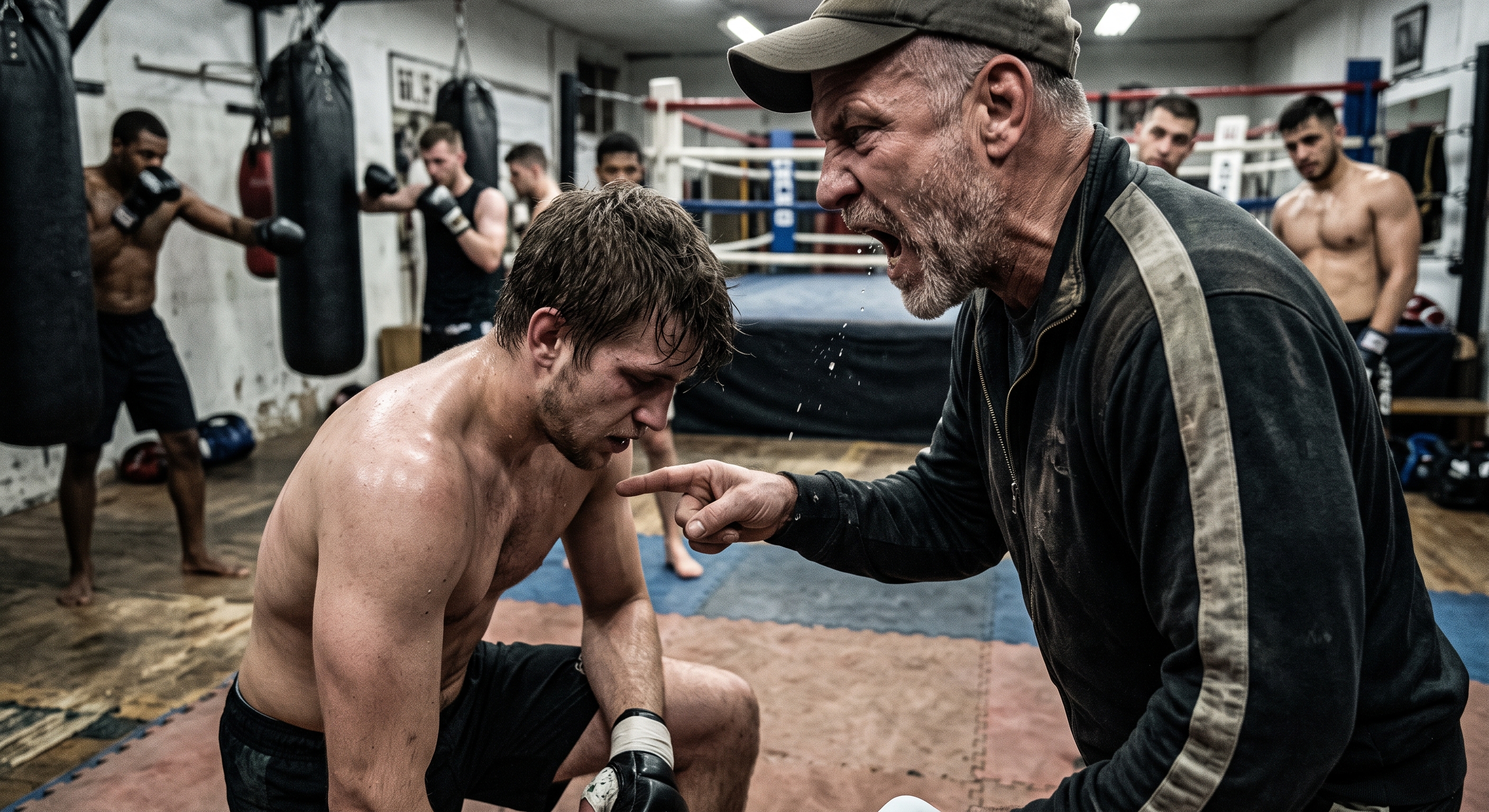
You know the coach I'm talking about. You've seen him in every fight movie ever made, and if you've been around combat sports long enough, you've seen him in real life.
He screams. He belittles. He makes an example of the weakest guy in the room. He runs practices designed to break people, and when they break, he calls it a filter —"separating the wolves from the sheep."His gym has a story about the day half the class quit, and he tells that story with pride. And when his fighters win, everybody points at the yelling and says: see? That's what it takes.
It sounds like I'm about to tell you this coach is a bad person. I'm not, actually. Most of the drill-sergeant coaches I've met over 27 years genuinely believe they're doing right by their athletes. They were coached that way, they survived it, they got good, and they've drawn the obvious conclusion: the harshness caused the toughness.
Here's the problem, and it's the entire reason this post exists: that conclusion is wrong, and it's wrong in a way we can actually examine — not as a matter of taste or softness, but as a matter of how human beings demonstrably learn, perform, and develop under pressure.
I want to be precise about my claim, because it's a bigger claim than "be nice." I'm not arguing that calm coaching is a kinder path to the same result. I'm arguing that fear-based coaching produces a worse fighter— measurably worse at the exact things fighting demands and that the gyms still running the drill-sergeant model are handicapping their own athletes while calling it toughness.
Let me make the case. Then you can judge it against every gym you've ever trained in.
First, Dismantle the Evidence for Yelling
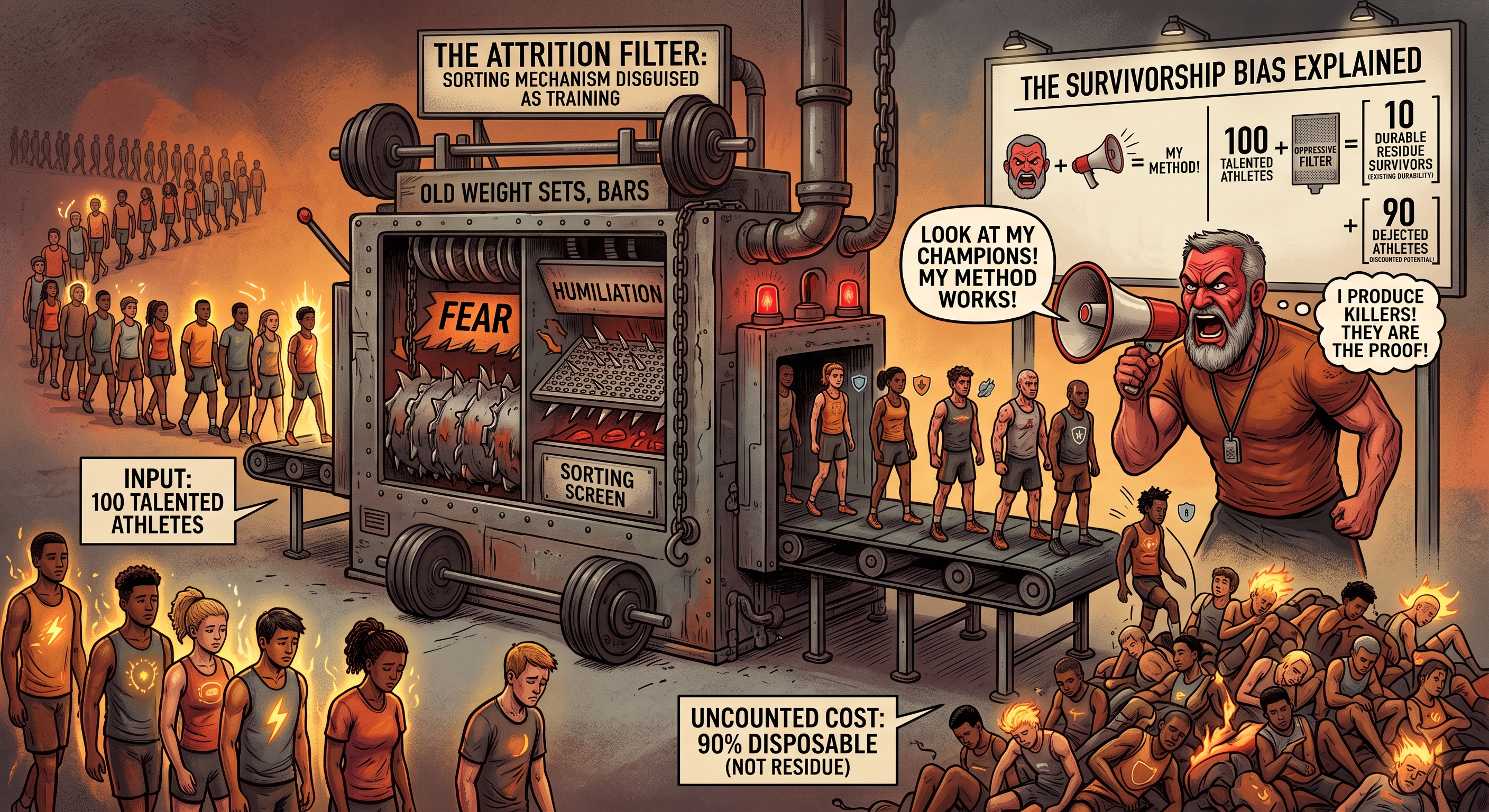
The screaming coach's proof is always the same: my method produces killers — look at my champions.
So look closer at that proof, because it contains the oldest statistical error in sports: you only ever meet the survivors.
The drill-sergeant gym is a filter, exactly like its coach says. But think about what a filter actually demonstrates. Run a hundred athletes through a program built on fear and humiliation, and the handful who come out the other side tough were, overwhelmingly, the ones who arrived tough — athletes durable enough to develop despite the environment. The coach then holds up his survivors as products of the method, when they're actually just its residue. The ninety who left didn't lack potential. Some of them — and after 27 years of watching who walks out of gyms and why, I'd bet heavily on this — had more raw potential than the survivors. They just had no reason to hand their development to a room that treated them as disposable.
Here's the math the yelling coach never runs: he's not asking "how good did my champions get?" He should be asking "how good would this whole roster have gotten in a room built for development instead of attrition?" A method that discards 90% of its inputs and takes credit for the durable 10% isn't a training system. It's a sorting mechanism wearing a training system's clothes — and every athlete it sorted out is a cost it never counts.
What Fear Actually Does to a Learning Brain
Now the deeper problem, because even for the survivors — the ones who stay — fear-based coaching is quietly sabotaging the exact abilities fighting runs on.
Here's the thing every fight coach knows, whether they've thought about the mechanism or not: fighting is a perception sport before it's anything else. The difference between a decent fighter and a great one isn't who knows more techniques. It's who reads the situation faster — who picks up the weight shift, the breathing change, the opening that exists for a quarter second. Fighting is processing chaos in real time and selecting the right response from a thousand options, under pressure, while someone interferes with you. That is a colossal cognitive task, and it runs on attention.
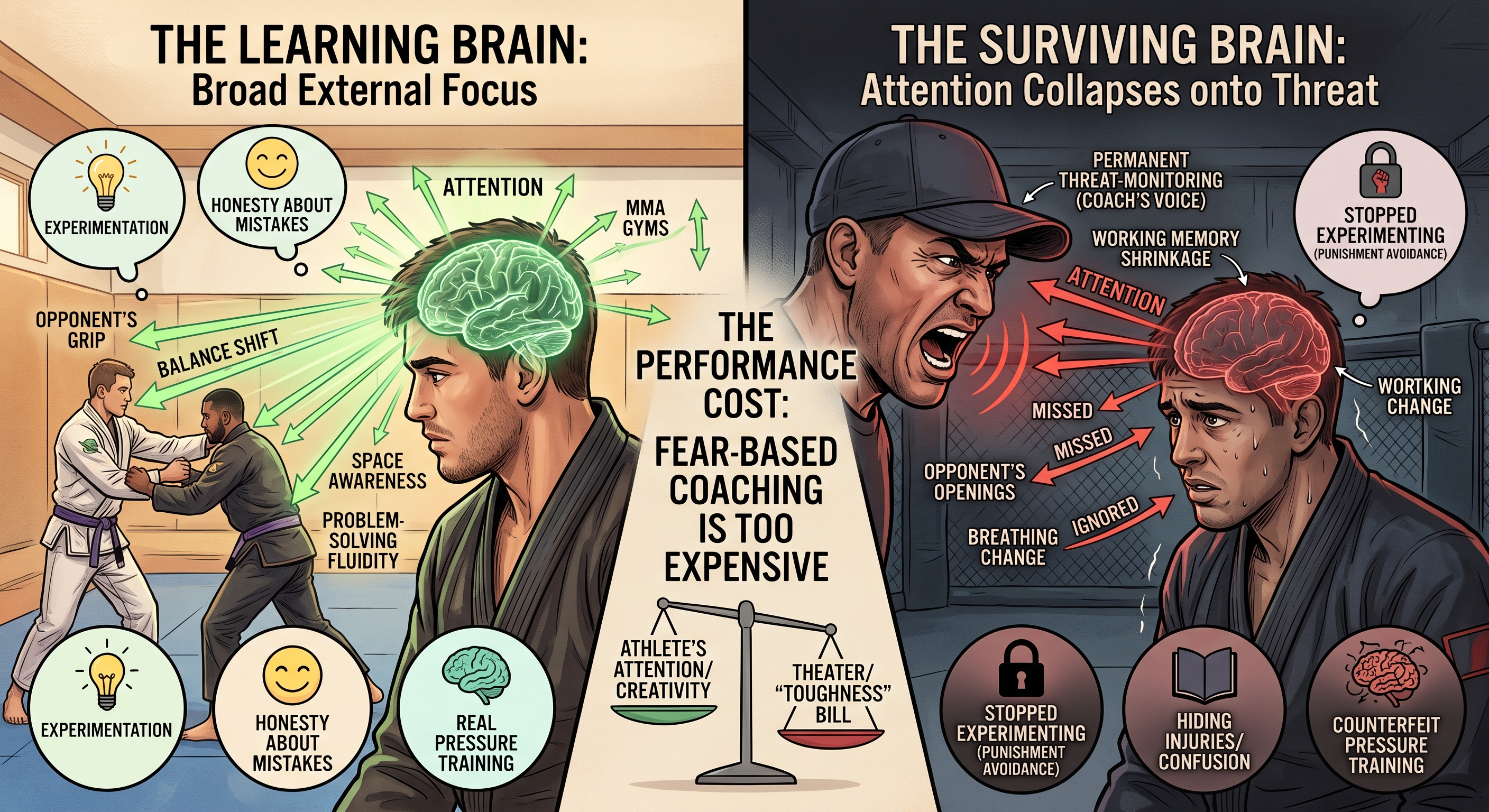
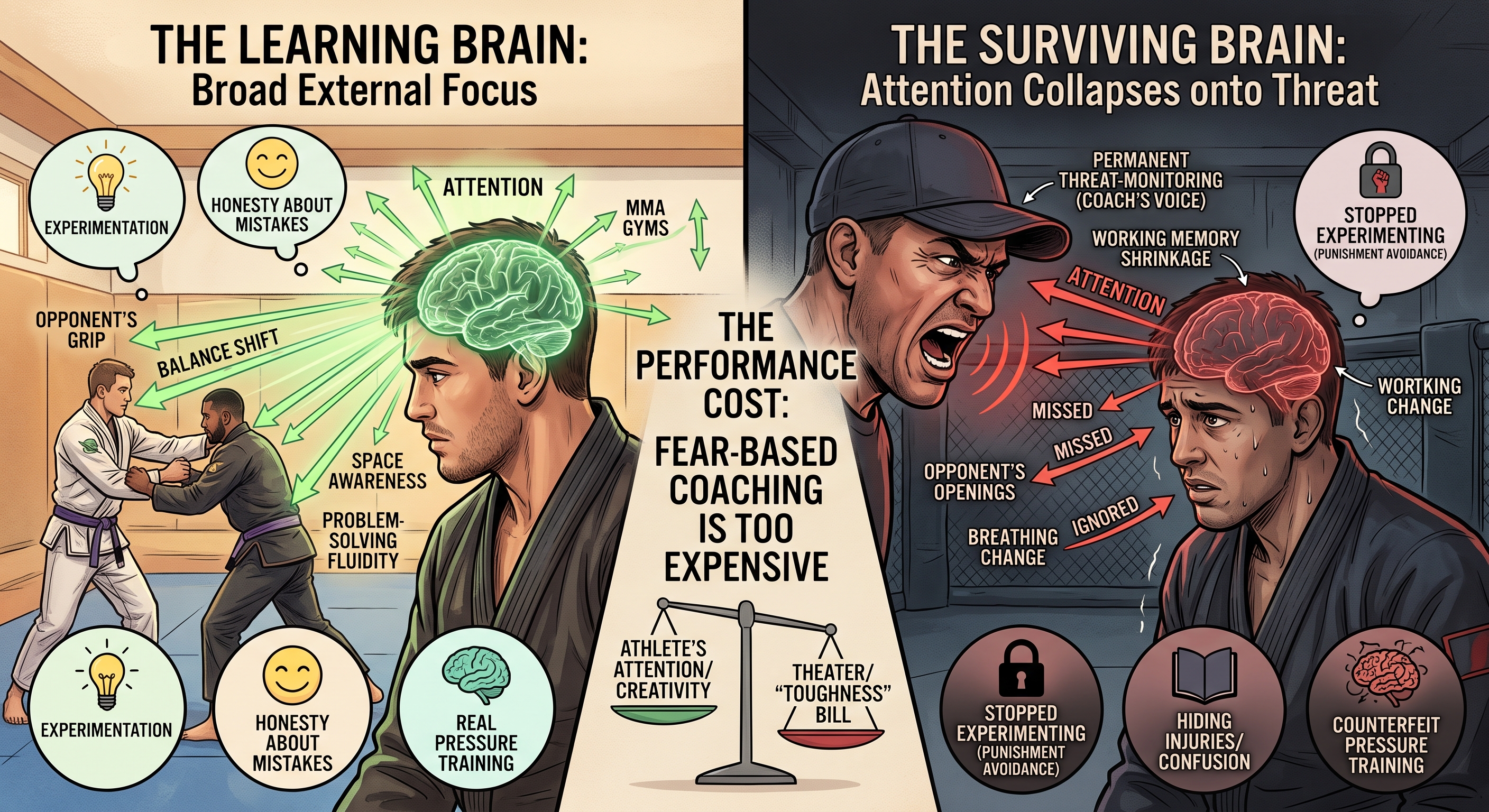
And what does a threatening environment do to attention? Exactly what it evolved to do: it narrows it. A nervous system that perceives threat stops exploring and starts surviving. Attention collapses onto the threat source. Working memory shrinks. The willingness to try new solutions — the engine of all motor learning — shuts down, because trying new things means risking mistakes, and in this room, mistakes get you humiliated.
So walk through what actually happens to an athlete in a fear-based gym, moment by moment:
Part of their attention is permanently spent on the coach. Not on the training problem in front of them — on threat-monitoring the man with the voice. That's processing capacity the drill leaves on the table, every rep, every round, for years.
They stop experimenting. The athlete who's afraid of being made an example of learns to do the safe, approved thing every time. He looks compliant. He drills crisply. And he is quietly not learning to solve problems — he's learning to avoid punishment, which is a different skill with a different result.
They hide everything. The injury, the confusion, the thing they don't understand. In a fear-based room, admitting a gap is dangerous, so gaps go underground — where they compound until they surface at the worst possible moment, usually in competition or in an injury that ends a season.
They learn a counterfeit version of pressure. This is the subtle one. The yelling coach believes he's inoculating athletes against fight-night stress. But the stress of being screamed at by your own corner and the stress of solving a live opponent are different problems, and training the first does shockingly little for the second. What actually builds performance under pressure is repeated exposure to the real pressure — live, chaotic, problem-solving pressure — with a nervous system calm enough to stay in exploration mode while it's happening.
Notice what all four of those have in common: none of them are about feelings. Every single one is a performance cost. The fear-based room isn't too mean. It's too expensive— it spends the athlete's attention, experimentation, honesty, and stress-training budget on theater, and calls the bill "toughness."
"But Fighting Is Violent. Shouldn't Training Be Harsh?"
This is the objection, and it deserves a straight answer because it sounds airtight: the cage is brutal, so the preparation should be brutal, and a calm gym is lying to its athletes about what's coming.
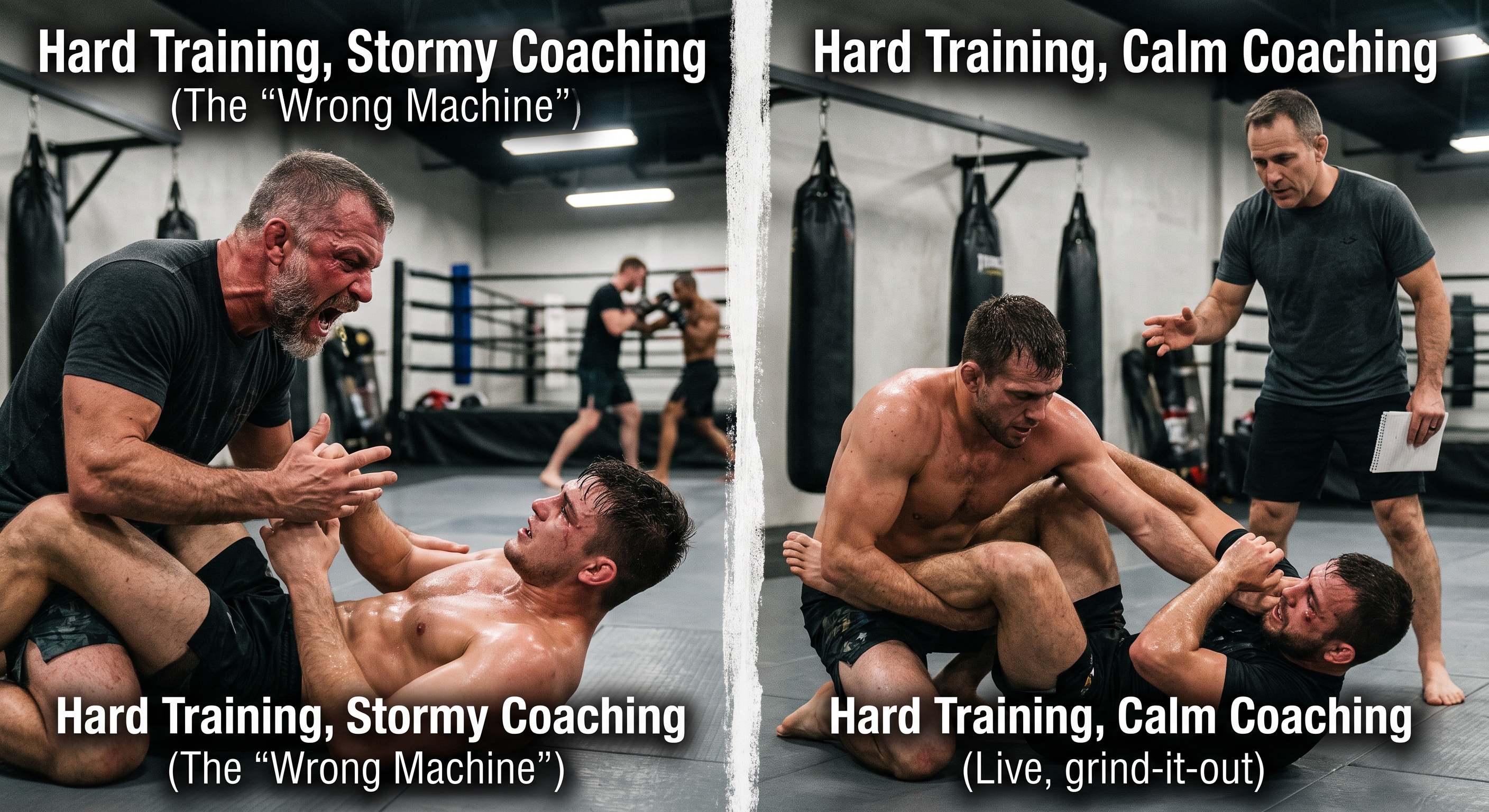
Here's the answer, and it's the distinction this entire philosophy hangs on: never confuse the difficulty of the training with the hostility of the coach. They are two completely separate dials, and the drill-sergeant model has them wired together for no reason.
Our training is hard. I'd put the difficulty of our rooms against anyone's — the fatigue is real, the sparring is live, the problems we put athletes in are genuinely uncomfortable, and nobody leaves a hard session at our gym wondering if they were challenged. Difficulty is non-negotiable, because difficulty is the stimulus. Remove it and nothing adapts.
But the difficulty comes from the training problem, not from the coach's temper. The opponent provides the chaos. The round provides the fatigue. The task provides the pressure. The coach's job is to design that pressure precisely — hard enough to demand adaptation, controlled enough that the athlete stays in the learning zone — and then to be thestable pointinside it. The one calm voice in the storm. The corner that thinks clearly precisely because it isn't emotionally flooded.
Think about what a fighter actually needs from a corner between rounds, sixty seconds to fix a fight that's going wrong: clear information, delivered calmly, to a brain that trusts the source. Now ask which gym produces that relationship — the one where the coach's voice has meant threat for five years, or the one where it's meant signal? A fighter conditioned to flinch at his own coach cannot fully use his own corner. We build the opposite reflex on purpose: when everything is chaos, the coach's voice is the one thing that has never once been the source of the danger. That reflex gets built in ten thousand calm corrections, and it pays out on the one night it matters most.
Hard training, calm coaching. The storm comes from the work. The steadiness comes from us. Gyms that get this backwards — calm training, stormy coaching — have built exactly the wrong machine.
What Toughness Actually Is
Underneath this whole debate is a definition problem, so let's fix it.
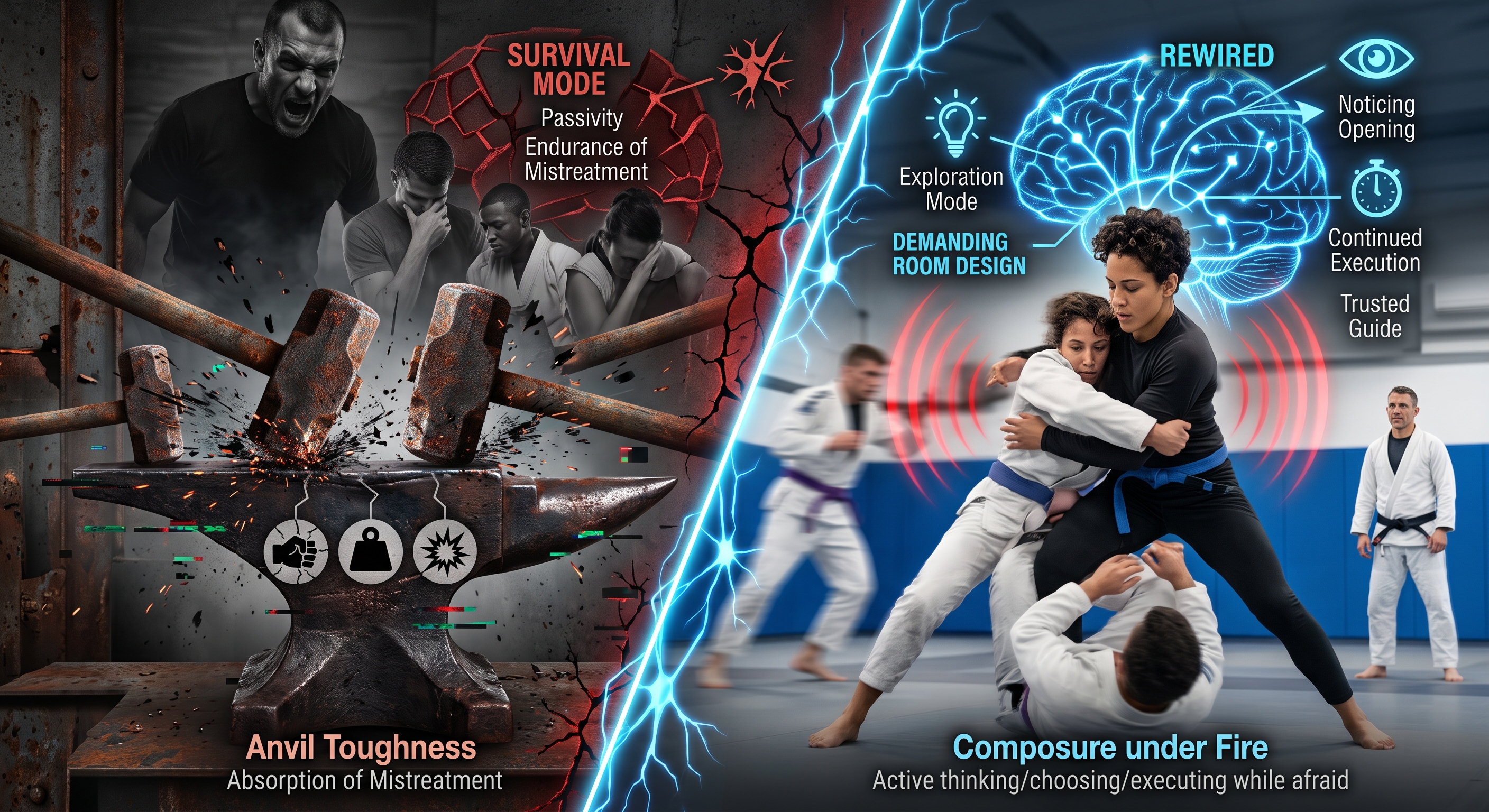
The drill-sergeant model defines toughness as the ability to absorb mistreatment. Take the abuse, don't flinch, come back tomorrow. And I'll grant that's a real trait — but it's the toughness of an anvil. It's passive. It's endurance of something done to you.
Fighting doesn't run on anvil toughness. Fighting runs on something much more demanding:t he ability to keep thinking, choosing, and executing while afraid. To stay in exploration mode when your body is screaming for survival mode. To eat a hard shot and, in the same second, notice the opening it created. That's not absorption. That'scomposure under fire— and it's a trainable skill with a specific recipe: repeated exposure to real difficulty, at survivable doses, with a calm nervous system and a trusted guide, until the athlete's relationship with pressure fundamentally rewires from threat to problem.
Every ingredient in that recipe is something the fear-based gym disrupts. And every ingredient is something a demanding-but-steady room provides by design. That's the whole argument, and you can test it against your own experience: think of the most genuinely composed person you've ever shared a mat with — not the loudest, the most composed— and ask what kind of room built them.
How You Can Tell Which Gym You're Standing In
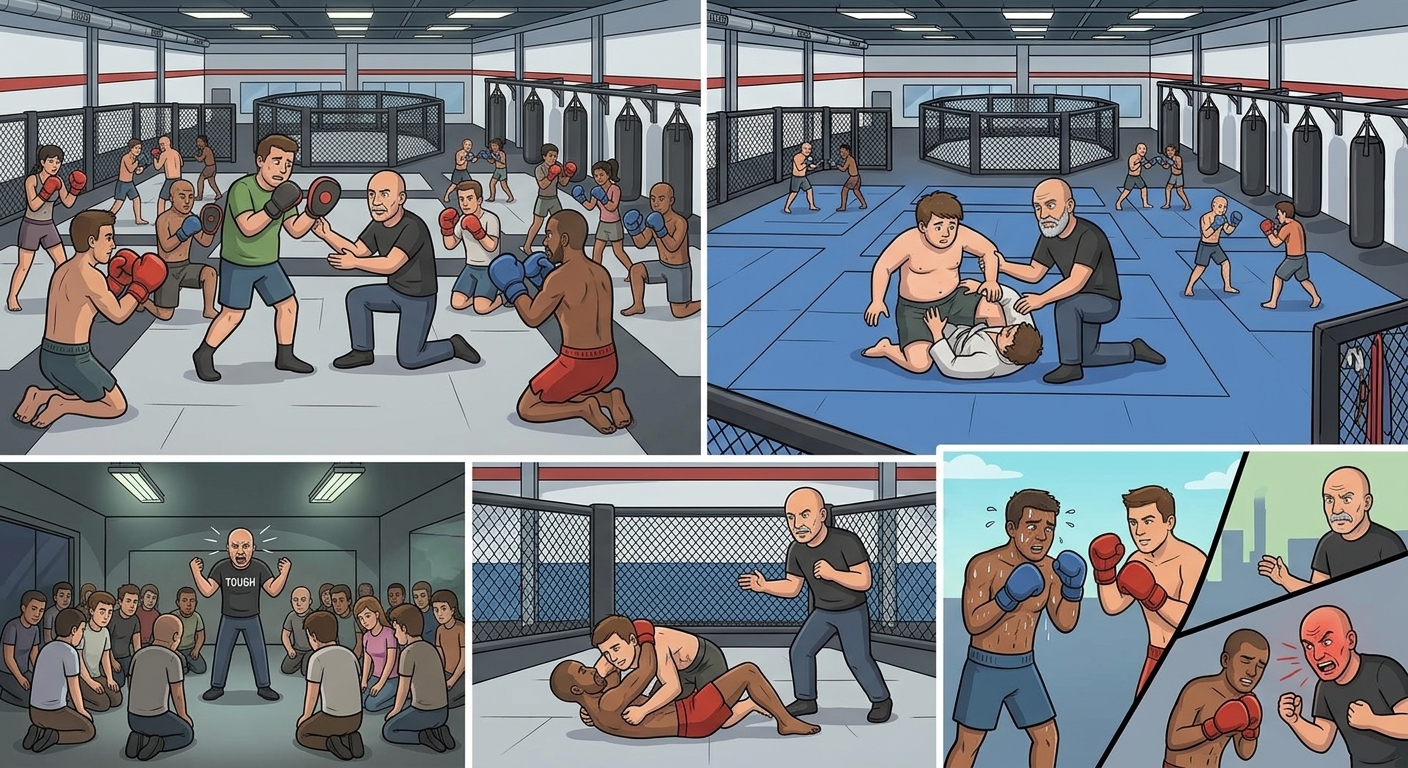
If you're evaluating a gym — yours or a prospective one — here's the field test. Don't listen to the philosophy speech. Watch for these instead:
Watch what happens when someone fails a rep in front of everyone. Information and another attempt? Or theater at their expense?
Watch the least talented person in the room. The prodigies get treated well everywhere. How a gym coaches its most awkward, slowest-progressing member is its actual philosophy, revealed.
Listen for questions. Athletes in psychologically safe rooms ask questions constantly — it means confusion is safe to admit. A silent class isn't a disciplined class. It's often a scared one.
Check whether hard and hostile are separated. Is the difficulty coming from well-designed training problems, or from the coach's mood? You can feel the difference within one session.
Watch the coach when things go wrong. The moment a drill collapses or a round gets sloppy is the moment the real coaching philosophy shows up. Escalation or clarity — you'll see which one lives there.
Twenty-seven years in, having built the largest and most successful MMA facility in Tennessee on exactly this model — hard training, calm coaching, full difficulty, zero theater — here's my standing answer to every coach who still believes the yelling is load-bearing:
Your champions didn't get tough because you screamed at them. They got tough because they trained hard and stayed long enough to adapt — and they stayed despite the screaming, not because of it. Imagine what walks out of your room every year that would have stayed in mine.
The quietest corner in the building, it turns out, is the one the fighters trust most when it's loud everywhere else.
Knox Martial Arts Academy has spent 27 years proving that demanding and demeaning are different words — building everyone from first-day beginners to world-class professional fighters in the largest and most successful MMA facility in Tennessee. Come watch a class. Listen to how it's coached. Then decide for yourself.
