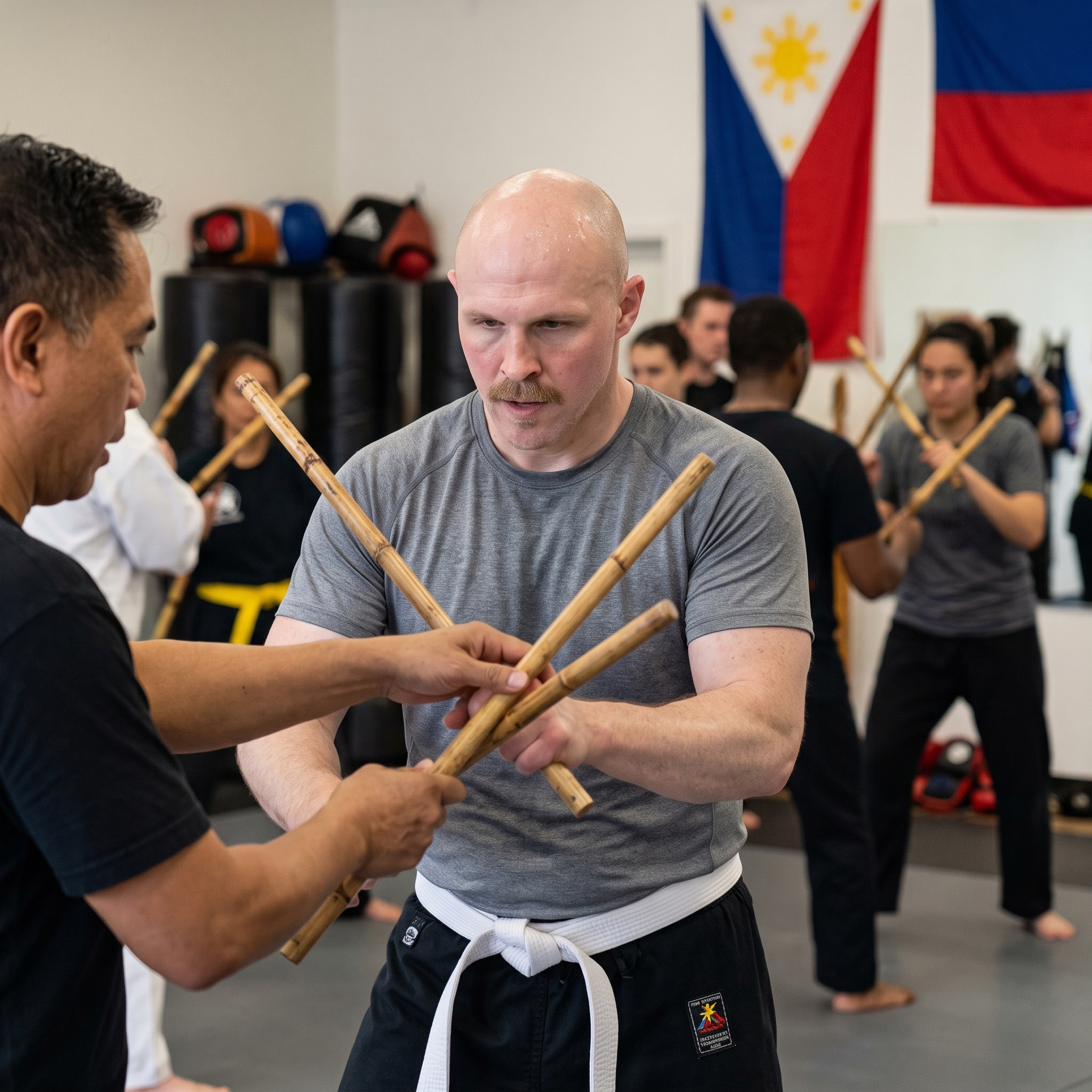
Why I Put a White Belt Back On
The KMAA Chronicles
Why I Put a White Belt Back On
There's a man in my building who makes me a beginner again, and I want to tell you why that's one of the best things that's happened to me in years.
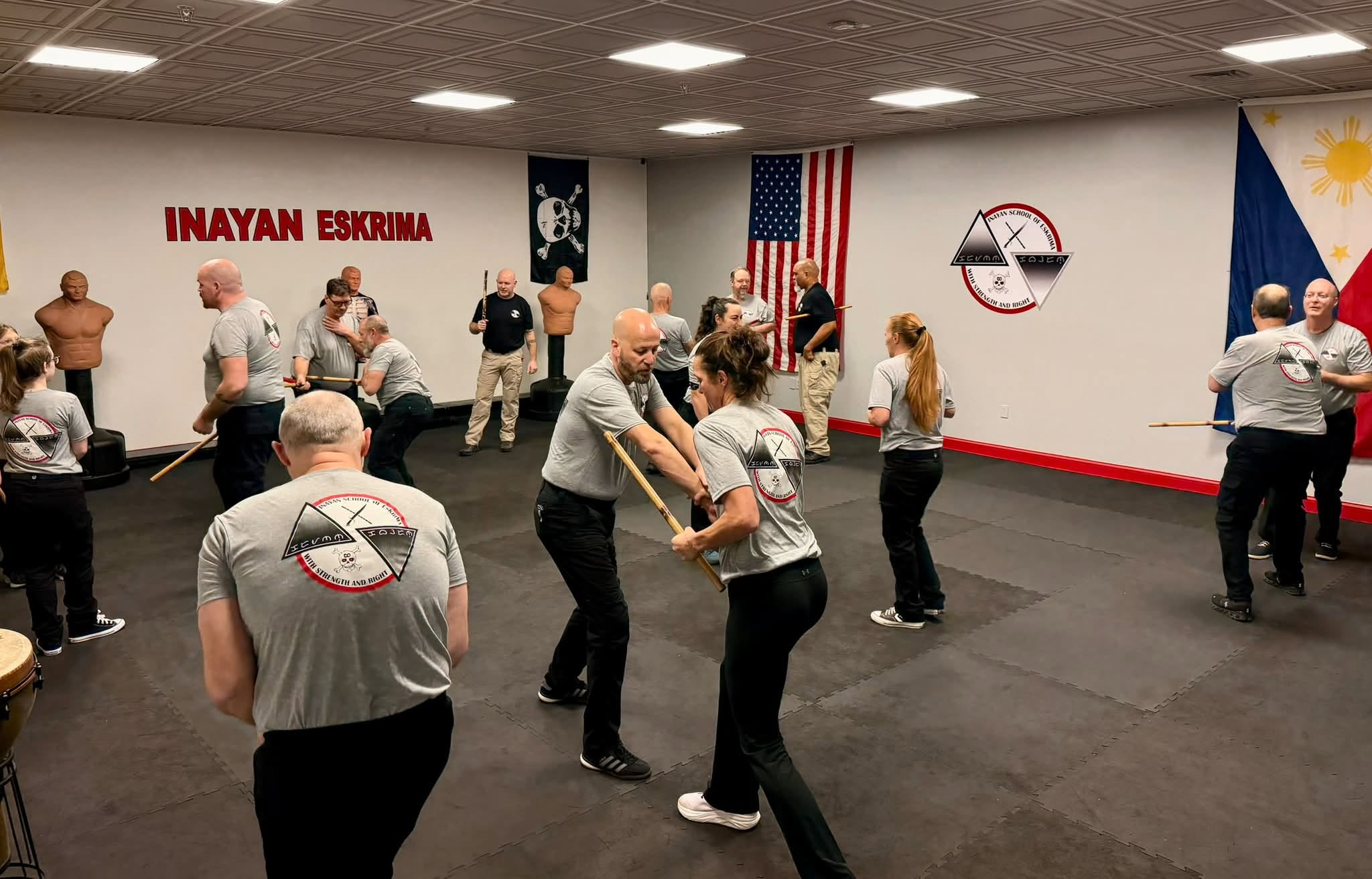
Some context, for those who don't know the layout: inside our facility, Guro Klement runs the Inayan School of Eskrima — a school teaching the Filipino martial arts, built around blade, stick, and empty hand. And a couple of times a week, the founder and head coach of this academy — a man with 27+ years of coaching across MMA, Muay Thai, kickboxing, and BJJ, who has cornered professional fighters at the highest levels of the sport — walks across his own building, stands in line with the newer students, and gets corrected on his basics.
People find this funny, and it is a little funny. It's also the point of this entire post. Because there are three stories tangled together in that picture — a story about a debt, a story about an art most fighters badly underestimate, and a story about what it does to a person to start again at their beginnings. Let me tell all three.
The Debt: This Isn't My First Time in That Line
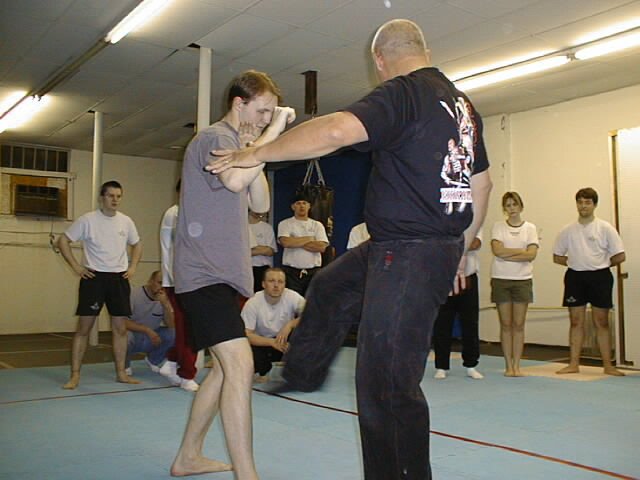
Here's the part most of our members don't know. This isn't me picking up a novelty hobby. This is me coming home.
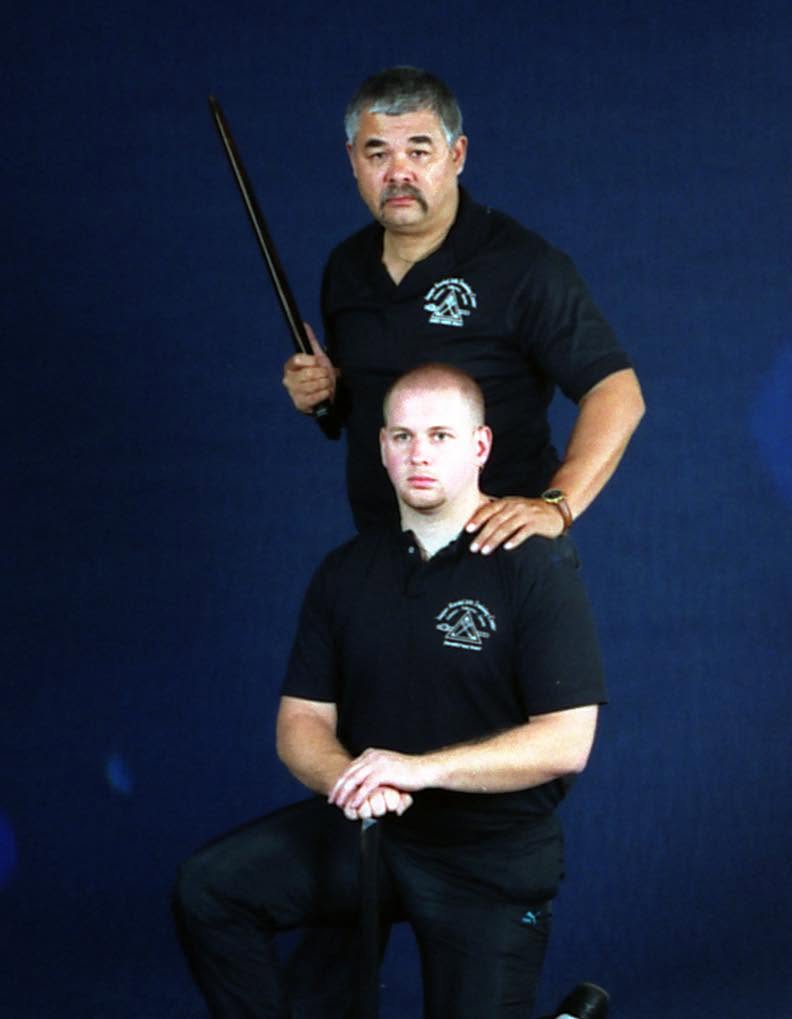
More than 27 years ago — before KMAA existed, before the 25,000 square feet, before any of it — I trained under Guro Klement for years in the Inayan System of Eskrima. He was one of my teachers when I was young and hungry and had no idea what I'd eventually build. And what I learned from him in those years never left me. It went underground, into the foundation of everything I've coached since.
I mean that literally, and I've never said it this publicly before: conceptually and principally, the tools I learned in Eskrima all those years ago made me a better coach in every art I've taught since — and our athletes have absolutely won fights with "Eskrima" ideas and concepts that they would not have won otherwise. Angles instead of exchanges. Limb destruction instead of blocking. Reading intent at the hand instead of waiting on the body. Our fighters have been benefiting from Filipino martial arts thinking for two decades without most of them ever holding a stick.
So when Guro Klement opened the Inayan School of Eskrima inside our walls, it closed a very old loop. My teacher, teaching his art, under the roof his teaching helped me build. And it put a question in front of me that I found I couldn't dodge: was I going to be the head coach who talks about the value of being a lifelong student — or was I going to walk across the building and be one?
So I got back in line. And I'll tell you what I found there: a wonderful teacher at the height of his craft, and a room full of students who are respectful, polite, diligent, serious, and welcoming — the culture every martial arts school claims and few actually build. Guro built it. It's an honor to stand in it as a student again.
The Art: Why Eskrima Thinks Differently Than Everything Else in This Building
Now, the second story, because I need to correct a misunderstanding that even experienced martial artists carry about the Filipino arts.
Most people, including most fighters, file Eskrima under "stick fighting" — a cultural curiosity, cool to watch, not relevant to the cage or the street. That filing is wrong, and here's the cleanest way I can explain why after a lifetime in both worlds.
Every other art in this building answers symmetrically. If you are punched, you punch back. If you are kicked, you kick back. If you are wrestled, you wrestle back. If the fight hits the ground, you groundfight back. Muay Thai answers Muay Thai problems with Muay Thai. BJJ answers grappling problems with grappling. The entire logic of matched competition — same tools, same targets, same game — is symmetry, and we get very, very good at symmetric answers here.
Eskrima refuses the symmetry. It grew up in a world of blades, multiple attackers, and no referees — a world where trading with the other person's strength is how you die — so it built its entire logic around asymmetric answers. Two concepts give you the flavor:
Defanging the snake. Don't fight the attack — destroy its delivery system. The weapon hand, the striking limb, the thing that makes the threat a threat. You don't out-duel the snake. You take its fangs, and the rest of the snake stops being a problem.
Non-engagement.The trained refusal to be where the fight wants you to be. Not blocking —not being there, and making the attacker pay for the space they just committed to. Where symmetric arts teach you to win exchanges, Eskrima teaches you to make the exchange itself a mistake.
And here's my actual thesis, as someone who has spent 27 years coaching the symmetric arts at a high level:the Inayan System of Eskrima is one of the most unique, most asymmetrical, most complete systems of reality-based self-defense I have ever encountered — and it has more crossover with Muay Thai, MMA, and BJJ than just about any FMA practitioner realizes. Read that last clause again. I didn't say more than MMA people realize — the MMA world barely thinks about FMA at all. I said more than the Filipino martial arts world realizes. The concepts hiding in these systems — the angling, the limb targeting, the intercepting logic, the flow between weapon and empty hand — translate into fight-winning ideas in the cage, and I have two decades of corners and wins that say so.
The Receipts: What the Record Actually Says About FMA
Don't take a nostalgic head coach's word for it. The Filipino martial arts carry a set of credentials that almost no other traditional art can match — and most people have never heard any of this.
It's the only martial art I know of that's enshrined in national law. In 2009, the Philippines passed Republic Act No. 9850, legally declaring Arnis (the umbrella term covering Eskrima and Kali) the national martial art and sport of the Philippines — taught in schools, embedded in the country's institutions, protected as living heritage.
The U.S. Army built it into Modern Army Combatives. When Matt Larsen — the man widely called the father of the Modern Army Combatives Program — surveyed the world's fighting systems to build the Army's hand-to-hand curriculum, the Filipino arts made the cut, integrated alongside wrestling and Brazilian Jiu Jitsu for exactly the qualities I described above: weapons logic, close-quarters efficiency, asymmetric problem-solving.
Elite units train it on purpose. Filipino systems like Pekiti-Tirsia Kali are used to train the Philippine Marine Force Recon, Army Scout Rangers, the police Special Action Force, and the Presidential Security Group, and have been adopted by military and law enforcement units around the world. Stateside, FMA-trained instructors have shaped defensive tactics programs across law enforcement and corrections for decades — because officers carry impact weapons and face blades, and FMA is the world's deepest curriculum on both.
Hollywood is quietly built on it. When fight choreographers need combat that reads as ruthlessly efficient on camera — the Bourne films are the famous example, and the fingerprints run through countless action franchises since — they reach for Kali. The industry whose entire job is making fighting look fast, direct, and real keeps choosing the Filipino arts. That's not proof of street efficacy by itself, but it's a telling verdict from professional students of movement.
The pedagogy itself is a cheat code. The Filipino arts famously train weapons first and derive the empty hand from them — the reverse of almost every other system. That ordering isn't tradition for tradition's sake. A stick moves faster than a hand, demands earlier reads, longer-range tracking, and precise interception — so the student's perception and timing get forged against a harder problem than fists will ever pose. And modern neuroscience gives this old method surprising support: research on tool use shows the brain literally extends its body map to incorporate a held tool — the weapon becomes, neurologically, part of your reach. FMA has been running that experiment for centuries. The result, which I watch happen in Guro's classes: coordination, hand speed, and reaction time that transfer straight back into empty-hand fighting.
And it survived a ban. When Spanish colonizers suppressed native blade culture, the arts went underground — famously preserved inside folk dances, blade patterns hidden in plain sight for generations, and the training stick standing in for the sword. An art that colonization couldn't kill, that a government eventually wrote into law, and that modern militaries voluntarily adopted, has passed more real-world stress tests than nearly anything else taught in a gym today.
Here's the summary the MMA world needs to hear: the Filipino martial arts are not a museum piece next to the "real" fighting arts. They're a parallel intelligence — a complete, battle-tested system that solved a harder problem set than sport ever poses, and whose concepts win sport fights anyway. I know, because I've been quietly winning fights with them for twenty years.
The Return: What Starting Over Actually Gives You
And now the third story — the one underneath the other two, and the real reason I'm writing this.
Kipling, in the poem every fighter should have memorized, names a test most people never voluntarily take:
"And lose, and start again at your beginnings
And never breathe a word about your loss..."
I've read that line for years. It hits different when you're living it — when you're the head coach standing in a beginner line in your own building, hands relearning angles they half-remember from a quarter century ago, being corrected in front of students who've watched you run this academy. Twenty-seven years of rank, reputation, and hard-won mastery, and none of it transfers. The stick doesn't care who I am. The pattern doesn't flow because my name is on the building. In Guro's class, I'm exactly as good as my last repetition — which is the most honest status any of us ever holds anywhere.
And here's what I've discovered, and I mean this without a drop of false humility: I don't mind starting again at my beginnings. I do so better prepared to appreciate all the small things I took for granted before.
The first time through, decades ago, I was young and hungry and racing toward competence — and like every young student, I blew past a hundred small wonders on the way. The feel of a pattern finally smoothing out. The moment your off-hand stops being a passenger. The particular quality of attention a good teacher gives a struggling student. The quiet fellowship of a line of people all being humbled by the same drill. I took all of it for granted, because I thought the point was up ahead somewhere, at mastery.
Twenty-seven years of coaching has taught me what I couldn't see then: the small things are the main things. They always were. Mastery, rank, the big building, the fighters on television — those are the visible peaks, but the actual substance of a martial arts life is the ten thousand small things, and the beginner is the only one positioned to experience them all fresh. Which means beginning again isn't a demotion from mastery. It's the one privilege mastery can't give you — the whole path, new again, walked this time by someone finally old enough to see what it's made of.
So that's what the white belt is. It's not a stunt and it's not humility theater. It's a debt being honored, an underestimated art being learned properly at last, and a 27-year coach getting the one gift the head coach's office can't provide: the beginner's seat, with the beginner's eyes, in a room run by his own teacher.
If you've been circling the idea of starting something — this art, any art, at any age, from any starting point — consider this your evidence that the beginning is not the embarrassing part of the path you rush through to get to the good part. The beginning is the good part. I've now stood at both ends of a martial arts life, and I walked back to the beginning on purpose.
Come stand in line with me. The Inayan School of Eskrima trains right here in our building, under a teacher I've trusted for almost three decades. There's room in the beginner line — I'd know, I'm in it.
Knoxville Martial Arts Academy is home to the Inayan School of Eskrima, led by Guro Klement — blade, stick, and empty-hand training in one of the world's most complete reality-based systems, inside the largest and most successful MMA facility in Tennessee. Ask the front desk about ISE classes. Look for the head coach in the beginner line.
