Moves vs Movement
The KMAA Chronicles
Moves vs. Movement:
Decoding the Physical Invariants of Combat
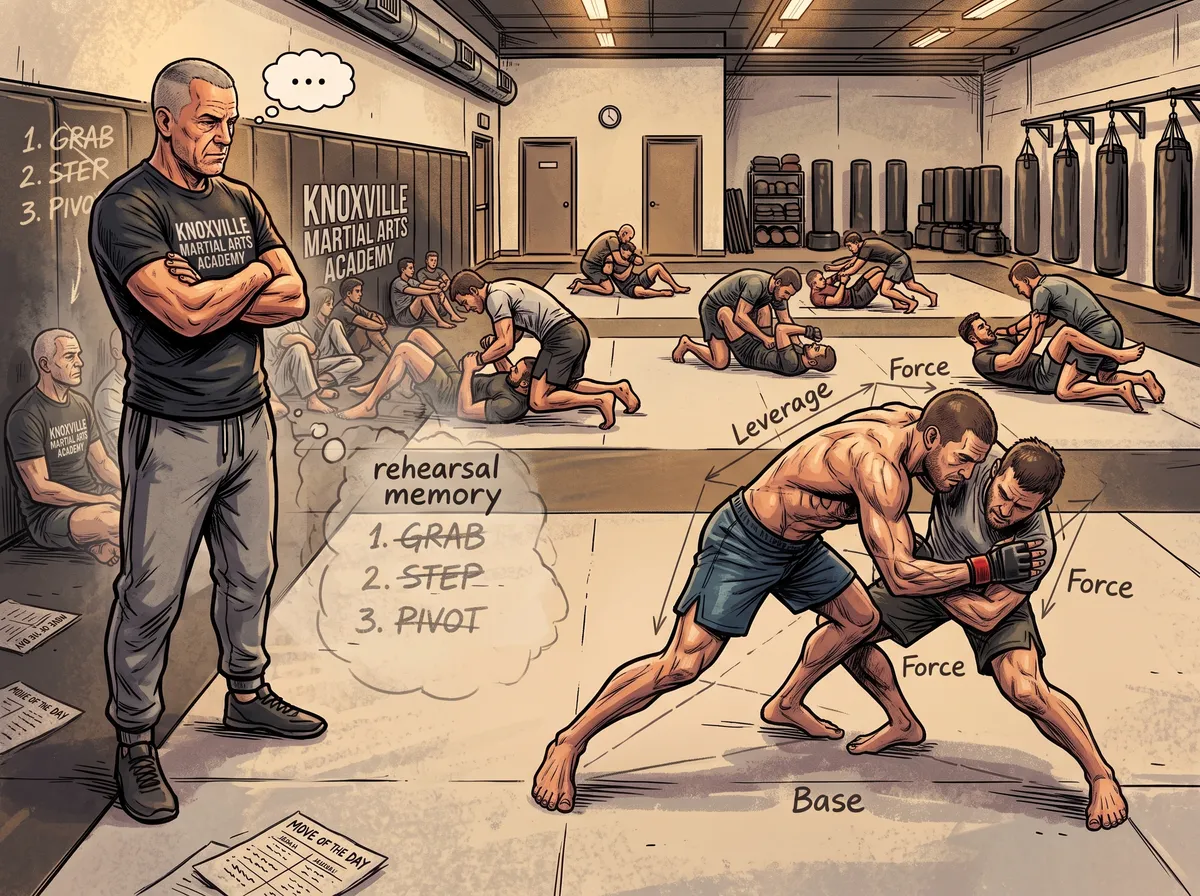
Walk into almost any martial arts academy on the planet, and you will witness the exact same cognitive trap being laid out on the mats. The curriculum is structured like an encyclopedic Rolodex. White belts are handed a list of twenty distinct techniques to memorize. Blue belts are handed fifty. By the time an athlete reaches an advanced rank, they are expected to have cataloged thousands of discrete, highly specific "moves."
If the opponent grabs your lapel with their right hand, execute step one, step two, and step three of this specific sweep. If the opponent throws a left hook, slip to the outside, load the hips, and execute this specific counter combination.
It is an incredibly attractive way to teach because it implies that combat is an equation that can be definitively solved. But there is a fatal flaw in the Rolodex model: human memory is fragile, and the physiological reality of violence is chaotic. When an athlete steps into the cage, walks onto the tournament mat, or finds themselves in a self-defense scenario, their heart rate spikes. The adrenaline dump triggers a cascade of chemical reactions designed for raw survival, significantly impairing the prefrontal cortex—the exact part of the brain responsible for recalling step seven of a twelve-step technique.
Under stress, athletes trying to remember "moves" freeze. They stutter. They wait for the specific visual cue they drilled in a compliant environment, and when the opponent gives them a slightly different stimulus, the software crashes.
To build truly resilient, adaptable martial artists, we have to fundamentally change what we are teaching. At Knoxville Martial Arts Academy, we realized that we cannot prepare athletes for the infinite variables of combat by giving them a finite list of moves. Instead, we have to teach them the universal physics of combat. We must transition from teaching moves to teaching movement, explicitly examining the underlying, universal physical invariants that govern all human bodies in space.
What is an "Invariant"? The Physics That Don't Care About Your Belt
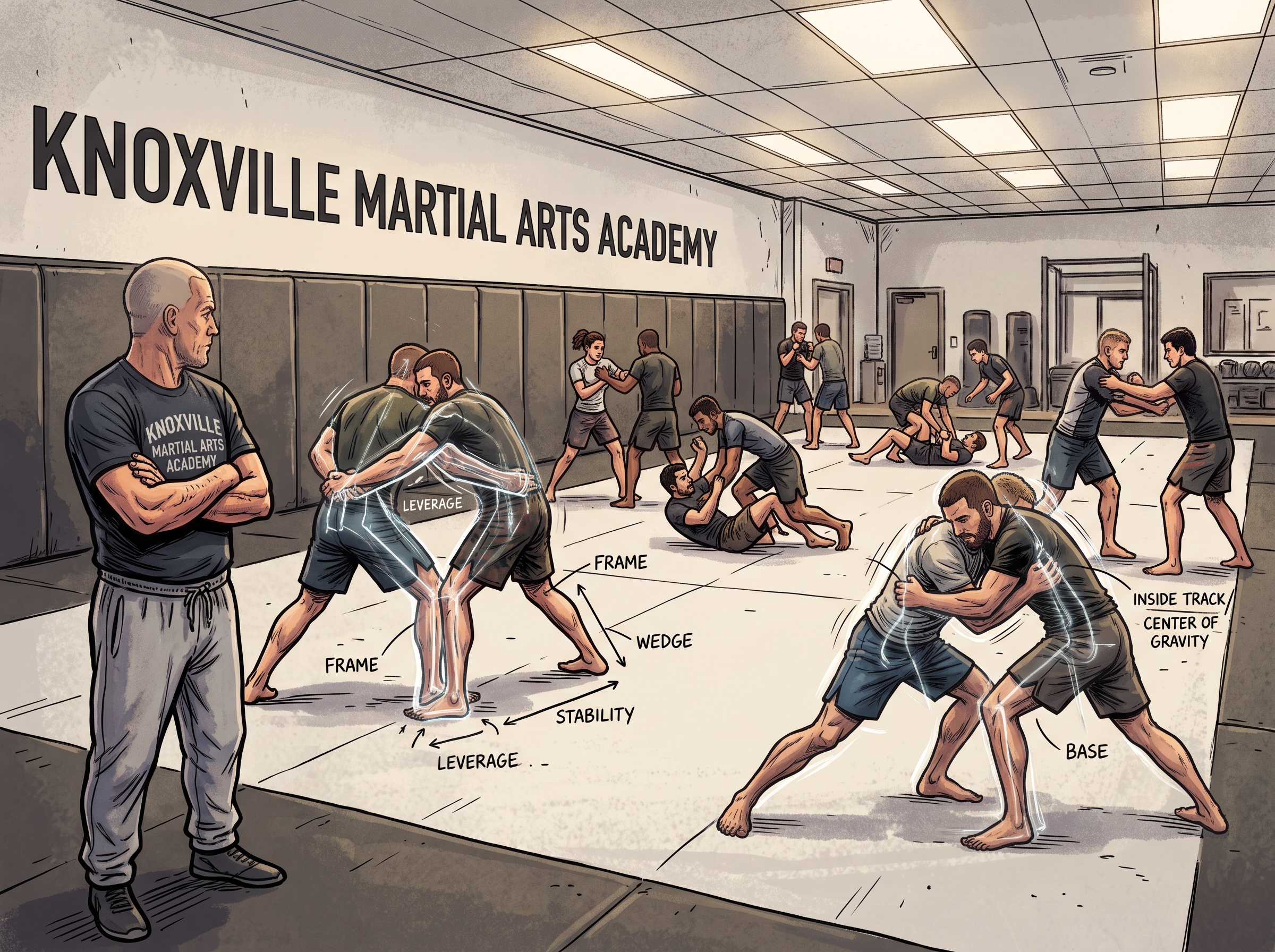
In Ecological Dynamics, an "invariant" is a property of the environment or a physical reality that remains constant regardless of the surrounding changes. In the context of combat sports, invariants are the undeniable laws of physics, leverage, and biomechanics that dictate success or failure in a physical exchange.
Gravity does not care if you are wearing a gi, a pair of Muay Thai shorts, or four-ounce MMA gloves. Base is base. Posture is posture. The mechanics required to disrupt a human being's center of gravity do not change just because we switch from discussing a wrestling exchange to a Brazilian Jiu-Jitsu match.
When we teach through the lens of invariants, we strip away the stylistic dogma and focus on the core physical truths. Consider the invariant of Using Frames and Wedges. In traditional instruction, a coach might teach a specific half-guard pass, telling the student exactly where to grip the pants and how to slide the knee. But if we teach the invariant of the wedge—understanding how driving a rigid skeletal structure between the opponent's body and the mat mechanically prevents them from recovering guard—the athlete learns a concept that applies everywhere. They can use that exact same wedge concept to maintain side control, pin an opponent against the cage fence, or stop a double-leg takedown.
Consider the invariant of Occupying the Inside Track. In striking, controlling the inside space allows a fighter to land straight punches down the middle while deflecting looping hooks. In the wrestling clinch, digging inside bicep ties or underhooks dictates who controls the steering wheel of the exchange. It is the exact same spatial and geometric principle, merely expressed in different phases of combat.
When an athlete understands invariants, they are no longer trying to remember what technique belongs to which discipline. They are simply reading the physical information of the human body in front of them and applying structural truths. They understand that establishing strong connections and utilizing Angles & Off-Line Movement is how you solve a problem, whether that problem is slipping a jab to land a cross or cutting an angle to finish a Front Headlock (FHL) transition into a D'Arce choke or a gator roll.
The Hard Cap on "Moves" vs. The Infinite Scale of "Movement"
The fundamental problem with a technique-based curriculum is that it suffers from a combinatorial explosion. If your answer to a problem is a specific "move," then you must have a different move for every conceivable problem.
What happens if the opponent is taller? You need a new move. What if they are left-handed? You need a different sequence. What if they defend your primary sweep by posting their hand just a few inches wider than your drilling partner did? Your move fails, and unless your instructor gave you the specific counter-move to that exact defensive posture, you are out of options.
Moves have a hard cap on their utility. They only work under a highly specific set of environmental and physical conditions. When you teach a move, you are giving an athlete a fish.
Movement, however, scales infinitely. Movement is the deep understanding of how to manipulate invariants to achieve a goal.
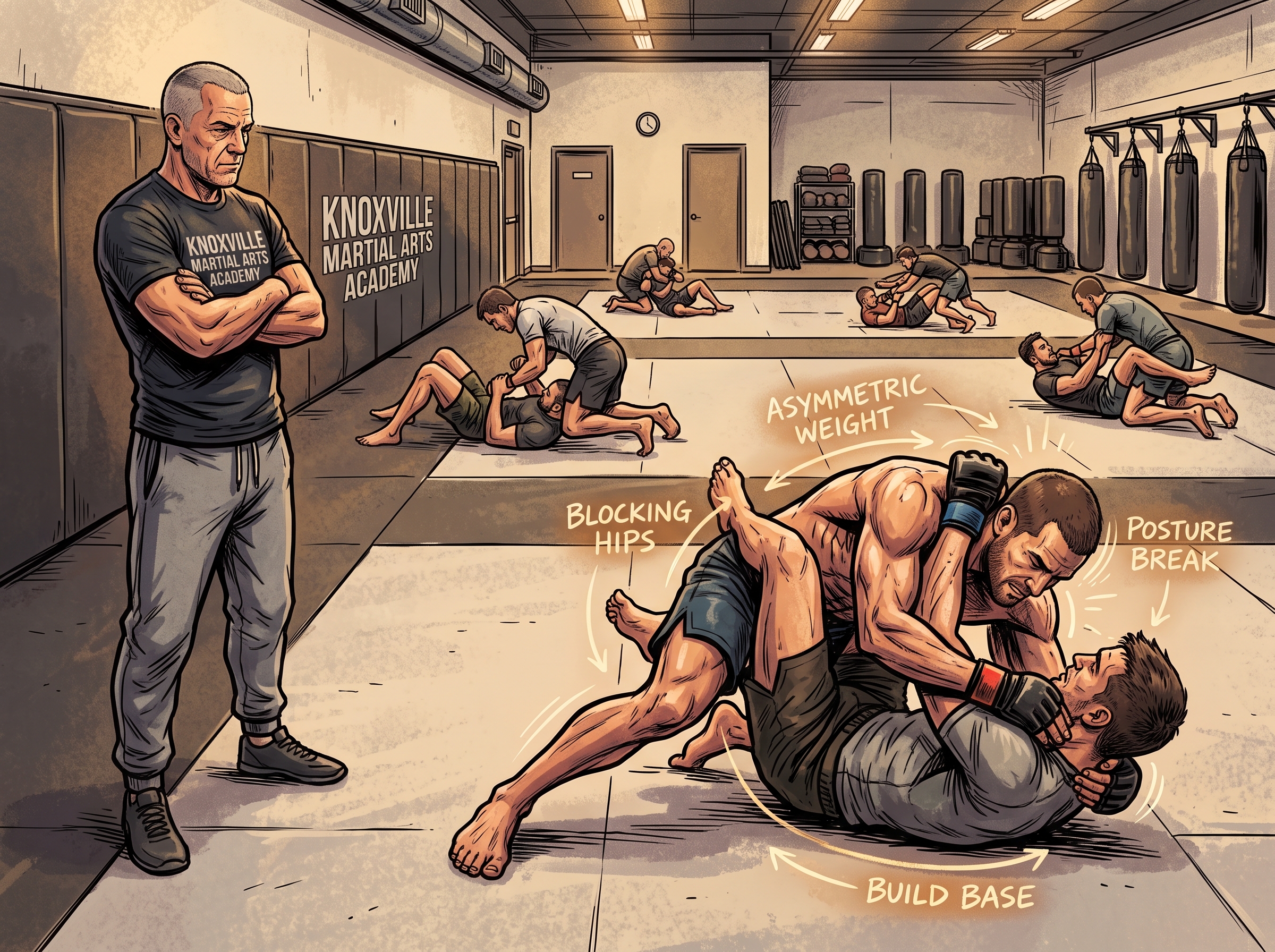
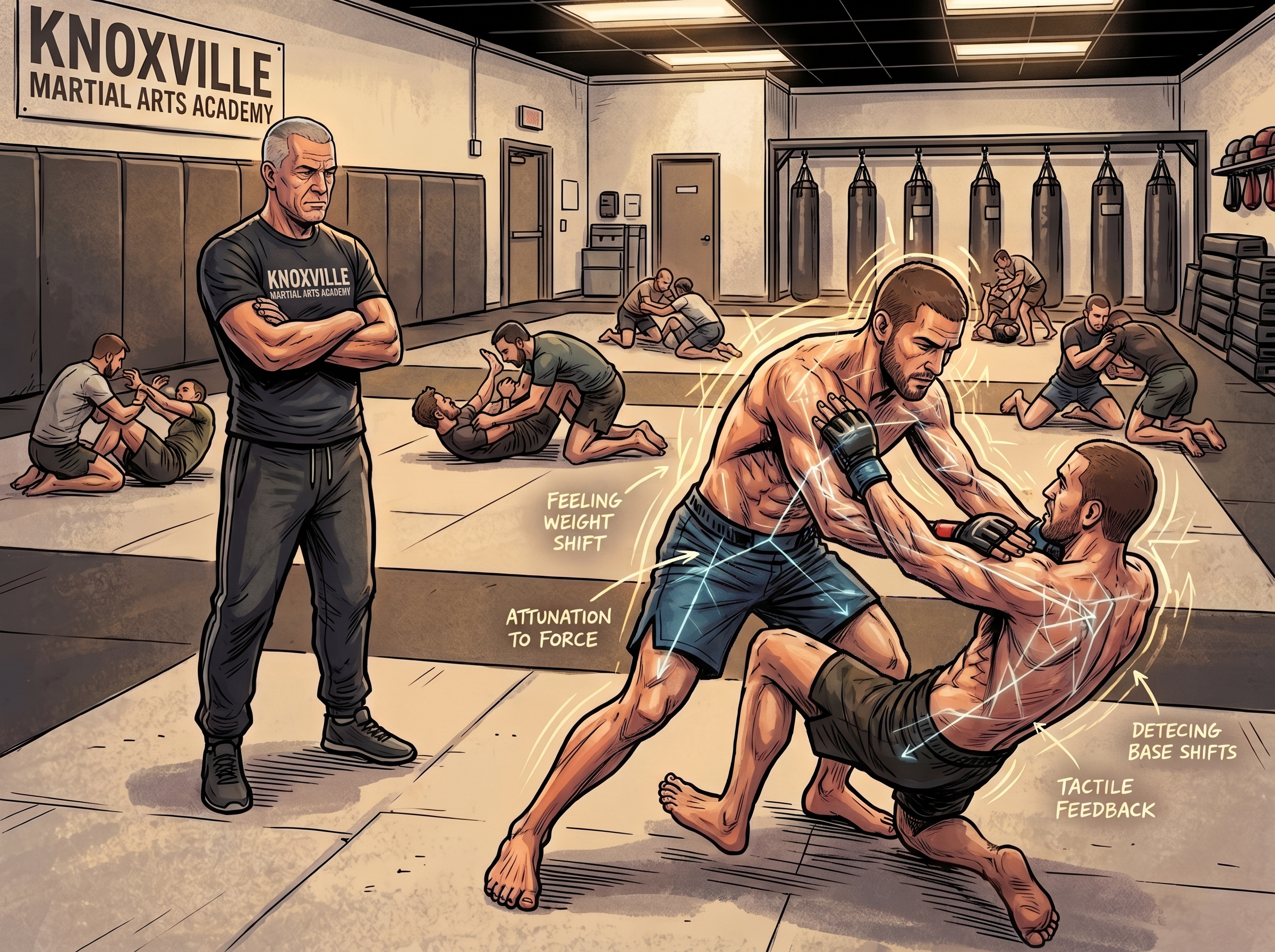
Let’s look at a hub position like the Front Headlock. If I teach a student a strict, five-step guillotine choke from the FHL, they will only be able to hit that guillotine if the opponent perfectly mirrors the drill. But if I teach them the movement invariants of the position—how to break the opponent's posture, how to place heavy, asymmetric weight across the cervical spine, how to block the hips from advancing, and how to read the opponent's attempts to recover base—the athlete becomes dangerous in a hundred different ways.
If the opponent tries to build base to their left, the athlete feels the weight shift and fluidly transitions to a go-behind score. If the opponent drives forward, the athlete uses that momentum to snap them down further or seamlessly transition to an Anaconda or Peruvian Necktie. The athlete is no longer executing a pre-planned technique; they are engaged in a dynamic problem-solving process, utilizing invariants to dictate the outcome.
The Anatomy of a Chest Wrap: A Cross-Disciplinary Case Study
To truly understand how invariants dissolve the boundaries between disciplines, we can examine a specific biomechanical control position: the chest wrap.
In many gyms, the clinch is taught as a series of disparate, disconnected techniques. You have your Muay Thai plum, your wrestling over-unders, and your Greco-Roman body locks. But if we strip away the sport-specific labels and look at the physics of controlling another human being's torso, we uncover the invariant realities of the chest wrap.
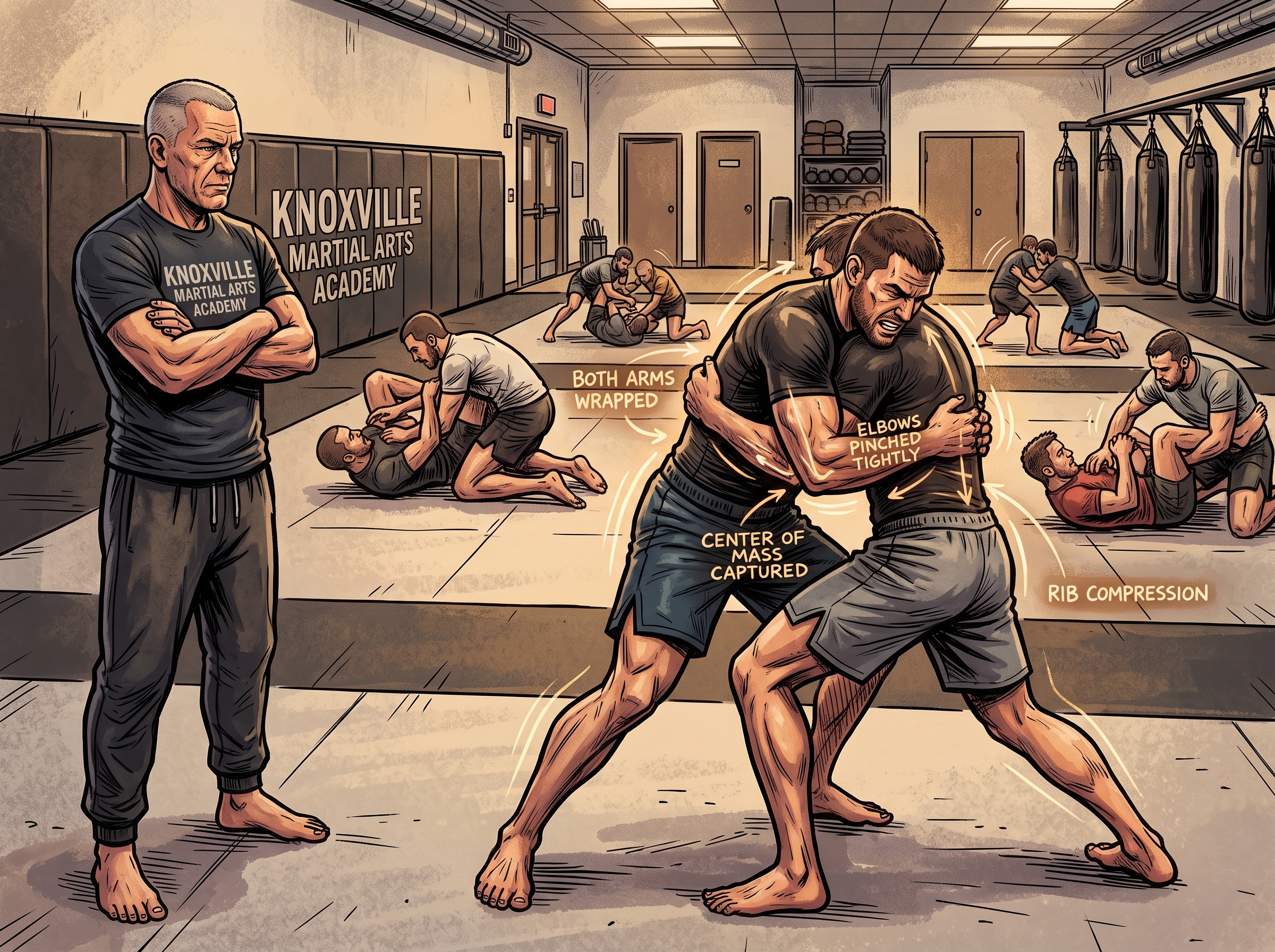
At KMAA, we explicitly define a chest wrap not as a standard over-under clinch, but as a position where both arms are wrapped entirely around the opponent's torso with the elbows pinched tightly.
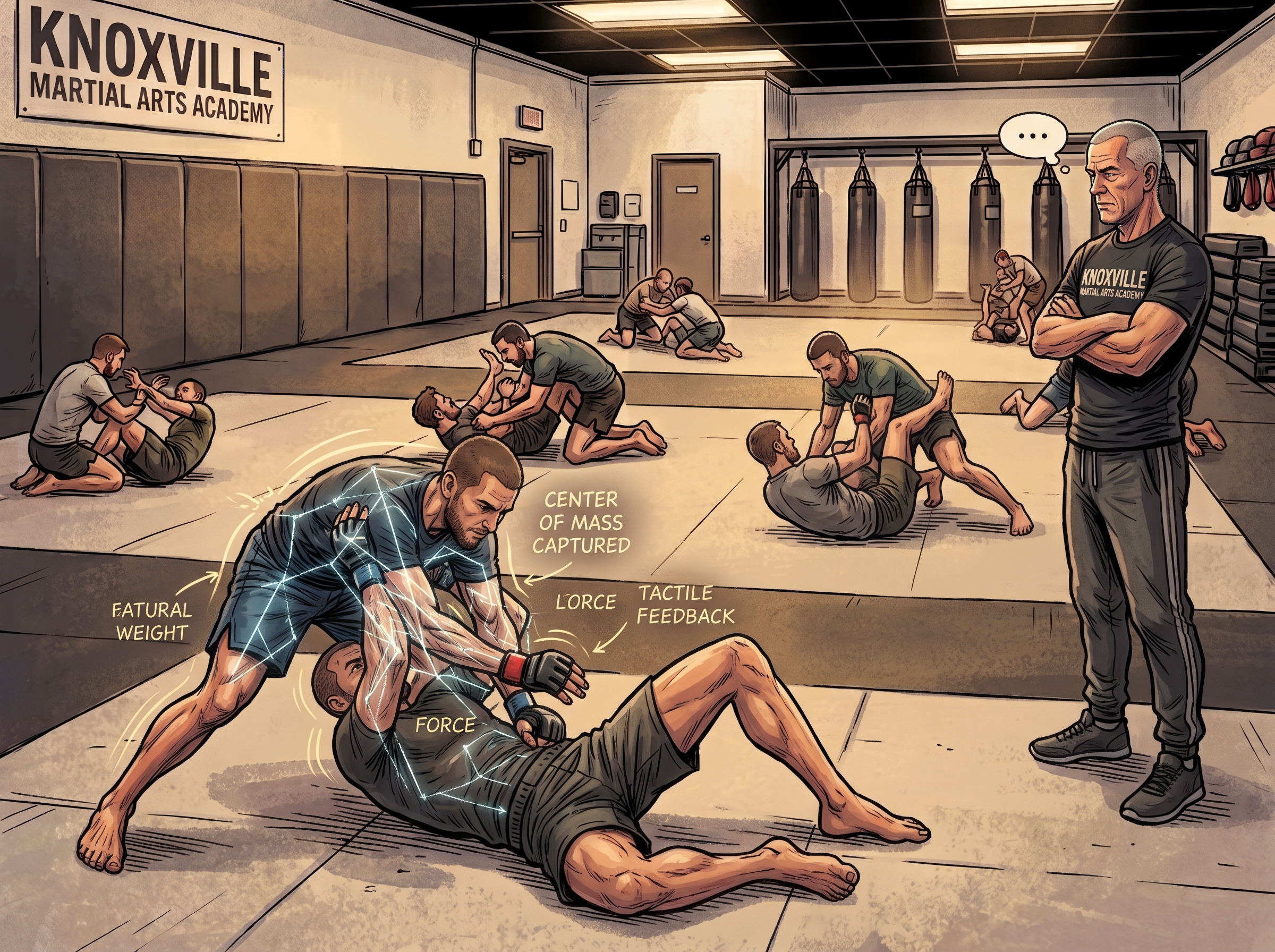
Why is this exact structural alignment so vital? Because of what it does to the opponent's center of gravity. When you secure a true chest wrap and drop your levels, you are effectively fusing your center of mass with your opponent's, but at a mechanically advantageous angle. By pinching the elbows tightly, you remove the slack from the connection, turning your arms into a vice that compresses the opponent's lower ribs and restricts their diaphragmatic breathing.
Because this is a universal physical invariant, its application is identical across all combat environments.
If you are a wrestler trying to secure a body lock takedown in the center of the mat, the chest wrap allows you to dictate the opponent's hips. If they attempt to sprawl, the tight elbow pinch prevents them from creating the necessary space to break your posture, allowing you to cut an angle and take them off-line.
Now, transport that exact same physical structure to an MMA fight against the cage. A striker is trying to frame away and create space to land an elbow. By dropping your levels and securing the exact same chest wrap—both arms around the torso, elbows tightly pinched—you completely neutralize their ability to generate rotational force. You have captured their center of mass. The invariant movement solution that wins the wrestling scramble on the open mat is the exact same invariant solution that neutralizes the striker against the fence.
The athlete doesn't need to learn a "wrestling move" and a separate "cage-wall move." They just need to understand the physics of the chest wrap.
Information-Movement Coupling: Reading the Matrix (Tau)
If we accept that combat is about applying physical invariants rather than memorizing techniques, the next question is: how does an athlete know when to apply them?
In the traditional Rolodex model, athletes are taught to rely on explicit visual cues. Look at his feet. Look at his shoulders. When you see X, do Y. This creates a catastrophic lag in processing time. Vision is a relatively slow sensory input when it comes to high-speed combat. By the time your eyes register that an opponent has dropped their right hand, your brain processes the information, searches its memory bank for the correct counter, and sends the signal to your muscles to execute the combination, the opening has already closed. Or worse, the visual cue was a feint, and you have just walked into a trap.
In Ecological Dynamics, we train athletes to rely on Information-Movement Coupling. This means tightening the loop between what the athlete perceives in their environment and how their body physically responds, bypassing the slow, conscious decision-making process.
Instead of waiting for a visual starting pistol, we teach athletes to read physical information. In grappling, this is felt through connection. When you establish strong connections with your opponent, your nervous system can detect millimeter shifts in their weight distribution before their body actually moves. You feel their posture degrading. You feel the base of support shifting from their left foot to their right.
In striking, this concept is often expressed through "Tau" (the optical variable specifying time-to-contact). Rather than trying to identify the specific type of punch being thrown, the elite striker is perceiving the rate at which the opponent's mass is expanding in their visual field. They are subconsciously calculating velocity, distance, and trajectory in real-time, allowing them to utilize angles and off-line movement before the strike ever fully extends.
This is the ultimate expression of the Constraints-Led Approach. By designing live, resisting games that constrain certain variables, we force the athlete to attune to this subtle physical information. We put them in a scenario where they must read the opponent's shifting center of gravity to survive.
They learn to couple the incoming physical information directly to a movement solution. They don't think, "His weight is moving to the right, therefore I will execute sweep number four." Their nervous system simply feels the structural degradation of the opponent's base and naturally guides their body to exploit it using the invariants of leverage and off-line geometry.
The Unburdened Athlete
Transitioning from a curriculum of "moves" to a methodology of "movement" is profoundly liberating for the athlete. It removes the paralyzing anxiety of trying to remember the "right" answer in the middle of a chaotic, violent exchange.
When we explicitly examine the underlying, universal invariants of physical combat, we give our athletes a master key that fits almost every lock. Whether they are trading strikes in the center of the ring, battling for inside control against the cage, or passing the half guard on the Jiu-Jitsu mats, the laws of physics remain their constant ally.
We are no longer building encyclopedias of techniques. We are building robust, adaptable problem solvers who speak the universal language of human movement. When the adrenaline spikes and the chaos ensues, they don't freeze trying to recall step seven. They simply connect, read the physical realities of the environment, and let the invariants do the work.
