
Out of the Cave
The KMAA Chronicles
Out of the Cave:
Why Getting Healthy Might Cost You Relationships — And How to Navigate It
I need to warn you about something, and it's the strangest warning a gym owner will ever give you.
It's not about injuries. It's not about soreness, or commitment, or cost. It's about a pattern I have watched play out hundreds of times across more than two decades of coaching — a pattern so consistent, so predictable in its stages, that I can now often tell you where a person is in it before they can tell me. And nobody warns people about it. Not gyms, not trainers, not the fitness industry, because the fitness industry only sells the first act of the story.
Here's the whole story, the way I've watched it actually unfold:
Someone walks into KMAA to lose weight. Simple, honest goal. They find something they didn't expect — a genuinely supportive, encouraging, healthy community. And they do lose the weight. But that's when the real story starts, because the weight was never the interesting part. Somewhere in those months of training, they start living healthier in ways nobody signed up for. They start telling the truth. They start having the conversations they'd been avoiding for years. They start setting boundaries. They take the culture of this gym out the front door and start applying it to their actual life.
And then — this is the part nobody warns you about —the people in their life don't like the new person.
The spouse gets irritable about the training schedule. The friend group gets weird about the missed happy hours, then weirder about the honesty. The family member who always relied on their compliance starts calling them selfish. The turmoil builds, slowly and then quickly, and it comes to a head. And at that head, the person faces a choice that has nothing to do with fitness anymore: become healthy, happy, and whole — or give it all back to make someone else comfortable.
I've watched people choose both directions. The ones who choose to shrink start coming less. Then rarely. Then they're gone — and they didn't leave because of the training. They left because getting healthy was costing them something at home that they weren't ready to pay.
This post exists so that when this pattern comes for you — and if you stay on this path, some version of it very likely will — you'll recognize it, understand exactly what's happening psychologically to everyone involved, and have real tools for navigating it. Because a 2,400-year-old story predicted all of it, almost beat for beat.
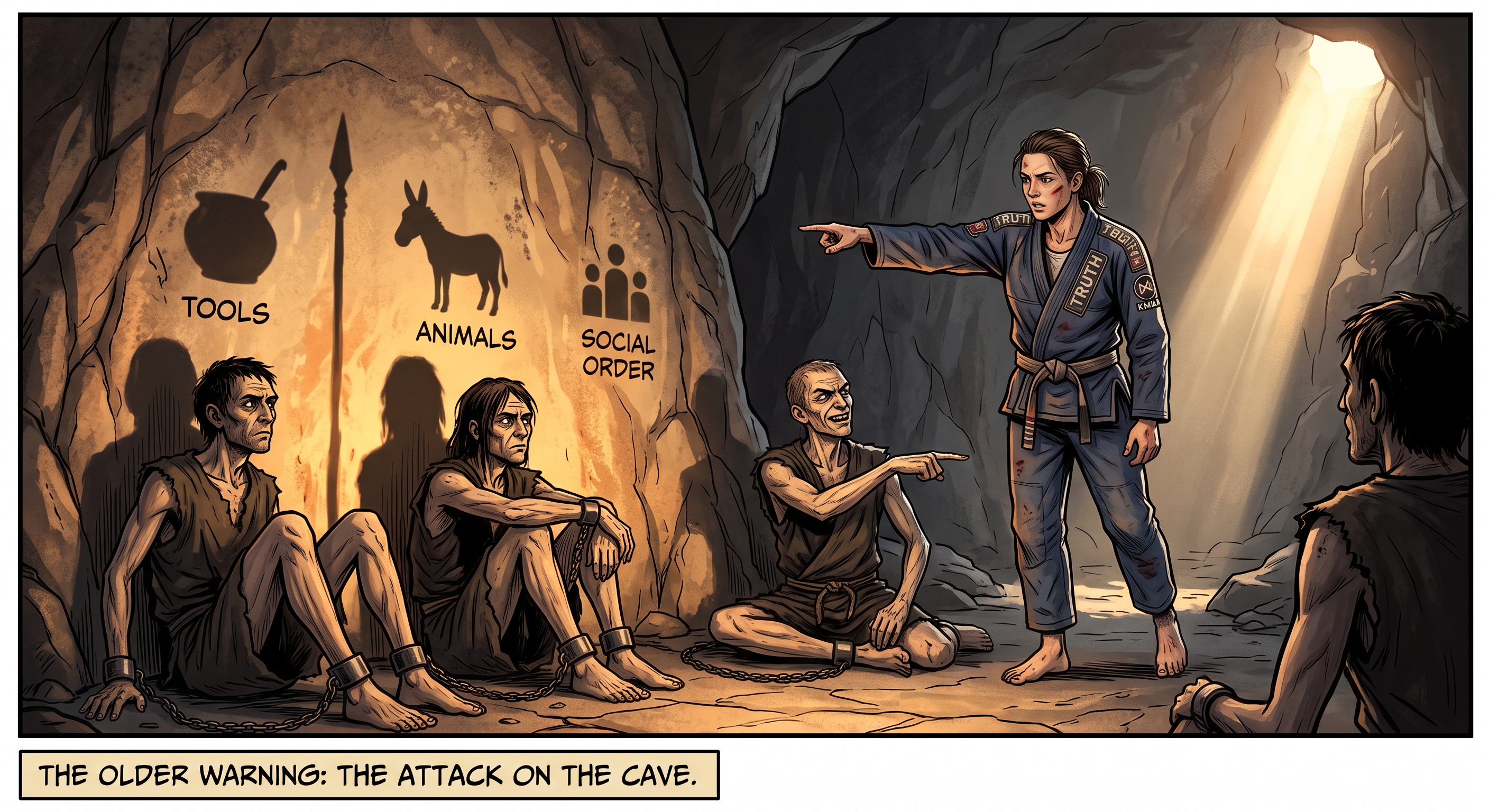
The Oldest Warning Ever Written
In Plato'sRepublic, Socrates tells a story you've probably half-heard before. Prisoners are chained in a cave, facing a wall, and all they've ever seen are shadows cast by a fire behind them. The shadows are their entire reality. They have names for the shadows, expertise about the shadows, a whole social order built on shadow-knowledge.
One prisoner gets free and climbs out. The climb is brutal — the fire scorches, the sunlight blinds, everything the freed prisoner believed gets painfully rearranged. But eventually their eyes adjust, and they see the actual world for the first time: real things, real color, the sun itself. The shadows, they now understand, were silhouettes of reality. Not reality.
Here's the part of the story most people forget, and it's the part this entire post lives in: the freed prisoner goes back down. They return to the cave to tell the others what's up there. And the others don't throw a parade. Their eyes ruined by the darkness after the light, the returning prisoner stumbles, and the cave-dwellers take the stumbling as proof the journey destroys people. They mock. They resist. And Plato ends the allegory with a line that should stop you cold: if they could get their hands on the one who tried to free them, they would kill him.
Twenty-four centuries ago, Plato understood something about human systems that I've spent two decades watching prove itself on and around these mats: people who have organized their entire reality around the shadows do not experience your escape as good news. They experience it as an attack on the cave.
Now let me show you the same story in modern psychological language, because when you understand the machinery, the whole painful pattern stops feeling like betrayal and starts being navigable.
What's Actually Happening to You
Start with the person in the mirror, because the first thing you need to understand is what this gym has actually been doing to you — underneath the fitness.
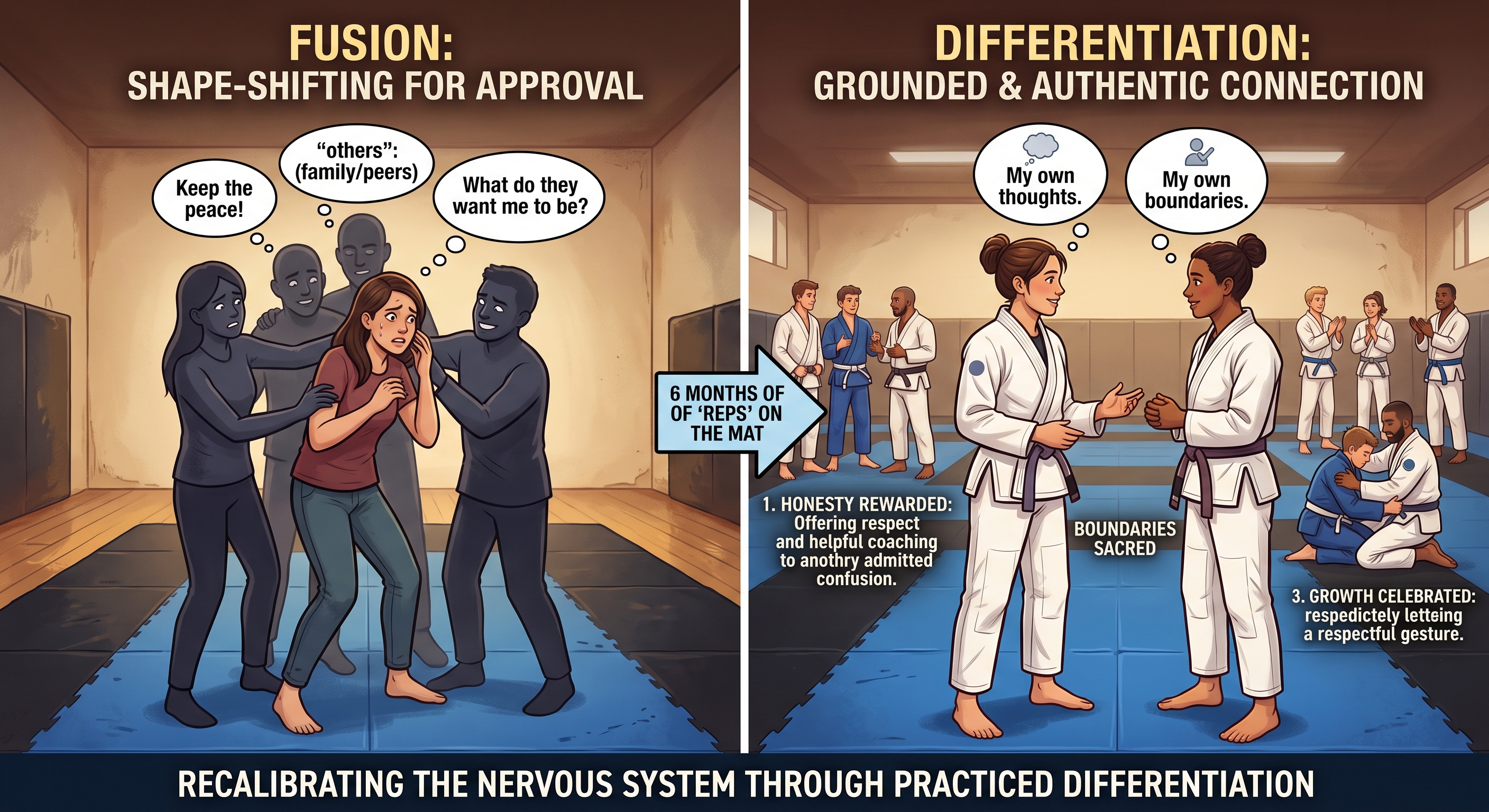
There's a concept from family systems theory (the work of psychiatrist Murray Bowen) called differentiation of self, and it's the best lens I've found for this in over a decade of counseling work. Picture a spectrum. At one end is fusion: your sense of okay-ness depends on other people's approval. Conflict feels unbearable, so you manage it by capitulating, by hiding what you actually think, by shape-shifting into whatever the room requires. At the other end is differentiation: you can stay warmly connected to people while still thinking your own thoughts, wanting your own wants, and — this is the hard part — tolerating their disappointment in you without either collapsing or counterattacking.
Most of us grew up learning fusion and calling it love. Keep the peace. Don't rock the boat. Read the room and become what it needs.
Now look at what training here actually rehearses, class after class, without ever calling it therapy:
Honesty gets rewarded instead of punished. On the mat, pretending you understand something you don't gets you hit. Admitting confusion gets you coaching. The room runs on truth — I've said for years that the mat tells the truth, and it teaches its people to do the same.
Boundaries are sacred here. You tap, everything stops. You say "lighter," it gets lighter. Hundreds of repetitions of the most radical lesson some people have ever received: your limit, stated out loud, will be respected.
Your growth is treated as good news. When you level up in this room, the room celebrates. Nobody needs you to stay small. Think about how rare that is, and how fast your nervous system notices the difference.
Do that three times a week for six months and something recalibrates in you that has nothing to do with your waistline. You've been running hundreds of reps of differentiation in a safe laboratory. You didn't decide to become someone who tells the truth and holds boundaries. You practiced your way into it, the same way you practiced your jab — and then, without thinking about it, you carried that recalibrated nervous system home.
And home was built on the old rules.
What's Actually Happening to Them
Here's where I need you to slow down and get more generous than you'll feel like being, because understanding the people who push back is the difference between navigating this season and detonating it.
The system wants its old shape back
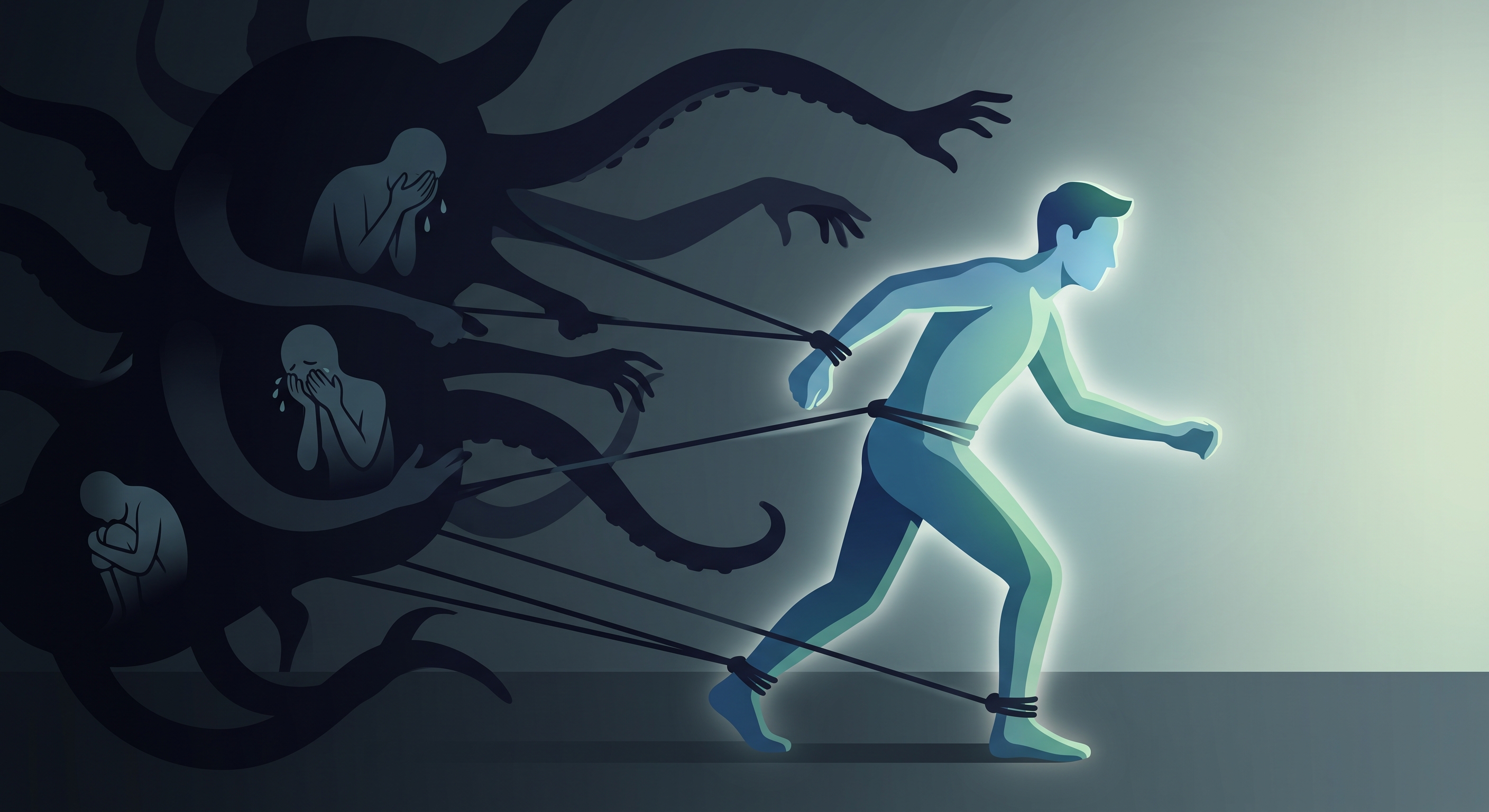
Family systems theory's most important insight is that relationships aren't just collections of individuals — they're systems, and systems seek equilibrium. Every long-term relationship settles into an arrangement: who accommodates, who decides, who manages whose emotions, who's allowed to need what. The arrangement might be unhealthy, but it'sstable, and human systems will defend stability with startling force.
When you change, you change the arrangement without anyone's permission. And the system responds with what Bowen's tradition calls the"change back" reaction— an almost automatic pressure campaign to restore the old equilibrium. It sounds like: "You've changed." "You think you're better than us now." "The old you never would have said that." "This gym is turning you into someone else."Notice that every one of those statements is technically true. You have changed. That's the point. The system just says it like an accusation, because to the system, it is one.
Here's what took me years of counseling work to fully appreciate: most of the time, nobody is consciously running this pressure campaign. The spouse isn't sitting up at night plotting to sabotage your growth. The system is doing what systems do — the same way your body fights a fever, the relationship fights the change. Recovery communities have known this forever: when someone gets sober, the family that spent years organized around the drinking often destabilizes rather than celebrates, because nobody knows how to be this family without its old organizing problem. Same machinery. Your health is the disruption.
The comparison stings more up close
Layer two. Psychologist Leon Festinger observed back in the 1950s what we all know from experience: we measure ourselves primarily against the people closest to us. A stranger's transformation is inspiring. A sibling's, a spouse's, a best friend's transformation — when we ourselves haven't moved — lands differently. It lands as an unspoken question: then what's my excuse?
You're not asking that question of anyone. You don't have to. Your changed life asks it just by existing in the same room as their unchanged one. Every boundary you hold is a demonstration that boundaries were possible all along. Every honest conversation you initiate proves the avoidance was a choice. You have become, without any intention of being one, a walking indictment— and people rarely respond to indictments with curiosity. They respond with defense.
There's a name for the social version of this: tall poppy syndrome— the impulse to cut down whoever grows past the group's baseline, because their height makes everyone else feel shorter. You've probably heard the cruder version: crabs in a bucket, where any crab that climbs gets pulled back down by the others. I'd add one honest note from 27 years of watching this: most people genuinely believe they want to see the people they love do well. And most of them do — right up until "doing well" means "visibly doing better than me." That's the line where support quietly turns into sabotage, and almost nobody knows they've crossed it.
They're also losing something real
Layer three, and this is the one that should soften you: your growth costs them something genuine. If the relationship was built on you being the compliant one, the fixer, the one who never made waves — then the person on the other side is losing a role, and roles are load-bearing. The friend who was always the together-one in the friendship. The parent whose authority ran on your deference. The partner whose comfort ran on your accommodation. They didn't consciously design that arrangement any more than you did. But they're losing it, in real time, without having asked for the renovation — and grief that can't name itself usually comes out as anger.
Why It Gets Worse Right Before the Choice Point
Now the part of the pattern that breaks people, because they misread it every single time.
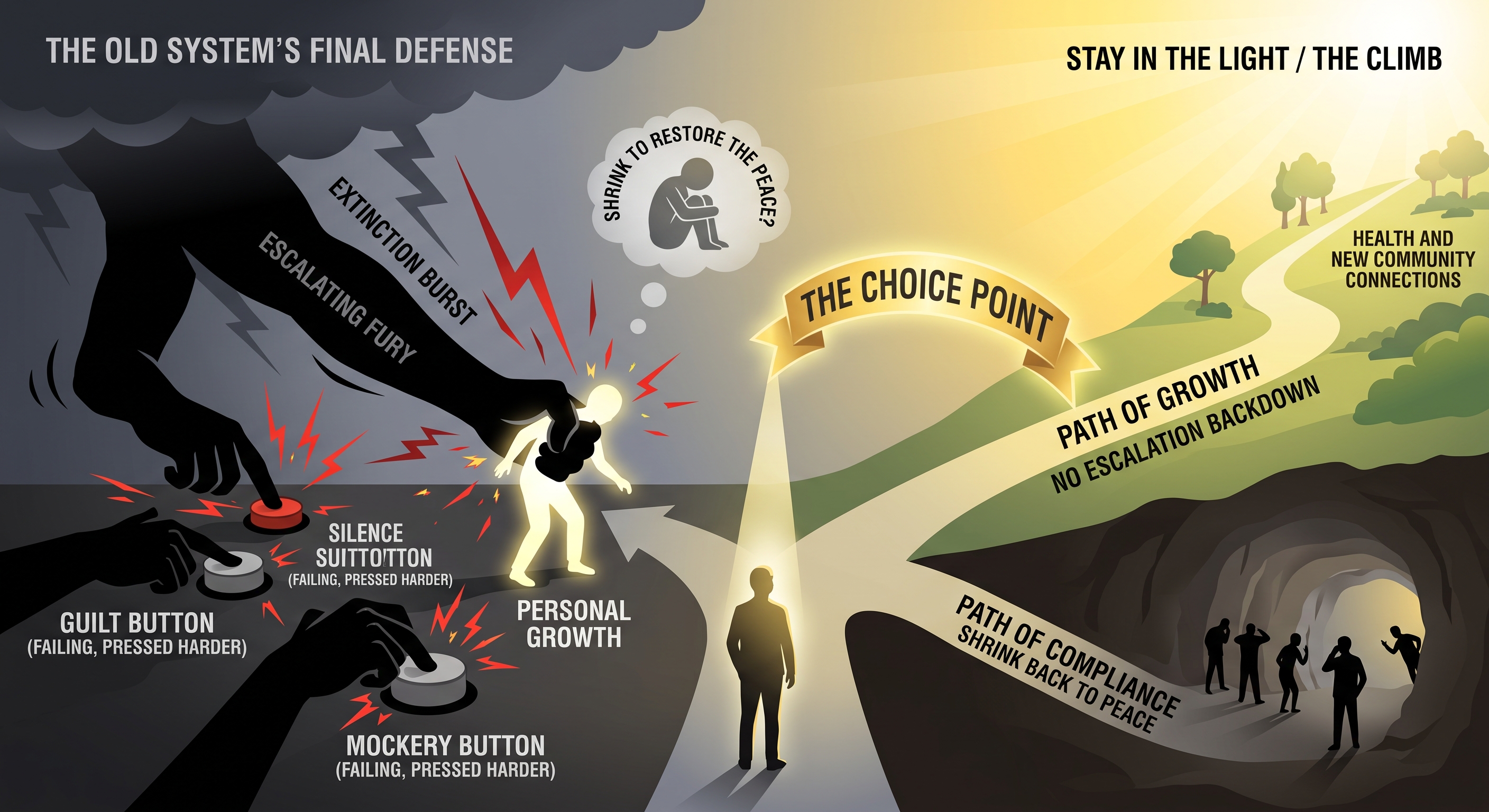
Behavioral psychology has a well-documented phenomenon called an extinction burst. When a strategy that used to work stops working, people (and animals, and toddlers — the machinery is that deep) don't immediately abandon the strategy. They escalate it. The vending machine eats your dollar, and you don't calmly walk away — you push the button harder, then mash it, then smack the machine. The old button used to work. Its failure produces fury before it produces adaptation.
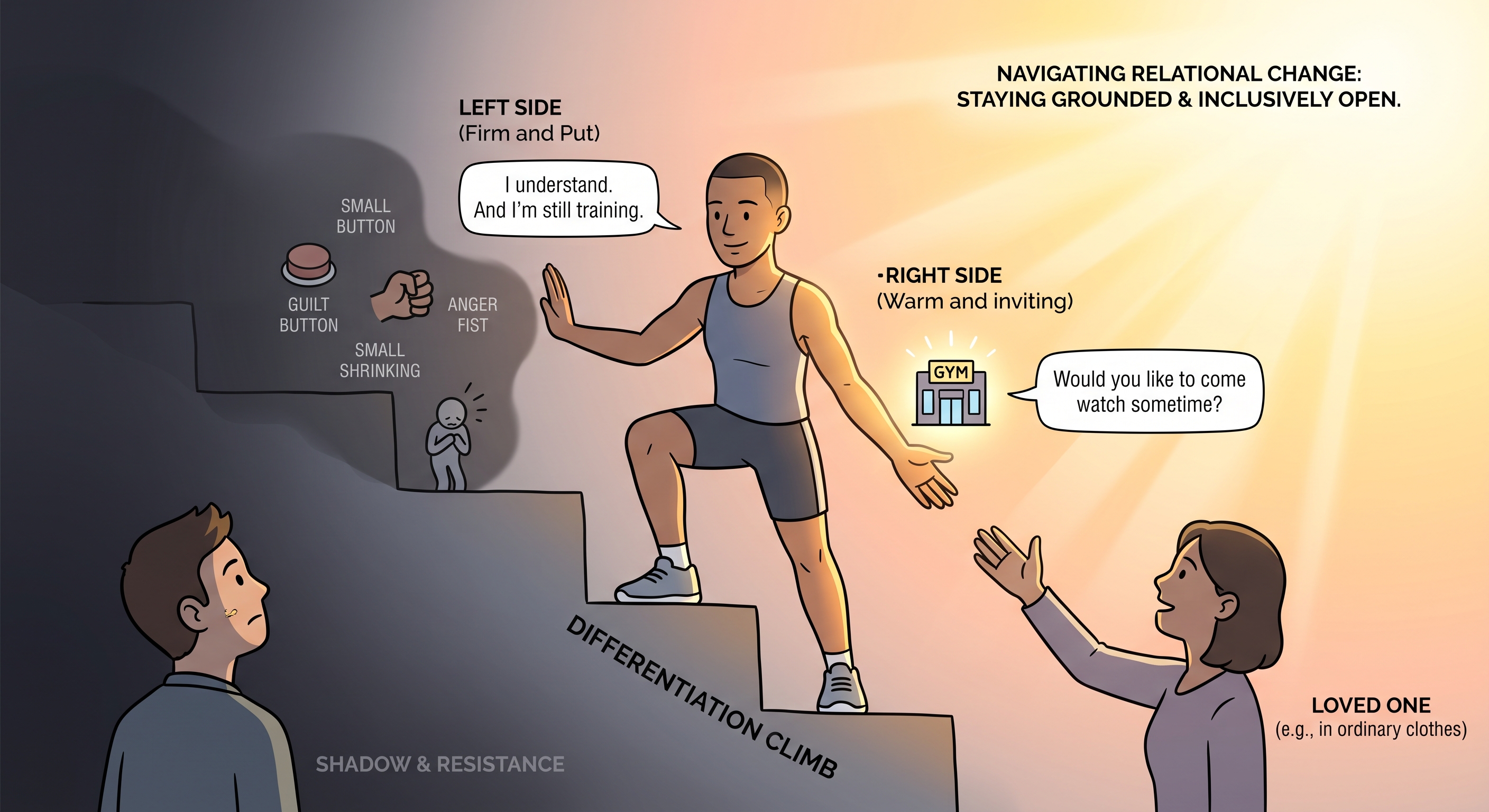
Apply that to your situation. For years, certain buttons reliably managed you: guilt worked. Silence worked. Mockery, sulking, the disappointed sigh — they all worked, in the sense that they returned you to compliance. Now, with your new training-built nervous system, the buttons have stopped working. And the people pressing them do exactly what the machinery predicts: they press harder. The guilt gets heavier. The comments get sharper. The cold shoulders get colder. The conflict spikes.
And here's the tragedy I've watched play out over and over: the person in your position reads the escalation as evidence they're doing something wrong. Things were never this bad before I started changing — maybe I'm the problem. So they conclude the growth is the damage, and they hand it back. They shrink to restore the peace. They come to class less and less, and then they're gone.
Read this sentence as many times as you need to: when the old ways of controlling you stop working, the people using them will often escalate before they adapt. The spike in conflict is not proof that your growth is destroying things. It's frequently proof that it's working — the system is making its loudest, final argument for the old arrangement.
That is the moment Plato was describing when the cave-dwellers turn on the returning prisoner. It's not the beginning of the end. It's the choice point— and you should walk into it knowing it's coming, because the person who's been warned experiences it completely differently than the person who's ambushed by it.
How to Navigate It: The Actual Tools
Everything above is diagnosis. Here's treatment — the things I'd tell you across a desk, in roughly the order you'll need them.
1. Expect it, so it can't ambush you
Half the damage of this pattern comes from the surprise. People expect getting healthy to be universally celebrated, so when it isn't, they assume something has gone terribly wrong — with themselves, with the relationship, with the whole project. Delete the surprise. Some relational turbulence is a normal, predictable feature of one person in a system getting significantly healthier. Not a sign of failure. A sign of motion. You cannot change your position in a web without every strand feeling it.
2. Learn the skill that actually matters: staying warm AND staying put
Here's what almost everyone gets wrong about boundaries. They think the skill is the confrontation — the dramatic speech, the line in the sand, the walking away. That's not the skill. That's usually just fusion wearing armor.
The actual skill — the differentiated move — is what family systems thinkers call non-anxious presence: the capacity to hold your position while staying connected and calm, without needing the other person to approve of it and without punishing them for being upset about it. It sounds like this: "I hear that you hate that I train on Saturdays. I understand it's a real change, and I'm not going anywhere — and I'm also going to keep training."No counterattack. No collapse. No twenty-minute justification, because over-explaining is just asking permission with extra steps. Warmth and firmness in the same sentence.
You already know this skill, by the way. It's the same one you use in hard sparring rounds: staying composed under pressure instead of panicking or flailing. You've been training it here for months. This is just its application under a different kind of fire.
3. Invite them up — don't just report the view
The freed prisoner's mistake, arguably, was coming back with a report: here's what I saw, here's why your shadows are wrong. Reports threaten. Invitations don't — or at least, far less.
Bring the people you love toward this, not just the news of it. Invite your spouse to a class, a gym event, a Saturday open mat — even just to watch. Some of the best outcomes I've seen in twenty-plus years came when the skeptical partner finally set foot in the building and discovered the "cult gym" was a room full of ordinary people being decent to each other, and became a member themselves. You cannot argue someone out of the cave. Sometimes you can walk them out, one small step into the light at a time. Give the people you love every genuine chance to come along.
4. Sort the scared from the invested
And when they won't come along — this is the discernment the whole season turns on. The people resisting your growth are not all the same, and treating them as if they are will either burn bridges you should have kept or keep you standing in fires you should have left. Two questions cut through it:
Are they scared, or are they invested? Scared people are reacting to loss and unfamiliarity. Given time, reassurance, and repeated evidence that the new you still loves them, they gradually adjust; watch for softening over months, small curiosities, grudging respect. Invested people benefited from your smallness— your compliance, your silence, your availability were features of the arrangement they built; and they don't soften with time; they just rotate strategies. Guilt fails, so they try anger. Anger fails, so they try recruiting others. Watch the pattern over months, not the words in any single fight.
Do they attack the change, or the changing?" I miss you — we never see you anymore" is about the change, and it's often legitimate; it deserves a real response and maybe a real adjustment. "You think you're better than everyone now" is about the fact that you dared to change at all — and no amount of adjustment will ever satisfy it, because the only acceptable adjustment is your return to the cave.
5. Grieve the right choice
Nobody says this part out loud, so I will: choosing your health can be the correct choice and still feel like loss. If a relationship recedes because it couldn't survive your honesty, you will feel grief, guilt, and loneliness — and none of those feelings are evidence you chose wrong. Researcher Brené Brown draws the distinction this season forces on you: fitting in is being accepted for a performance; belonging is being accepted as yourself. Some of what you're grieving was never belonging. It was well-managed fitting in — and what the growth cost you was mostly the illusion. That truth helps eventually. It doesn't help immediately. Grieve anyway, and don't let the grief talk you back down the tunnel.
6. Let this community hold the standard with you
Finally: you were never meant to differentiate alone. The reason the cave's pull is so strong is that it'sfull of people, and the climb looks empty. It isn't. The community that trained this health into you is the community that will help you keep it — people who have walked this exact pattern, some of them years ahead of you in it, who can tell you on the hard weeks that the turbulence is a stage and not a verdict. Use them. That's not weakness or gym-dependency. That's what healthy systems are for— and learning to lean on a healthy one is itself part of the recalibration.
The Choice, Named Plainly
So here's the whole pattern, laid out in advance, so it can never ambush you:
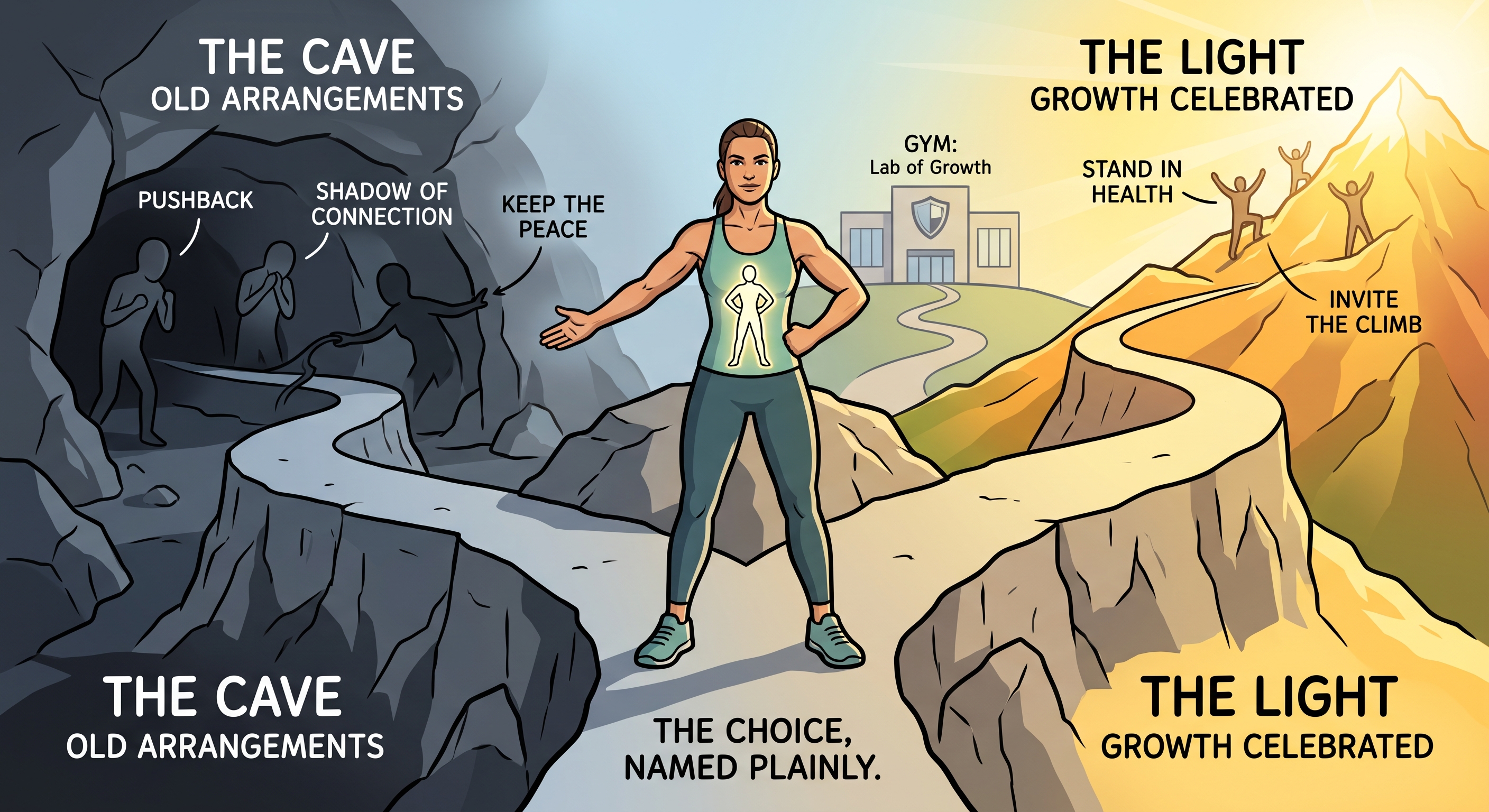
You came in to lose weight. You found a room where the mat tells the truth, boundaries get honored, and growth gets celebrated — and you practiced your way into becoming someone healthier than the systems you live in were built for. Those systems pushed back, not because the people in them are evil, but because systems defend their equilibrium, comparisons sting at close range, and some people were leaning their whole weight on your smallness. The pressure spiked hardest right before the choice point, exactly as the machinery predicts. And at that point you faced the question Plato asked twenty-four centuries ago: having seen the light, do you move back into the cave to keep the peace — or do you stay in the light, keep your hand extended toward the people you love, and give them every chance to climb?
I've watched hundreds of people stand at that fork. The ones who chose the cave — who gave the health back, rep by rep, boundary by boundary, until they disappeared from these mats — I think about them often, and the honest truth is that surrendering their growth rarely saved the relationships they surrendered it for. The arrangement they returned to was a shadow of connection, not connection. That was the whole problem to begin with.
The ones who stayed in the light — who held their position with warmth, invited relentlessly, sorted wisely, grieved honestly — most of them are still here. And here's the ending nobody predicts: many of their hardest skeptics eventually came around. Some are on these mats today. Because a person standing calmly in their own health, refusing to shrink and refusing to attack, is the single most persuasive argument for the climb that a cave-dweller will ever see.
Be that argument. The people you love may need years of watching you stand in the light before they trust it enough to climb toward it.
Stand there anyway.
Knoxville Martial Arts Academy has spent 27 years watching people come in for the weight loss and stay for the person they became — in the largest and most successful MMA facility in Tennessee. The mat tells the truth. Eventually, its people do too. That's the whole risk, and the whole reward.
