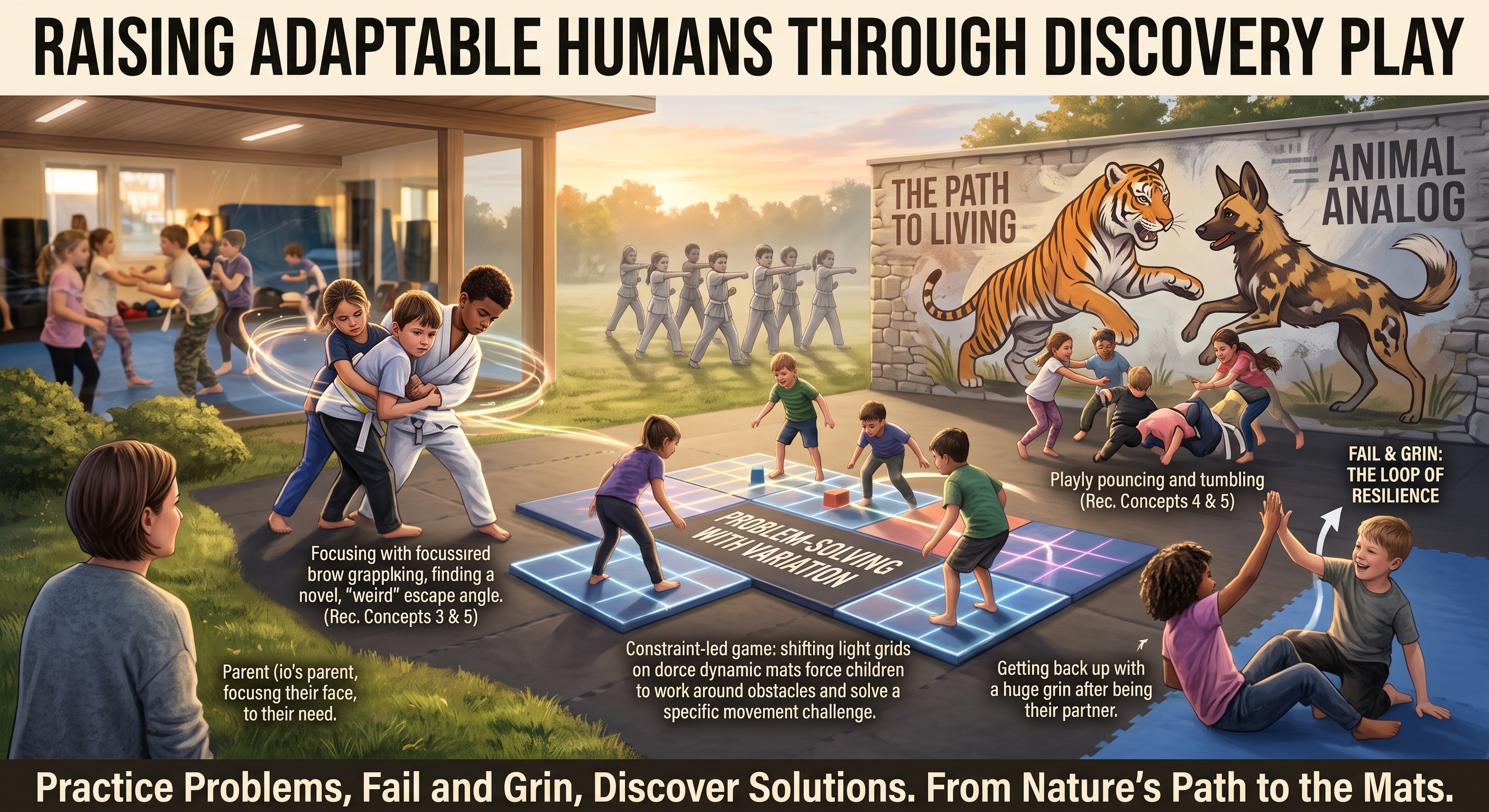
Play As the Way
The KMAA Chronicles
Play As the Way: Your Kid Isn't Learning "Karate" Moves. They're Learning How to Learn.
If you've stood off the mats watching one of our kids' classes, there's a decent chance you've had a quiet, nagging thought you haven't said out loud:
"...Is this it? They're just playing games."
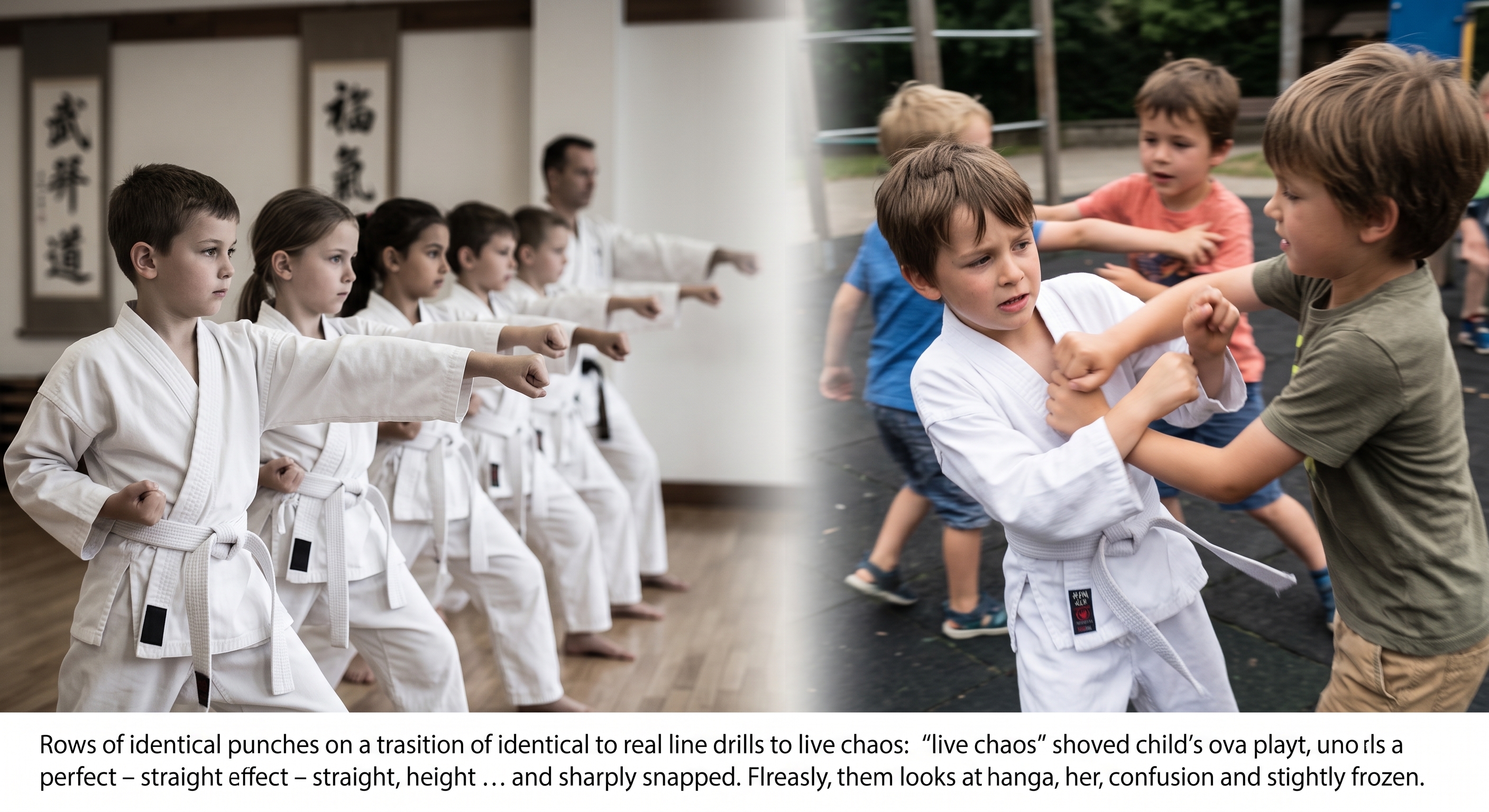
You were maybe expecting the classic picture. Rows of children in matching uniforms, snapping identical punches into the air on command. A stern instructor counting in Japanese. Stillness, straight lines, synchronized kicks. That picture is what martial arts for kids has looked like on television — and in most schools — for fifty years. And when you instead watch a KMAA class where kids are playing what looks suspiciously like tag, solving some strange balance puzzle, or scrambling after each other laughing, it's fair to wonder whether your kid is actually learning martial arts or just burning energy in an expensive room.
So let me tell you exactly what you're looking at — because our youth program is built the way it's built on purpose, module by module, on the back of the best available science about how young humans actually acquire skill. And once you see it, you won't be able to unsee it: the games are not a break from the martial arts training. The games are the most advanced martial arts training we know how to deliver.
More than that: what your kid is really developing in there isn't a catalog of moves at all. It's something that will outlast every move — the ability to solve new problems with their body and their brain under pressure. They're not learning karate moves. They're learning how to learn.
The Problem With Rows of Identical Punches
Start with the traditional picture, because it fails somewhere most parents never get to see.
The line-drill model trains children to reproduce a fixed movement on cue: the instructor demonstrates the "perfect" punch, kids copy it two hundred times, and mastery is defined as how closely your copy matches the demonstration. It looks disciplined. It looks rigorous. Parents love watching it, because progress is visible — cleaner lines, sharper snap, better synchronization.
Here's the problem, and it's not a small one: a real opponent never attacks on cue, from the right distance, at the agreed angle. Neither does a playground shove, a slipped footing on the stairs, or any of the thousand messy physical moments a child's life will actually contain. The line drill teaches a child to execute a known answer to a known question. But fighting — and frankly, living in a body — is an endless stream of unknown questions: this angle, this speed, this off-balance moment, right now.
Movement scientists have a name for what happens when lab-perfect technique meets live chaos: it often doesn't transfer. The skill was welded to the exact conditions it was practiced in — the quiet room, the cooperative count, the stationary target — and when the conditions change, the skill degrades or disappears. Every experienced coach has seen the heartbreaking version of this: the kid with three years of beautiful kata who freezes completely the first time another child actually grabs them. Nobody ever asked their body a live question before. They memorized answers.
And there's a second cost, quieter but just as real: rows-and-repetition training teaches kids that being good means waiting to be told what to do and doing exactly that. That's not a fighting skill or a life skill. In a world your kid will graduate into — one that changes faster every year — it might be the exact opposite of the skill they'll need most.
What the Games Are Actually Doing
Now the other model — the one you're watching through on our mats. It comes from a body of research in motor learning and skill acquisition called theconstraints-led approach, and while the academic literature behind it runs deep (it grew out of ecological psychology and dynamical systems research, and it now shapes athlete development in professional sport worldwide), the core idea is simple enough to say in one sentence:
Kids don't learn movement best by copying answers. They learn best by solving problems — and the coach's real job is to design the problem.
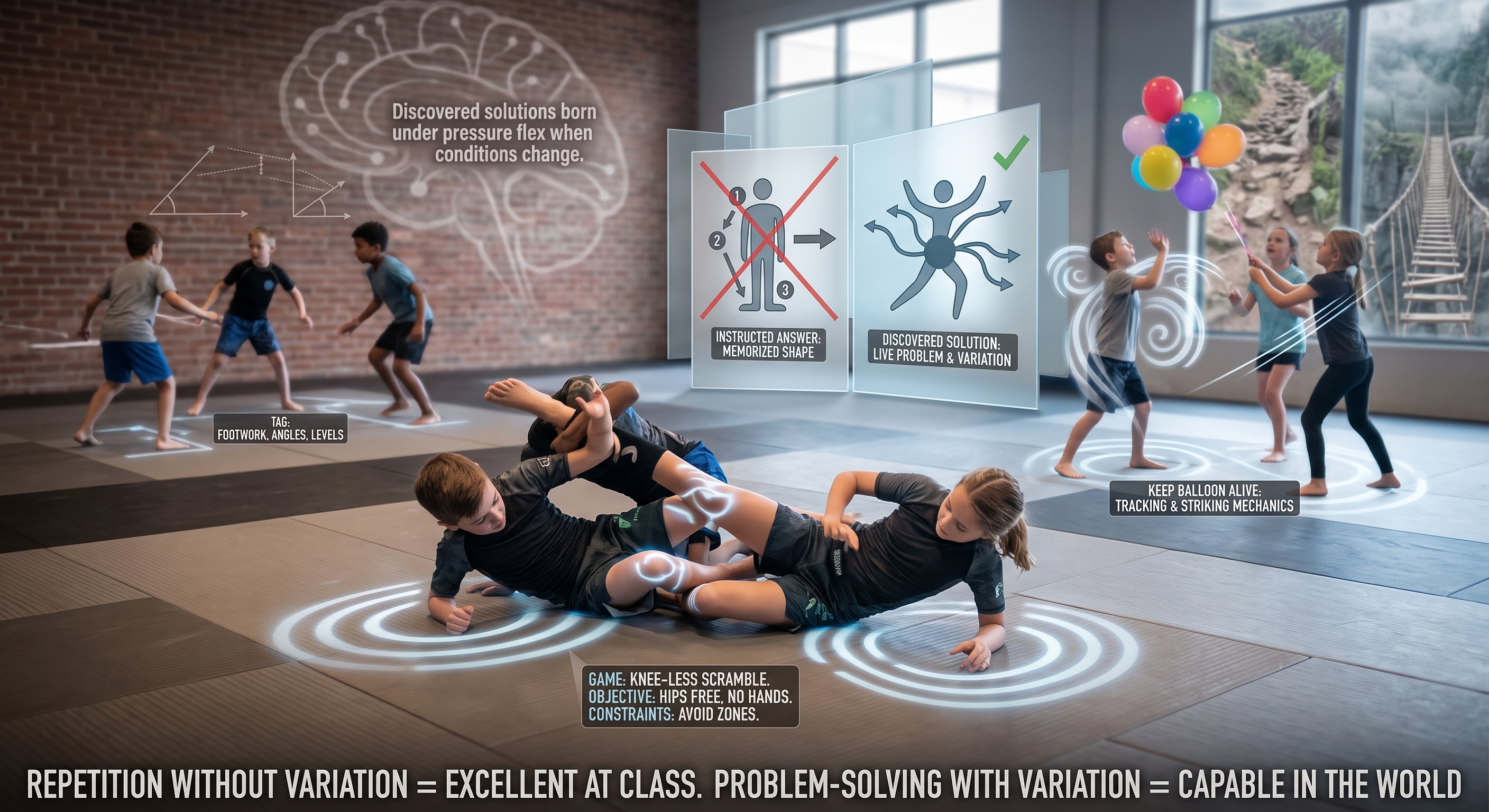
Here's what that looks like in practice. Instead of saying "here is the correct escape, memorize it," we build a game with carefully chosen rules — a constraint here, a boundary there, a scoring twist that quietly makes one kind of movement valuable and another kind useless. Then we turn the kids loose inside it. The game itself starts asking each child questions, live, at their own level: How do you keep your balance when someone's pushing you? How do you get your hips free? How do you protect your space without using your hands? The child experiments. Something fails. They adjust. Something works. Their body files it away — not as a memorized shape, but as a solution they found, connected to the real feel of a resisting partner, live timing, and shifting balance.
That difference — instructed answer versus discovered solution — turns out to be enormous. The discovered solution belongs to the child. It shows up again under pressure, because it was born under pressure. It flexes when conditions change, because it was never welded to one condition in the first place. This is why sport scientists keep finding that game-based, problem-solving practice produces athletes who are more adaptable than their drill-trained peers: not better at one rehearsed move, but better at the actual skill underneath all moves —reading a situation and organizing an answer in real time.
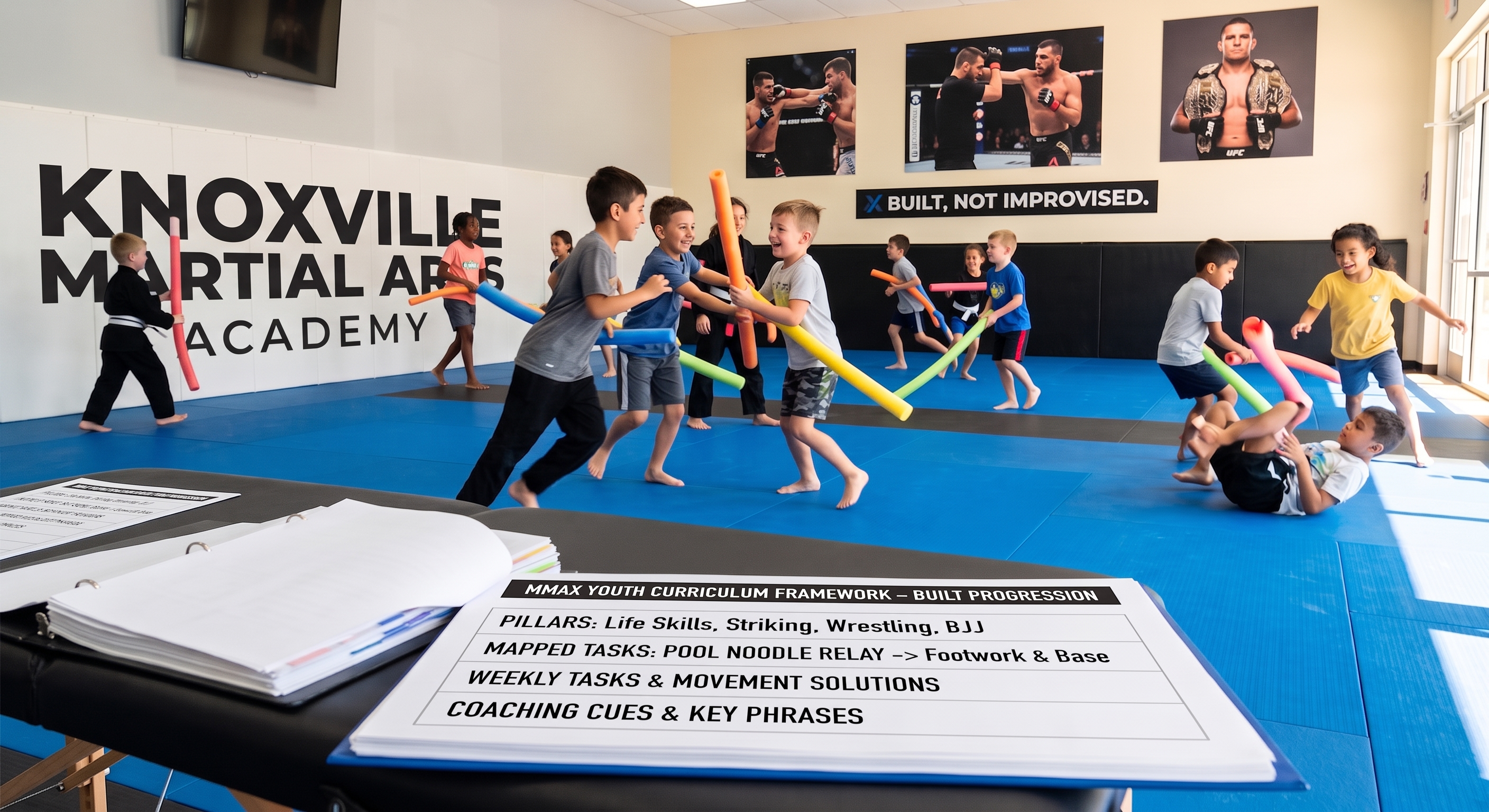
So when you watch our floor and see what looks like tag — look closer. That tag game has rules tuned to force level changes and angle-taking, which is footwork. That "keep the balloon alive" chaos is tracking and striking mechanics. That wrestling-ish scramble with the funny rule about knees is teaching base, hips, and escapes. Every game on our floor was designed backward from a specific movement problem we want their bodies to learn to solve. The kids think they're playing.They are playing — that's the delivery system. The curriculum is hiding inside it.
Here's the shortest version of the science: repetition without variation produces a kid who's excellent at class. Problem-solving with variation produces a kid who's capable in the world. We're not running a class-performance program. We're running a capability program.
Nature Figured This Out First
If the game-based approach still feels like a modern educational fad to you, I want to zoom out — way out — because the deepest endorsement of what happens on our kids' floor doesn't come from sport science at all. It comes from biology.
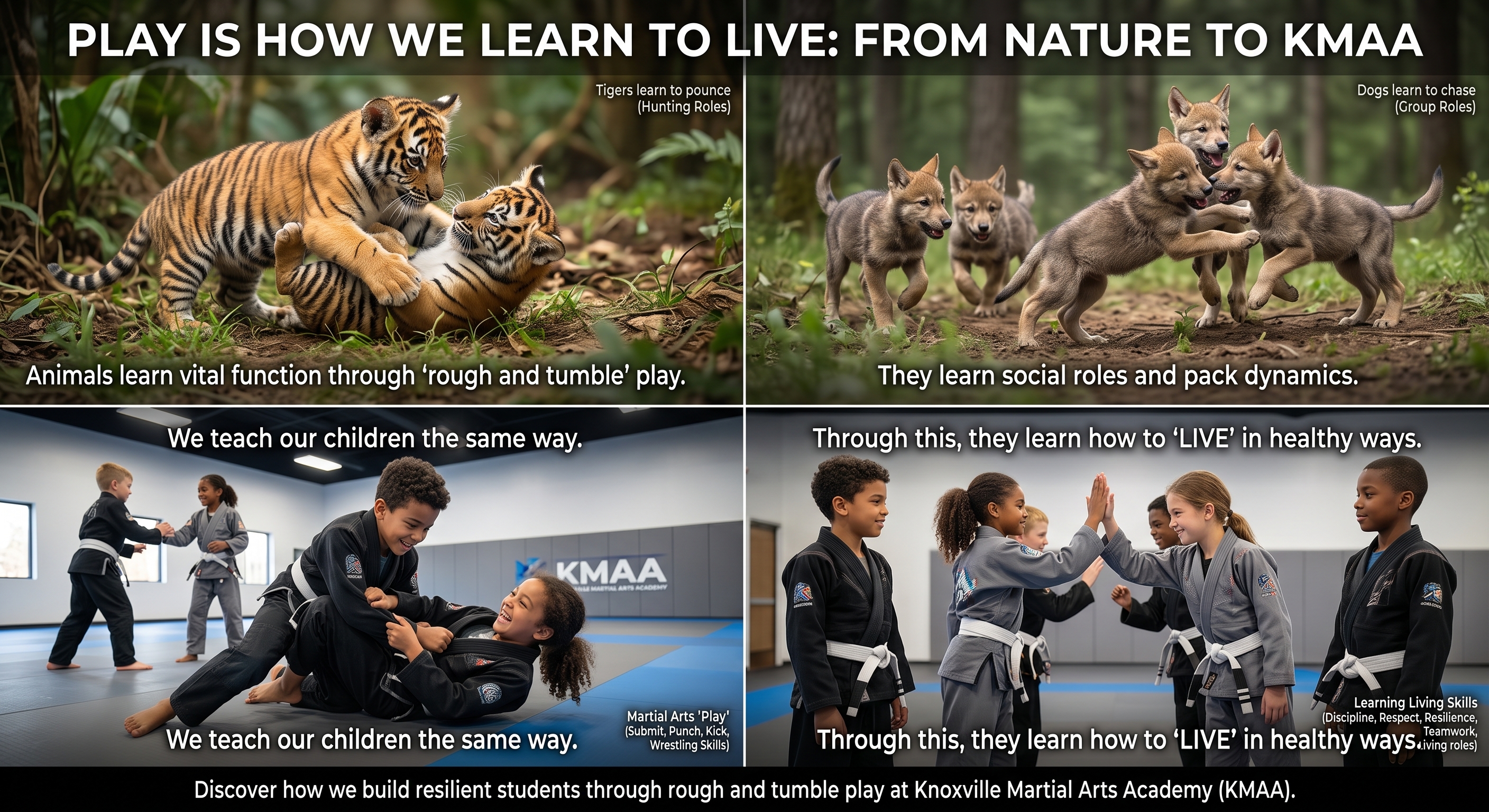
Watch any young mammal on the planet. Tiger cubs pounce on each other, on their mother's tail, on anything that moves — and in doing so, they're building the exact timing, targeting, and body control they'll need to hunt. Puppies chase each other in loops and mob each other in piles — and they're learning how to run down prey and how to operate inside a pack. Bear cubs wrestle. Foals sprint and dodge. Across every species that has to do anything complicated to survive, nature uses the same single teaching method, and it isn't rows of identical repetitions with the answer demonstrated up front. It's rough and tumble play.
And here's what the biologists will tell you that most parents have never heard: the play isn't just rehearsing the physical skills. Young animals learn their social world in those wrestling piles — how to read another animal's signals, how hard is too hard, when to press and when to yield, how to lose a tumble and stay in the group, where they fit and how to challenge that fit fairly. The pounce practice and the pack practice happen in the same game. Play is how young mammals learn their hunting roles, their social roles, their hierarchy roles — their living roles. Researchers who study play across species keep arriving at the same conclusion: rough and tumble play isn't a childhood luxury. It's the developmental engine, and young mammals deprived of it show measurable deficits in exactly the skills it builds — social judgment, emotional regulation, resilience under stress.
Human children are young mammals. The same engine is installed in your kid, and it runs on the same fuel. Which puts a hard question to modern childhood, because we have spent the last few decades systematically draining rough and tumble play out of it — banned from playgrounds, engineered out of recess, replaced by screens and supervised stillness — and then we wonder why kids struggle with exactly the capacities that kind of play was building for a million years.
Our classes put the engine back to work, deliberately and safely. Through rough-and-tumble martial arts play, our students are learning what every young mammal learns — yes, the "hunting" skills: how to wrestle, strike, escape, and submit. But tangled up in every round of it, inseparable from it, they're learning how to live: how to read a partner, how to modulate their own force, how to win without gloating and lose without unraveling, how to challenge and be challenged inside a relationship that holds. That's not a side effect of the wrestling. That's what the wrestling is for, and it always has been — for tiger cubs, for puppies, and for your kid.
Nature never taught a single young animal with a lecture and a line drill. It teaches through rough-and-tumble play — and it uses the same game to teach the pounce and the pack. Our floor works the same way: the kids are learning to grapple, and inside the grappling, they're learning to live with each other.
Built, Not Improvised
Now, a fair question: plenty of kids' programs "play games" because games kill time and children like them. What makes ours different from glorified daycare with mats?
The answer is that our curriculum is engineered, module by module, and I'll open the hood a little so you can see it.
Every module in our youth program — from our Little Dragons (ages 3–5) through MMAX Youth (ages 6–12) — is built across four skill groupings, every single time: Life Skills, Striking, Wrestling, and BJJ. Notice which one is listed first. That's not alphabetical.
Inside each module, every game and task is documented for our coaches with the same structure: the core question the module is asking, the core idea kids should walk away with, the key phrases and coach cues every instructor uses — so a child hears the same language from every coach on our staff, in every class, and the lessons compound instead of scattering. And each task is mapped to the specific movement solutions we're developing — the small set of body answers that show up over and over in grappling and striking no matter how the situation varies. We track which games develop which solutions, at which ages, in which order.
In other words: it looks loose out there because the experience is loose — that's what makes it work for kids. Underneath, it's one of the most tightly designed curricula we've ever built at this academy, and I say that as someone who also builds athlete-development systems for professional fighters. Your seven-year-old's Tuesday class and our pro team's fight camp run on the same underlying science. We just hide your seven-year-old's version inside a game about pool noodles.
The Part That Matters More Than Martial Arts
Here's where I tell you what I actually think your kid is getting out of all this, and why "Life Skills" leads every module we write.
Think about what a child is actually practicing, underneath the content, in a problem-solving class versus a copy-the-answer class:
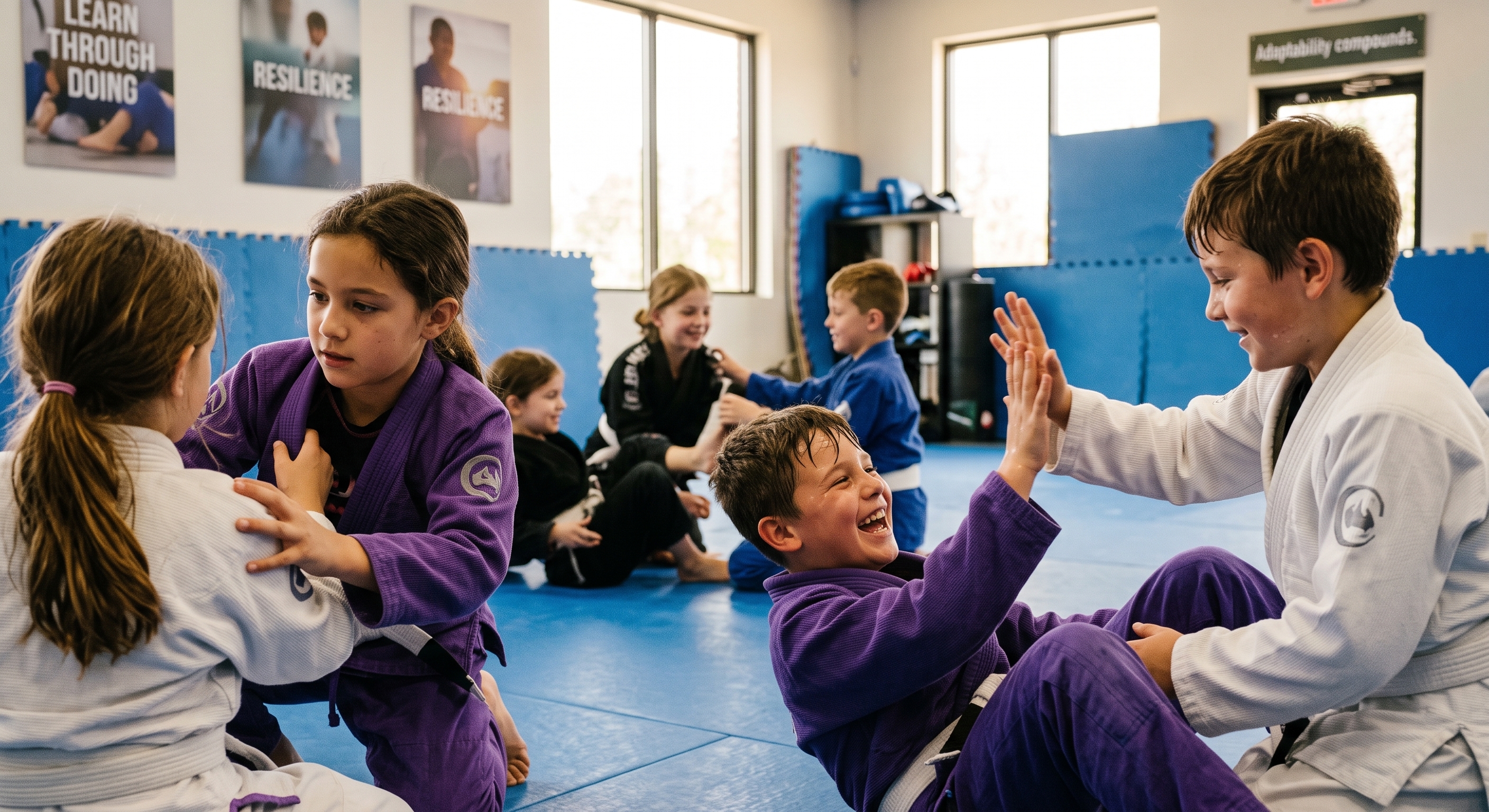
They're practicing being confused and staying in the game. Our games don't come with the answer attached. A child meets a problem, doesn't know what to do, and — here's the crucial part — keeps engaging anyway until something works. That tolerance for not-knowing-yet is the foundation of all learning, and most schooling accidentally trains it out of kids by punishing wrong answers. We build it back in, three classes a week, disguised as fun.
They're practicing failing in front of people and going again. In a game, getting caught or swept isn't a failed test — it's just the next round starting. Kids in our program fail dozens of times per class, cheaply, laughing, and try again immediately. That's resilience, not as a poster on a wall, but as a rehearsed reflex.
They're practicing reading a situation instead of waiting for instructions. Every live round asks them to notice what's happening and choose. Over years, that becomes a disposition: this is a kid who assesses and acts, rather than a kid who looks at an adult and waits.
They're practicing winning and losing with someone they have to hug afterward. Their training partners are their friends. You learn to compete hard and hold the relationship — maybe the single most transferable social skill we teach.
Now project that forward fifteen years. The specific techniques may fade if they stop training (though the movement literacy largely won't). But the kid who spent their childhood being handed novel problems and figuring them out — who learned that confusion is the start of learning rather than the proof of stupidity — walks into their first job, their first crisis, their first everything with a different operating system.A daptability is the only skill that never becomes obsolete. Everything else we could teach your child has a shelf life. That one compounds for the rest of their life.
That's the real product of this program. The armbars are the delivery vehicle.
What to Watch For in the Class
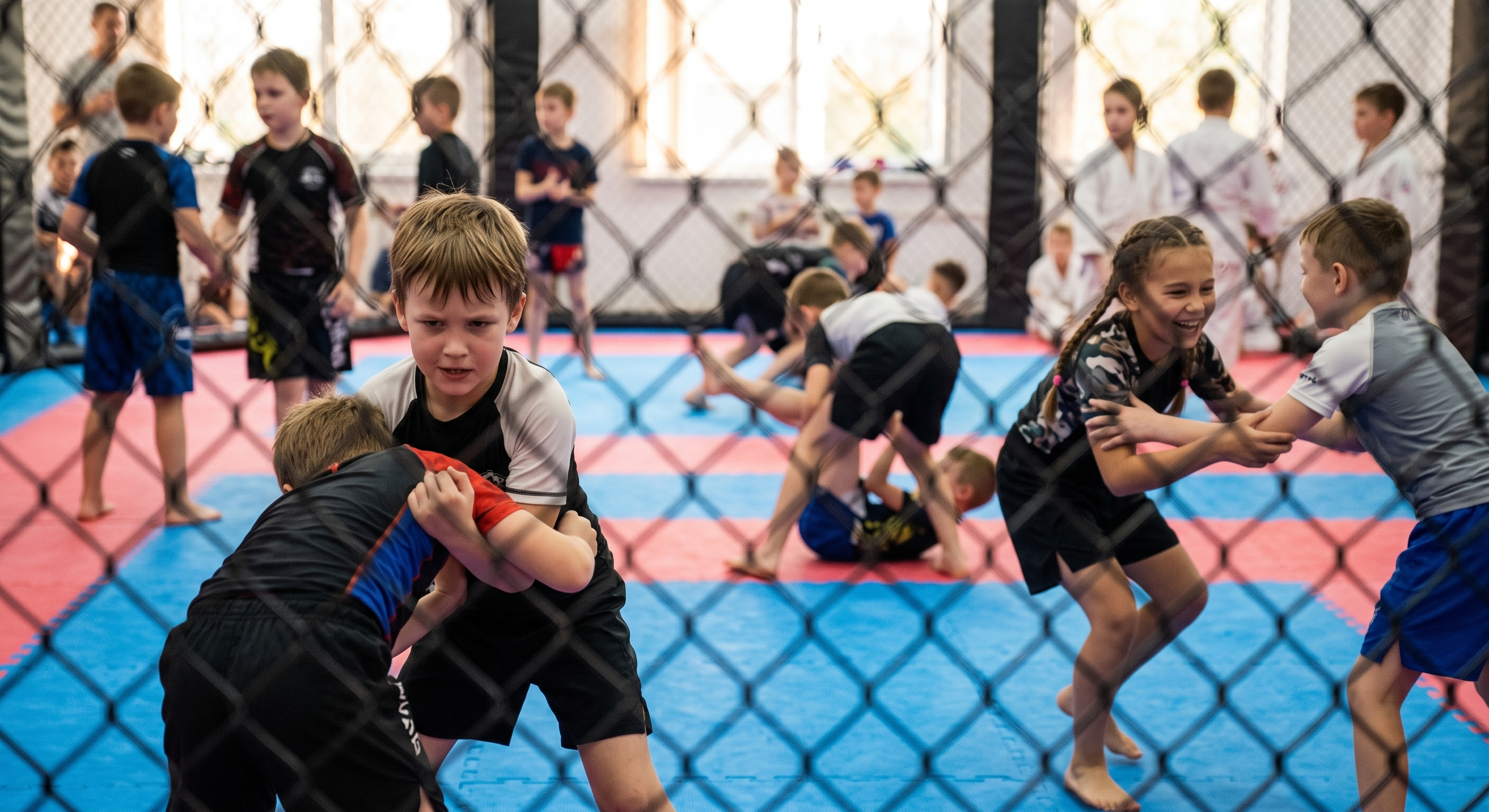
So next time you're watching through the cage links or watching the children on the mats, retire the old scorecard — how straight the lines are, how identical the punches look — and watch for what actually predicts your child's development:
Watch them meet a problem they can't solve yet. The furrowed brow mid-game, the second and third attempt — that's the learning happening, live. If your kid looks slightly challenged and fully engaged, the class is working.
Watch what happens right after they fail. Caught, tagged, swept — then right back in, usually grinning. Count how many times that loop runs in one class. Each loop is a repetition of the most important skill on the floor.
Watch them try something weird. An odd angle, an unorthodox escape, something no coach demonstrated. In a copy-the-answer school, that's disobedience. Here, it's the whole point — a child hypothesizing with their body. Some of the weird stuff will work, and it will be theirs.
Listen for questions in their answers. On the ride home, don't ask "what moves did you learn?" Ask"what problem did you get to solve today?"— and watch what that small change does to how they talk about their training.
Rows of identical punches photograph beautifully. But you're not raising a photograph. You're raising a human being who will spend their whole life meeting situations nobody prepared them for — and the deepest thing we can give them, three classes a week, wrapped in games and laughter, is a nervous system that meets the unprepared-for moment and says: I've never seen this exact problem before. Let's figure it out.
That's what's happening on the mats. Your kid is playing. And your kid is learning how to learn.
Knoxville Martial Arts Academy's youth programs — Little Dragons (ages 3–5) and MMAX Youth (ages 6–12) — are built module by module on modern skill-acquisition science, in the largest and most successful MMA facility in Tennessee. Come watch a class. Bring your questions. We love explaining what the games are really doing.
