
The Accountability You Ask For
The KMAA Chronicles
The Accountability You Ask For
(And the Accountability You Get)
Accountability might be the most popular word in America that almost nobody actually wants.
We love it as a concept. We put it in our New Year's posts. We ask our friends for it: hold me to this, don't let me quit, call me out if I slip. Every January, gyms across the country fill up with people who used that exact word on the drive over. Businesses print it on walls. Teams chant it. Churches preach it.
And then it shows up.
Not the concept — the thing itself. A real person, looking at you, saying the true sentence you asked them to say. And in that moment, almost everyone discovers the same thing, and it's the thing I want to talk about, because 27 years of coaching and more than a decade of counseling work have shown it to me from every possible angle:
Accountability is easy to ask for. It is very, very hard to live through.
Not because there's anything wrong with you when it stings. Because of a gap almost nobody sees coming — and if you understand the gap before you're standing in it, you have a real chance of becoming one of the rare people accountability actually works on.

The Gap: Who Asks vs. Who Answers
Here's the mechanism, and once you see it, you'll see it everywhere.
When you ask for accountability, the person doing the asking is your best self. It's you on a good day — clear-eyed, motivated, humble, already imagining the better version of you on the other side. That self signs the contract cheerfully, because that self assumes it will also be the one receiving the call-out.
It won't be.
The call-out arrives weeks or months later, and it never finds your best self at home. It finds your actual self — the tired one, the embarrassed one, the one mid-failure, the one with a story already half-built about why this time doesn't count. The best self asked for a mirror. The actual self answers the door, sees the mirror, and wants to break it.
That gap — between the self that asks and the self that answers — is not a character flaw. It's the human condition, and I've never met anyone who doesn't have it, myself included. But what you do inside that gap is just about the most revealing thing about a person. I've said for years that integrity is what you do when you don't know what to do. Here's the companion truth: character is what you do when the accountability you asked for actually arrives.
In that moment, only two roads remain. You can let the true sentence land — which feels, for about ninety seconds, like dying — and then grow. Or you can make the person who said it the problem.
Most people choose the second road. Not because they're wicked. Because the first one costs more than they thought they'd agree to pay.

Why the Mat Is the Best Accountability Machine Ever Built
This is where I tell you why a martial arts gym, of all places, has anything worth saying on this subject.
The mat tells the truth. I say it constantly because nothing else I've found says it so cleanly: on the mat, no gap between the self that asks and the self that answers, because the feedback doesn't wait for a convenient moment. You hold your breath, you gas. You drop your hand, you get touched. You skip six weeks, the first round back files its report. There's no story you can build fast enough to outrun it, no reputation that pads it, and no one to blame — the feedback isn't an opinion delivered by a person you can resent. It's just what happened.
And here's what I've watched that honesty do to people, hundreds and hundreds of times: it trains the receiving muscle. People who train for years get corrected thousands of times — by coaches, by partners, by the round itself — in doses small enough to absorb. Somewhere in that process, correction stops registering as attack and starts registering as information. The ninety seconds of dying gets shorter. The ego learns it can take a true sentence and survive.
That's the real product of this place, underneath the technique. Not toughness — correctability. And it transfers. The member who can hear "your guard drops when you're tired" without crumbling is being rehearsed, rep by rep, for the day someone they love says a much harder true sentence across a kitchen table.
Accountability isn't a personality trait. It's a capacity, and it's trainable — in small honest doses, over time, in a room where correction is information instead of humiliation. That's what the mat builds. That's why it matters far beyond the gym.

What Real Accountability Is Made Of
Because the word gets used for everything from friendship to surveillance, let me be precise about what the real thing requires. After three decades of building it — in a gym, in a counseling office, in a church — I've found it stands on four legs:
It's chosen. Real accountability is requested in daylight, by the person who'll be held. Standards imposed on someone who never agreed to them aren't accountability; they're just power. Everyone who trains here chose this room, and chose it knowing it has standards.
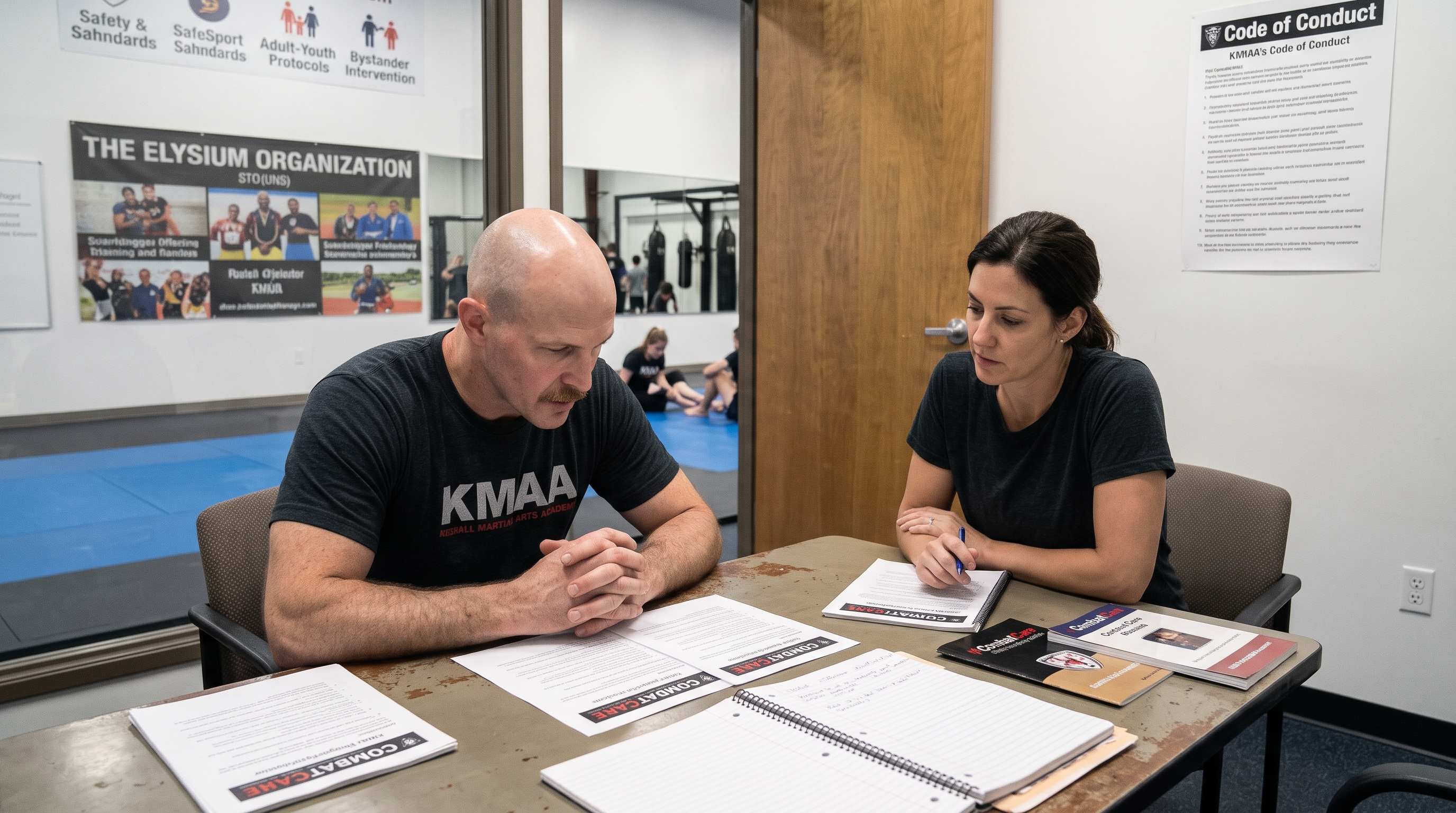
It's written. A standard that lives only in someone's head can move whenever it's convenient — and a standard that moves isn't a standard; it's a mood. That's why we have a written code of conduct that members and athletes alike agree to, and written safety systems underneath it. Paper protects everyone, most of all the person being held, because they can always check the standard against what's being asked of them.
It's mutual. The people holding the standard are under it. Nobody in a healthy house is above the rules of the house — more on this in a moment, because it's the leg that matters most.
It's safe to invoke. "Problems go up" has been our rule for years: concerns travel to the people with the power to fix them — never sideways into gossip, never downward onto someone with less standing. A standard you're afraid to appeal to isn't protecting you.
Notice what this list excludes. It excludes control dressed up as care — standards that appear from nowhere, shift without notice, and only ever bind one party. If you've lived under that counterfeit somewhere, I understand why the real word makes you flinch. The counterfeit is real, it does damage, and the test for telling them apart is exactly the four legs above: Did I choose it? Can I read it? Does it bind the people enforcing it? Can I appeal to it without fear?
Run that test on any room you're in — any gym, any team, any church, any relationship. Including ours.

The Part Most Leaders Skip: It Has to Run Uphill
Here's the question I'd ask of anyone who holds authority anywhere, and the question you should ask of me: who holds you?
Because accountability that only flows downhill isn't accountability at all. It's hierarchy with a nicer name. A leader who weighs everyone and is weighed by no one has built a room that serves them, whatever the posters say. So let me answer the question plainly, on the record, about myself.
The written code of conduct at KMAA binds me. The safety and safeguarding system we built — CombatCare, modeled on the standards used in Olympic sport — was designed on purpose so that no one in a position of trust sits outside it, starting with the people at the top, and it includes reporting channels that do not route through the person being reported. Our leadership team holds decisions together, not by one man's say-so. At KMAA we have a Gold Team of five people, and I'm just one vote on that team; and I've been outvoted many times! At home I'm married to a woman who has never once let me get away with anything, which may be the most rigorous oversight on this list; if you know Taylor Turner you know she won't accept anything other than the very best!
I'm not listing all that to decorate myself. I'm listing it because you should refuse to be held by anyone who can't answer the question. Before you give any coach, mentor, pastor, or leader the right to speak hard truth into your life, ask them who speaks it into theirs — and watch whether the answer is specific. Names, structures, paper. If the answer is vague, or the question offends them, you've learned everything you need to know. The people most worth trusting with your growth are the ones who visibly submit to the same scale they weigh you on.
When the Bill Arrives
Now the hard part of the essay, the pattern I've watched for 27 years and have never enjoyed watching once.
Sometimes the gap wins.
Someone asks for a standard — sincerely, on a good day, in their best-self voice. The standard is agreed to, sometimes even in writing, with people they chose themselves. And then one day the standard does exactly what they asked it to do: it says the true sentence at the moment the true sentence is most expensive. And the person leaves. Not just the standard — often the whole room, the whole community, sometimes the whole version of their life that made the request.
That is their right. Every standard worth anything is chosen, which means it can be unchosen; nobody is anybody's prisoner here, and plenty of people who've moved on from our mats remain people I love and respect. Leaving is not the failure I'm talking about.
The failure I'm talking about is what sometimes happens to the story on the way out. Because the person leaving still has to live with the person who asked. And the cheapest way to resolve that tension is to rewrite the request: the boundary I asked for becomes the control I escaped. The mirror I requested becomes the surveillance I survived. The people I chose to hold me become the people who wouldn't let me go. I've seen that rewrite enough times that I can usually hear it coming before the person has finished composing it — and if you live long enough inside any community with real standards, you will hear a version of it told about rooms you know firsthand, by people whose request you personally watched them make.
When you hear it, I'd ask you to do two things, in this order.
First, take it seriously anyway. Sometimes the story is true. Institutions fail people. Leaders fail people — I have failed people, in thirty years, and some of them had every right to walk. The four-legs test exists precisely because the counterfeit exists, and a community that answers every departure with "they just couldn't handle the Standard" has stopped examining itself, which is its own kind of rot. Every time someone walks away from this house, the first question we ask behind closed doors is not "what was wrong with them." It's "which failure was this — theirs, or ours?" Honestly asked, every time, because the day we stop asking it is the day the critics become right.
Second, check the story against the paper. That's what written standards are ultimately for. Not control — memory. The code of conduct says what was actually agreed. The structures show who was actually bound, including the people at the top. A story can be rewritten in a season. Paper, witnesses, and thirty years of people who stayed are harder to edit.

Why We Keep Building It Anyway
Given all this — given that accountability is expensive to live through, given that some percentage of people will always flee the bill and burn the bridge behind them — the obvious question is why anyone would keep building rooms with real standards. The market has answered, loudly: most rooms don't. Most gyms, most communities, most friendships now run on affirmation-only. Nothing is ever said that could cost anything. Everyone is doing amazing. And everyone, quietly, stays stuck.
We keep building it because of what happens to the people who stay in it.
I've watched people in this room hear the true sentence, take the ninety seconds of dying, and come out the other side — over and over, year after year, until they became people who could hear anything, from anyone, and use it. I've watched correction turn into trust. I've watched members become the kind of parent, spouse, and friend who can both speak a hard truth in love and receive one without armor. There is no version of human flourishing — none — that doesn't pass through exactly that gate. Scripture puts it in six words I've never improved on: faithful are the wounds of a friend.
So here's where I land, and it's the whole post in three sentences. Accountability is easy to ask for and hard to live through, because the self that asks is never the self that answers — and the distance between those two selves is the most important training ground in your life. The real thing is chosen, written, mutual, and safe to invoke, and it binds the people at the top first — accept no substitutes in either direction. And when it finally arrives at your door with a true sentence in its hand, it will feel like your enemy and be the best friend you have.
Everyone says they want to be held to a Standard. The mat finds out who means it.
Come find out what you mean.
Knoxville Martial Arts Academy has spent 27 years building people who can hear the truth and use it — under a written code of conduct, real safeguarding standards, and leadership that answers to the same scale it holds. The mat tells the truth. So do we. Come watch a class and test every word of this for yourself.
