The First 90 Days
The KMAA Chronicles
The First 90 Days:
Why Everyone Quits at Week Six
(And How to Be the Exception)
I can predict the future. Not all of it — just one very specific piece.
Somewhere around your sixth week of training, on an ordinary Tuesday afternoon, a thought is going to arrive in your head. It will sound completely reasonable. It will sound, in fact, like wisdom. It will sound like this:
"Maybe I'll skip tonight. I'm tired, work was brutal, and honestly... I'm not even sure this is working. I'll go Thursday."
You will not feel like you're quitting. Nobody feels like they're quitting. You'll feel like you're being flexible. Reasonable. Listening to your body. And Thursday will become next Monday, and next Monday will become "after things calm down at work," and about a month later you'll be a person who used to train — carrying a vague guilt about it that flares up every time you drive past the gym.
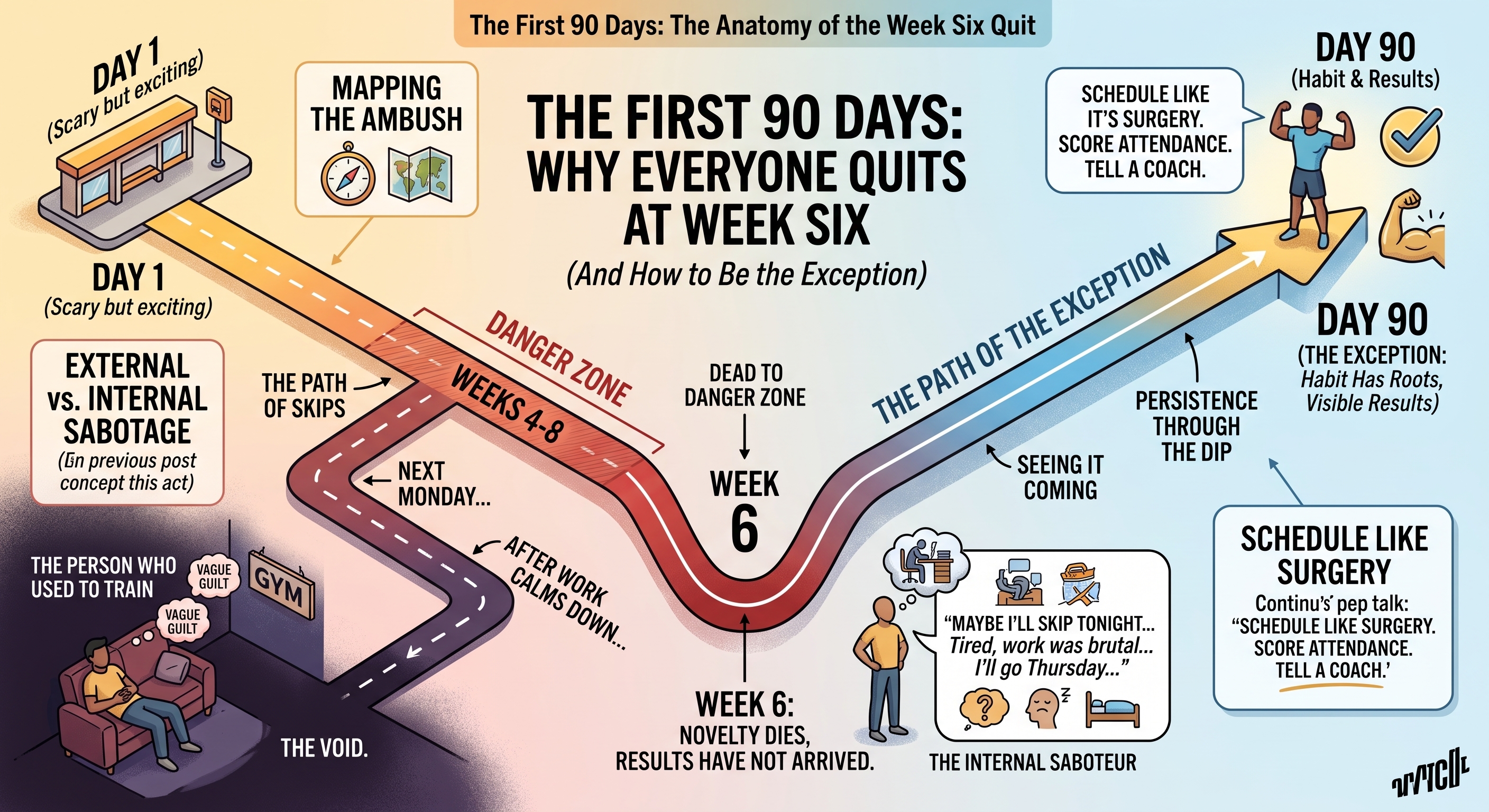
I've watched this exact sequence play out for 27 years. The timing is so consistent it's almost eerie: the danger zone lives roughly between weeks four and eight, and week six is its dead center. Not week one, when everything is scary. Not month six, when the habit has roots. Week six — after the novelty dies, before the results arrive.
Recently I wrote about the external saboteurs of your progress — the people in your life who push back when you start getting healthy. This post is about the internal one. The voice that doesn't need anyone else's help to talk you off the mat. And I'm writing it for one reason: the week-six dip is not a sign that training isn't for you. It's a documented, predictable, survivable phase that nearly everyone passes through — and the people who make it to day 90 aren't the ones who don't feel the dip. They're the ones who saw it coming.
So let's map the ambush before you walk into it.
Why Week Six, Specifically
The week-six quit isn't a character flaw. It's a collision — three separate psychological curves all hitting their worst point at the same time. Look at what's happening in each one.
Curve one: the novelty high wears off
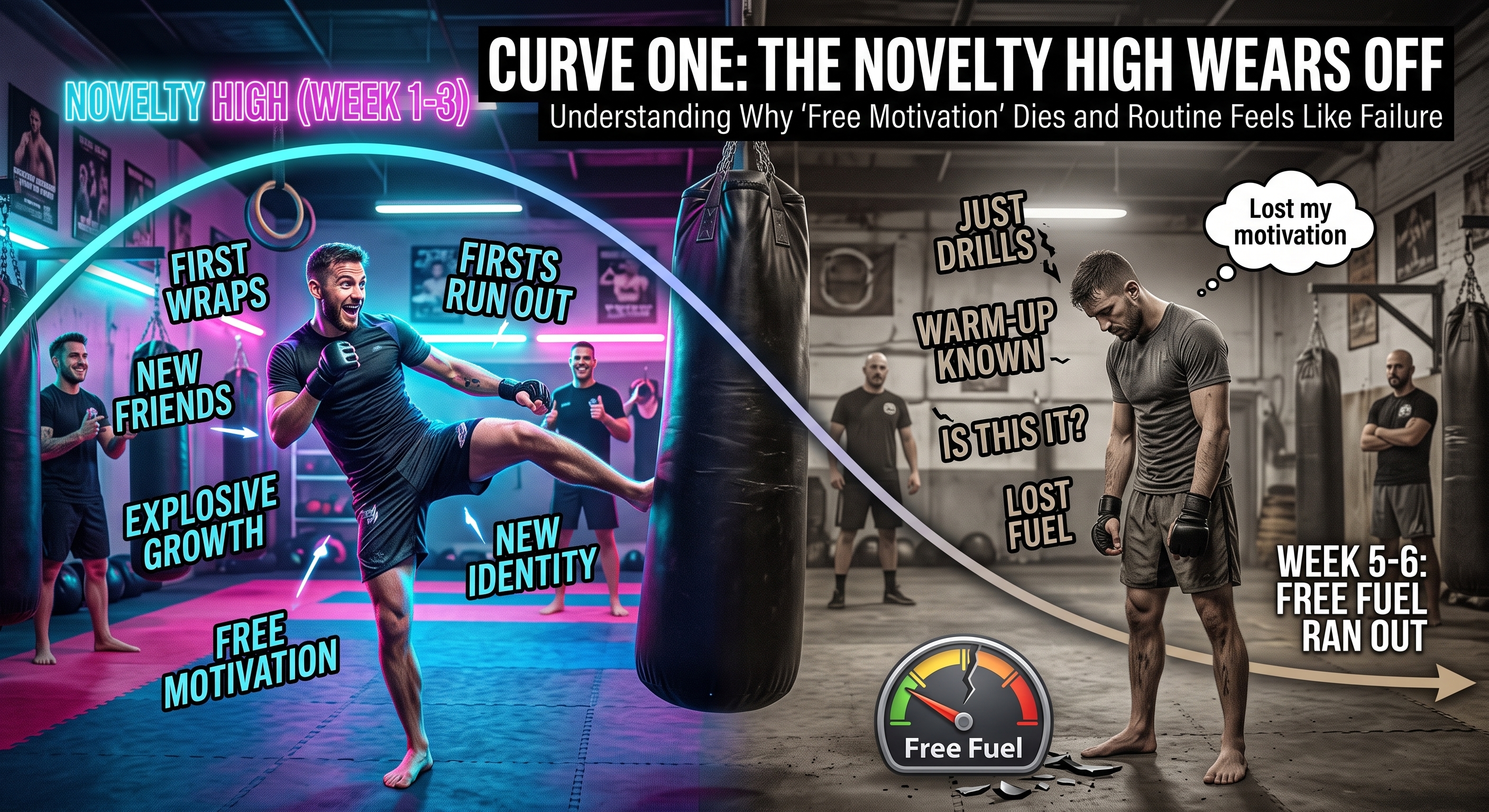
Your first few weeks of training run on the cheapest fuel there is: newness. New skills, new people, new soreness, new identity to try on. Your brain loves novelty — it hands out motivation for free when everything is unfamiliar. Week one, just learning to wrap your hands is an event. Every class delivers a first.
By week five or six, the firsts run out. You know the warm-up. You know the drills. The gym has become a place you go instead of an adventure you're on — which is actually the beginning of it becoming part of your life, but it doesn't feel like that. It feels like something is missing. And it is: the free fuel. Nobody warned you that the free fuel was always going to run out, so you interpret its absence as a problem with the gym, or worse, with you."I've lost my motivation"— as if motivation was ever going to carry you past the point where motivation always dies.
Curve two: the results haven't arrived yet
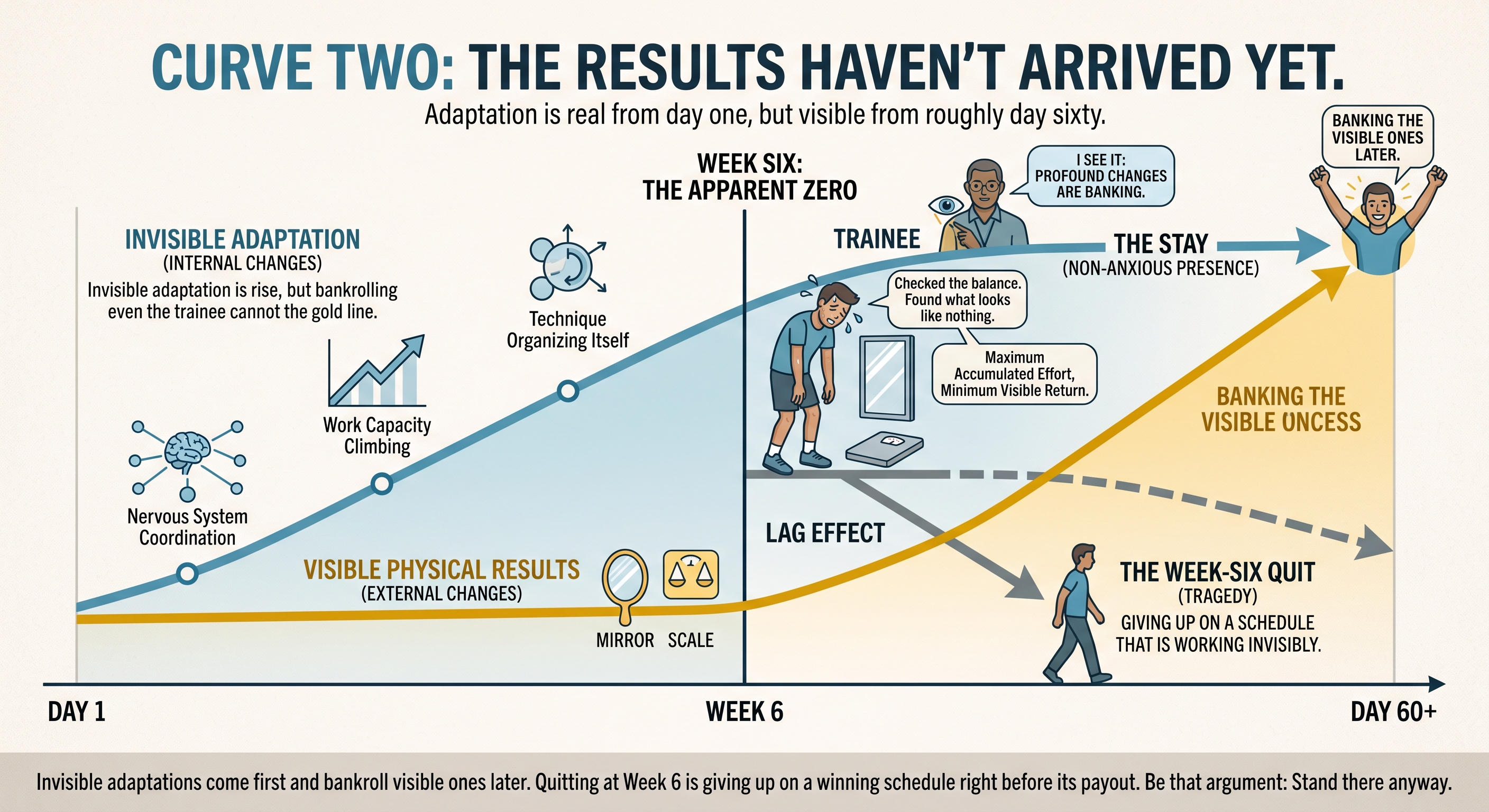
Here's the cruelest piece of timing in all of fitness: adaptation is real from day one, but visible from roughly day sixty.
By week six, your body has already made profound changes — your nervous system is coordinating movements that were impossible a month ago, your work capacity is climbing, your technique is organizing itself. I can see it from the edge of the mat, clearly. You can't. Because the changes you actually signed up for — the mirror, the scale, the clothes — run on a lag. The invisible adaptations come first and bankroll the visible ones later.
So week six delivers the worst possible ratio: maximum accumulated effort, minimum visible return. You've paid six weeks of sweat into an account, checked the balance, and found what looks like nothing. Every quitting decision I've ever watched gets made right there, staring at that apparent zero — usually about two to four weeks before the balance was going to become visible. That's the tragedy of the week-six quit: it's not that people give up on something that wasn't working. It's that they give up on something that was working, invisibly, right on schedule.
Curve three: the habit isn't load-bearing yet
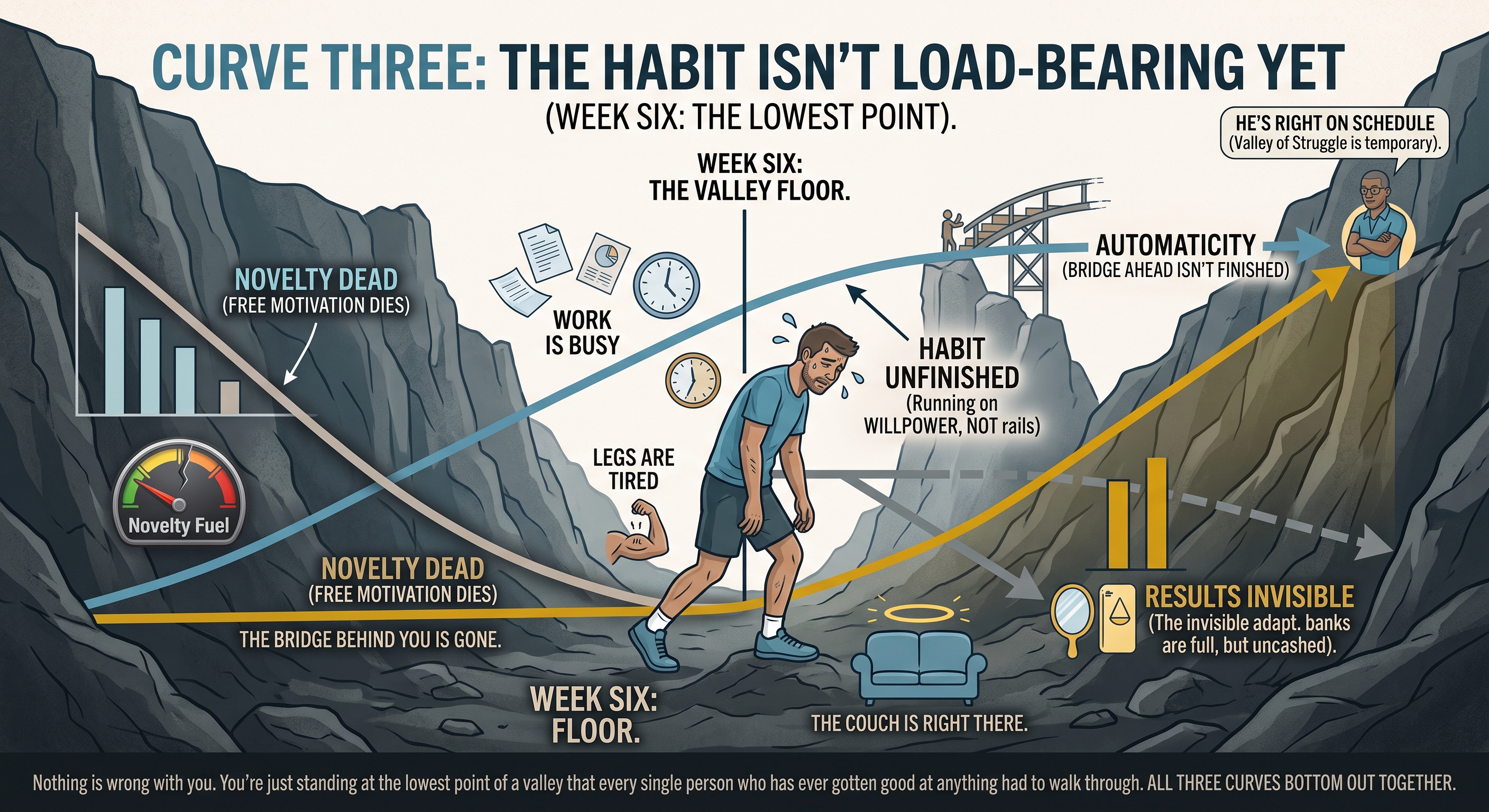
The behavioral research on habit formation keeps landing in the same territory: automaticity — the point where a behavior starts running on rails instead of on willpower — takes on average around two months to form, and often longer for effortful behavior. Which means week six sits in the worst structural spot imaginable: too late to be running on novelty, too early to be running on habit. The bridge behind you is gone, and the bridge ahead isn't finished, and the only thing holding you up in the gap is deliberate, effortful choice — on exactly the weeks when work is busy, and your legs are tired, and the couch is right there.
Novelty dead. Results invisible. Habit unfinished. All three curves bottom out together, and that's the whole anatomy of week six. Nothing is wrong with you. You're just standing at the lowest point of a valley that every single person who has ever gotten good at anything had to walk through.
Read the quitting thought again — "I'm not even sure this is working" — and notice what it actually is: a completely accurate report of your visible results, delivered at the precise moment your invisible results are about to surface. The thought isn't lying about the evidence. It's just reading the wrong account.
The Survival Map
Now the practical part. You know the ambush is coming and you know why. Here's how the people who make it through actually make it through — and after 27 years of watching day-90 people and week-six people, I can tell you the difference is never talent, fitness, or even discipline in the way most people mean it. It's five specific moves.
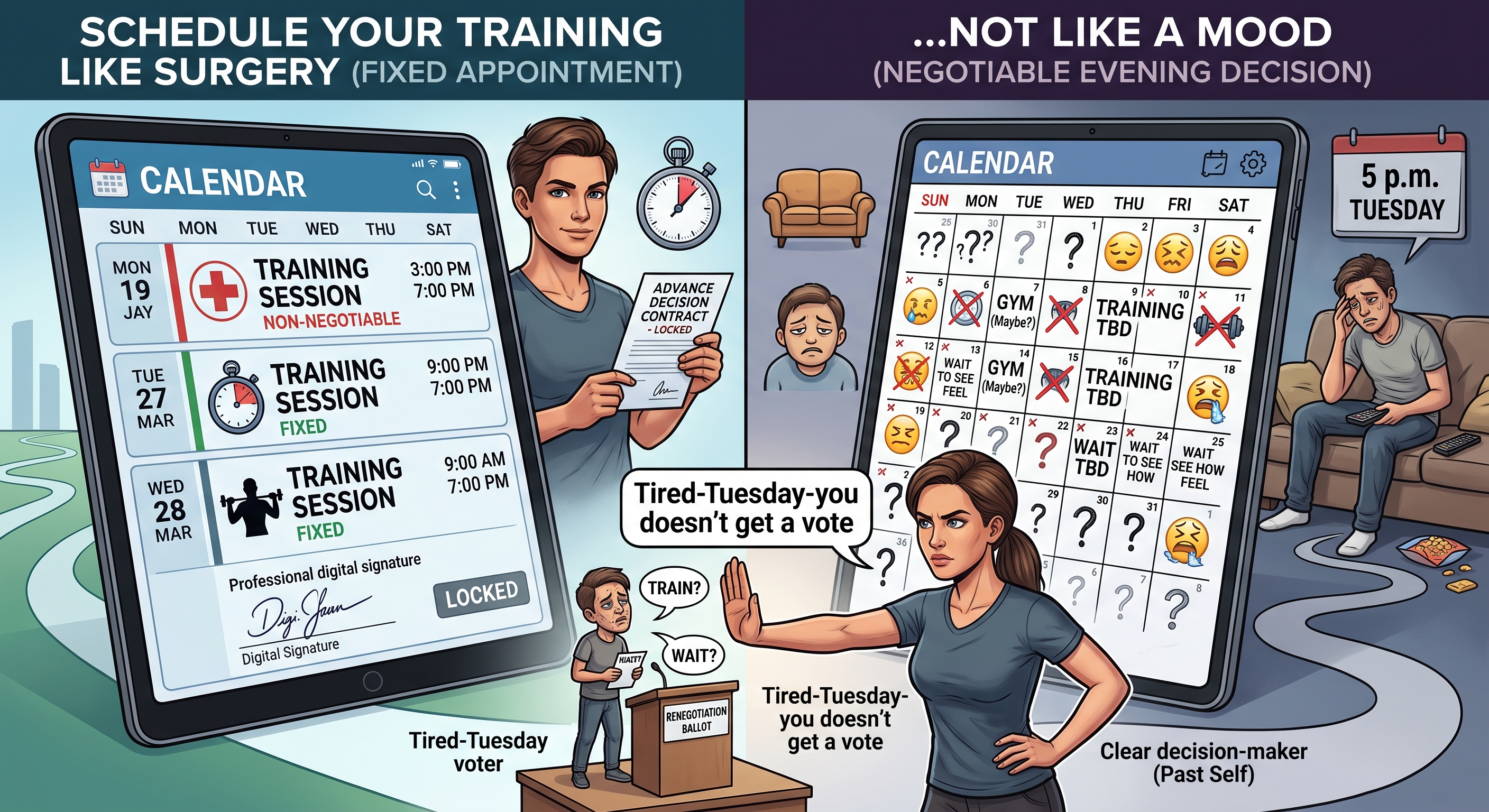
1. Schedule your training like surgery, not like a mood
The week-six quit almost always disguises itself as a scheduling decision, so take scheduling decisions off the table. Your training nights are appointments — fixed, recurring, written down, defended — not open questions your evening self gets to re-litigate at 5 p.m. based on how tired it feels. Here's the rule that saves people: the decision to train was made once, in advance, by the clearest version of you. Tired-Tuesday-you doesn't get a vote — they only get to execute. Every time you renegotiate a decision you already made, you're asking the worst-positioned version of yourself to make your best decisions. Stop holding that election.
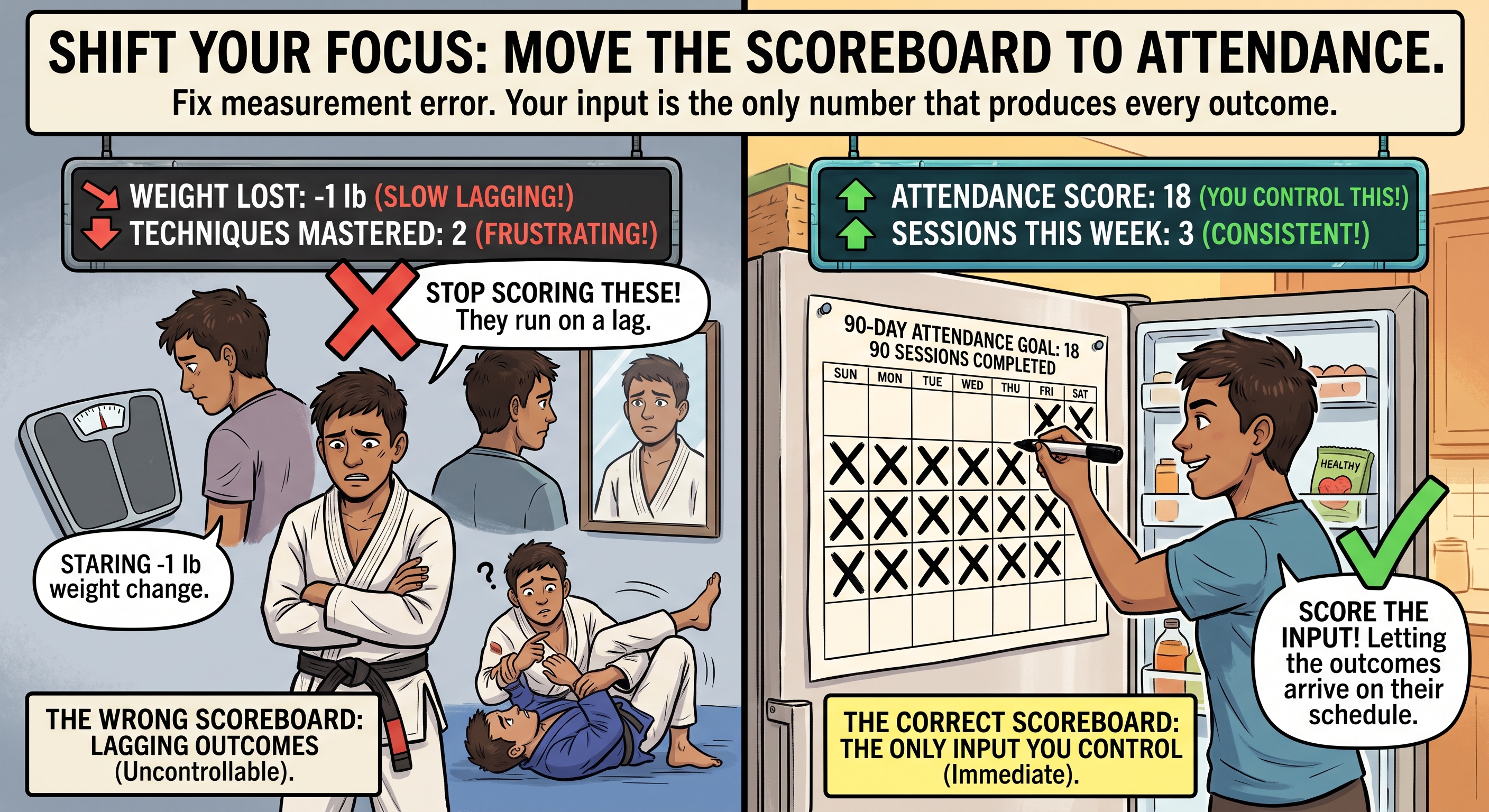
2. Move the scoreboard to the only number you control
The reason week six feels like failure is that you're scoring the wrong metric. The scale, the mirror, the skill level — those are outcomes, and outcomes run on lag. You don't control outcomes directly. You control exactly one thing: attendance.
So make attendance the entire scoreboard for your first 90 days. Not weight lost, not techniques mastered —sessions completed. Put a calendar on the fridge and mark every class. This isn't a motivational sticker trick; it's fixing a measurement error. Showing up is the one input that produces every outcome you want, on a timeline you can't rush — so score the input, and let the outcomes arrive on their own schedule. When the quitting voice says "this isn't working," a fridge that shows eighteen marks in six weeks gives you the correct answer:th e part I control is working perfectly.
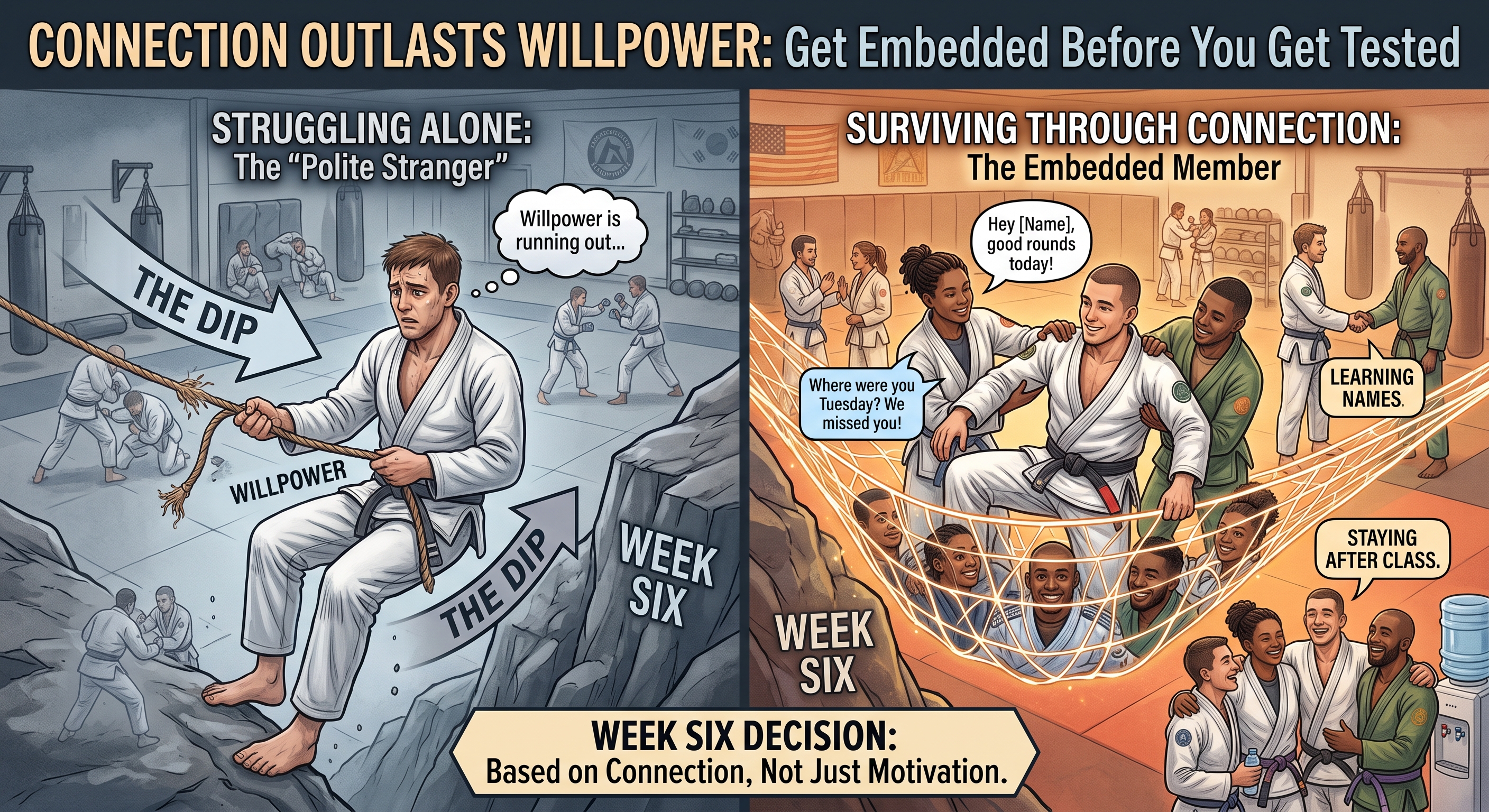
3. Get embedded before you get tested
Here's the strongest single predictor I've observed of who survives the dip, and it has nothing to do with the training itself: whether anyone at the gym would notice you were gone.
The member who knows three people's names, who has a regular pad partner, who gets a "where were you Tuesday?" text — that member survives week six at a dramatically higher rate than the equally motivated member who trained for six weeks as a polite stranger. Decades of research on what keeps people in hard things keeps confirming the same unglamorous truth: connection outlasts willpower. So treat the social side of your first month as training, not as a bonus: learn names, stay for the conversation after class, say yes to the gym events. You're not just being friendly. You're building the net that catches you in week six — before you need it.

4. Tell a coach you're in the dip
This one costs you a single sentence, and it might be the highest-leverage move on this list: when the dip arrives, say so out loud to a coach. "Hey — I've hit the wall a little. Not feeling it lately."
Two things happen. First, the dip loses its secrecy, and secret struggles are the ones that turn into quiet exits — nobody ghosts a gym where they've told the truth about how they're doing. Second, you hand me the chance to do my actual job, which is showing you the progress you can't see. Because I can see it — the footwork that organized itself, the third round you now finish, the flinch that disappeared — and week six is precisely when you need someone with a trained eye to read your invisible account balance out loud to you. Every coach here has walked people through this valley for years. Use us. That's what we're for.

What's Waiting at Day 90
Here's what makes this whole fight worth mapping: the valley has a far side, and it's closer than it looks from the bottom.
Somewhere in weeks eight through twelve, the three curves that ambushed you all turn friendly at once. The habit finishes forming — you stop deciding to go and just find yourself going. The visible results finally surface — the clothes, the mirror, the compliment from someone who hasn't seen you in a while. And a different kind of novelty comes back: not the cheap newness of week one, but the deep interest of someone skilled enough to see how much there is to learn. Day-90 people almost universally report the same strange thing: the thing I almost quit is now the thing I'd protect above nearly everything else in my week.
And they carry something else forward, something bigger than fitness: they now havelived proofthat the wall isn't the end of the road — that "I don't feel it anymore" is a phase to be walked through and not a verdict to be obeyed. That proof transfers to everything. The career, the marriage, the faith, the next hard thing. People who have survived one week six stop being afraid of all the others.
So here's the whole post in three sentences. Around week six, a reasonable-sounding voice will invite you to leave, at the exact moment your invisible progress is about to become visible. That voice is not wisdom — it's a predictable dip that 27 years of coaching says almost everyone feels and anyone can outlast. Schedule like it's surgery, score your attendance, get embedded, tell a coach, and answer the identity question once — and 90 days from now you'll be the person giving the week-six pep talk to somebody else on the edge of the mat.
We'll see you Tuesday. Especially the Tuesday you don't feel like it — especially that one.
Knoxville Martial Arts Academy has spent 27 years walking beginners through the week-six valley and out the other side — in the largest and most successful MMA facility in Tennessee. If you're in the dip right now, tell a coach tonight. That one sentence has saved more training careers than any technique we've ever taught.
