
The Self Defense Advice...
The KMAA Chronicles
The Self-Defense Advice
Women Get Is Mostly Garbage
Before I say a single critical word, let me tell you what this post is not.
It is not a criticism of any woman who has ever bought the keychain weapon, taken the one-day seminar, or memorized the "go for the eyes" advice. If that's you, you did the responsible thing with the options the market handed you. You identified a real concern, you took action on it, and you spent your money and your Saturday trying to make yourself safer. The failure in this story is not yours.
The failure belongs to an industry — and it is an industry — that has spent decades selling women safety-shaped products instead of safety. The cat-ear keychains. The pepper spray nobody's ever practiced drawing. The two-hour corporate seminar with the foam-padded "attacker." The social media reels promising that this one wrist-release will work on a man twice your size. The entire economy of it runs on a single quiet assumption: that women will buy the feeling of safety and never have to test whether the product delivers the reality of it.
I've spent 27 years coaching fighters, over a decade doing clinical counseling work — which means I've sat with people on the worst day of their lives and the long aftermath of it — and I've watched hundreds of women walk into our gym carrying some version of the garbage advice. So I'm going to say the quiet part plainly, and then I'm going to spend the rest of this post earning it:
Most of the self-defense advice women receive is not just useless. It's worse than useless, because it sells confidence without capability — and confidence without capability is a liability dressed up as a plan.
Here's the respectful, honest, adult version of this conversation. The one the seminar never gives you.
Start With the Truth Nobody Wants to Say Out Loud
Every honest conversation about women's self-defense has to start with a biological fact that the gimmick industry is financially motivated to skip, because it's bad for sales:
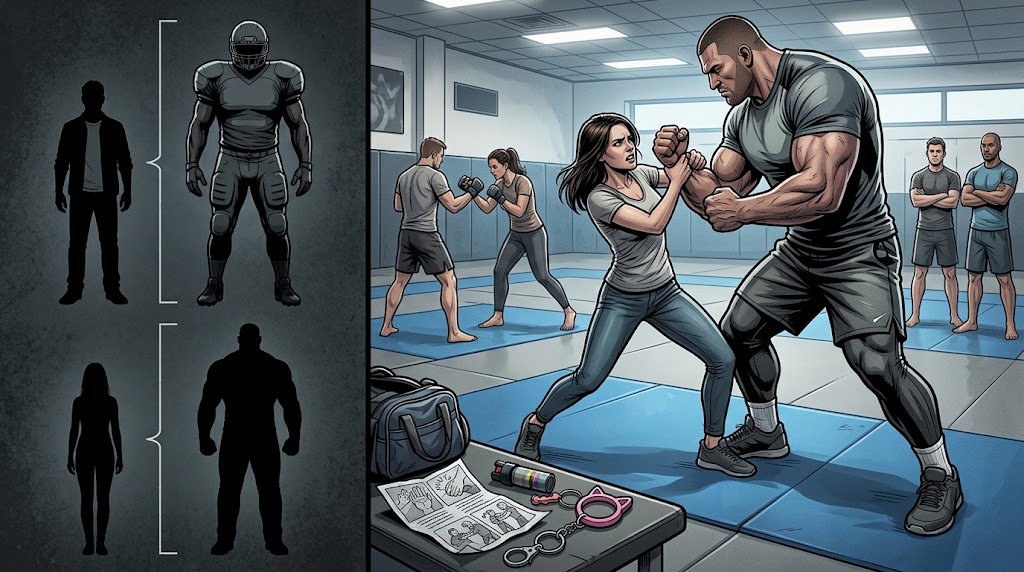
Human beings are sexually dimorphic. Men are, on average, substantially bigger and stronger than women — and the gap is much larger than most people think.
This isn't a social claim or a cultural one; it's measured, repeatedly, in the exercise-science literature. The average man carries dramatically more upper-body muscle mass than the average woman. Grip-strength studies — one of the cleanest proxies for functional fighting strength, because grabbing, holding, and controlling run through the hands — have found that the overwhelming majority of women fall below nearly all men, and that even highly trained female athletes often test at or below the level of untrained men. Studies of punching force have measured the average man generating far more power than the average woman — not twenty percent more, multiples more.
I've heard the gap put this way, and while I can't verify the exact math, it captures the honest scale of the problem better than any statistic: the strength difference between the average woman and the average man is comparable to the difference between the average man and a Division 1 linebacker.Sit with that for a second. If you're a man reading this, imagine building your personal safety plan around the assumption that your attacker will be a 250-pound college linebacker — and then imagine someone selling you a keychain for that problem.
Now, here's what that fact is not. It is not a reason for despair, and it is absolutely not the gimmick industry's conclusion of "so just comply." It's the design constraint. It tells you what a real solution has to accomplish. And it immediately exposes the garbage advice for what it is, because every piece of it fails the same test:
"Go for the eyes/groin / throat" assumes you can land a precise strike, under the worst adrenaline dump of your life, against a resisting, moving, stronger person — a skill that takes trained fighters years to develop against people their own size.
The keychain weapon assumes you'll have it in hand, deploy it under ambush conditions, and that a scratch will stop someone the strength gap says can absorb it and keep coming. A tool you've never trained to access under pressure isn't a weapon. It's jewelry.
The one-day seminar assumes the most important physical skills of your life can be installed in an afternoon — when we know, from a century of motor-learning research, that skills rehearsed a handful of times against a cooperative partner evaporate almost completely under real stress. You don't rise to the occasion. You fall to your training, and four hours of choreography rounds down to zero.
Here's the one-sentence test for any self-defense product or program: does it acknowledge the strength gap and answer it with a mechanism — or does it quietly pretend the gap doesn't exist? Everything the industry sells to women fails that test. Which raises the only question that matters: what actually answers it?
The Only Thing That Actually Evens the Playing Field
There is exactly one thing I have seen, in 27 years, that genuinely moves the odds for a smaller, weaker person against a bigger, stronger one. It isn't a product, it isn't a technique, and it cannot be purchased in an afternoon:
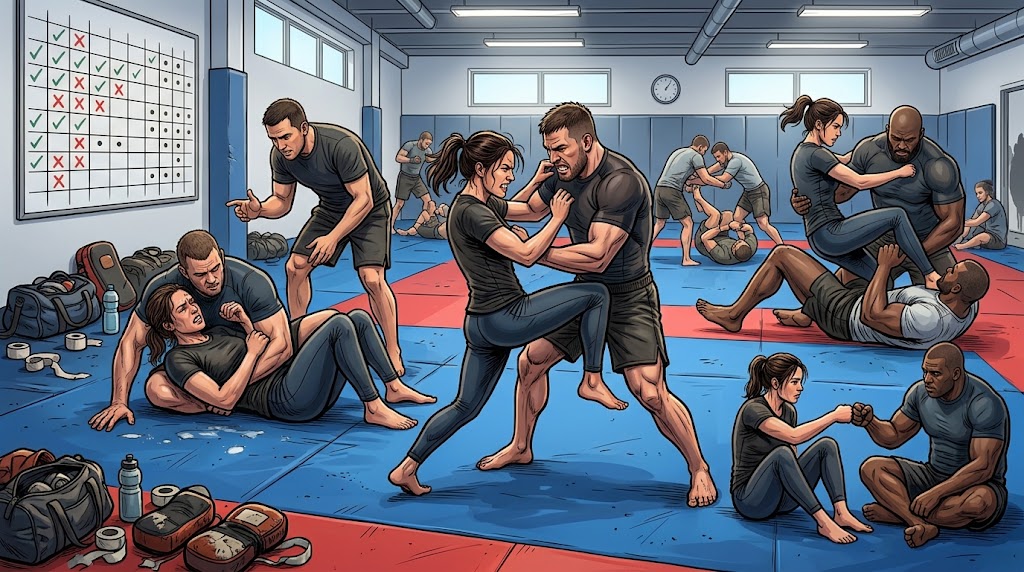
Consistent training, under live resistance, over time.
Every word in that sentence is load-bearing, so let me unpack the two that the gimmick industry hopes you never think about.
"Live resistance" is the dividing line between everything that works and everything that doesn't. A choreographed move — practiced on a partner who attacks on cue, from the agreed angle, and lets the defense succeed — teaches your body a lie. It teaches you what the defense feels like when it'sallowed to work. Training against live resistance — a partner who is actually trying to hold you down, actually resisting your escape, actually countering what you do — teaches your body the truth, and it does something no seminar can: it lets you fail safely, hundreds of times, and adjust. The woman who has spent a year getting held down by training partners and working her escapes against full resistance isn't guessing whether her skills work on a bigger person. She has tested them against bigger people three nights a week. Her confidence isn't purchased. It'searned evidence.
"Over time" is the other one. Under a real adrenaline dump — tunnel vision, time distortion, fine motor skills gone — the only skills available to you are the ones drilled so deep they run without thinking. There is no shortcut to that depth. It's built the same way in every human who's ever built it: repetition, against resistance, across months and years. This is exactly why the seminar model is structurally fraudulent even when the instructor means well — not because the techniques shown are wrong, but because showing a technique andinstallingone are different things, and only one of them fits in a Saturday.
Training doesn't erase the dimorphism — nothing erases it, and anyone who tells you otherwise is selling something. What training does is stack every learnable advantage on your side of a scale that biology tilted against you: technique, leverage, timing, composure under adrenaline, and the thousands of repetitions your attacker almost certainly doesn't have. That's what "evening the playing field" honestly means. Not a magic equalizer. A long, deliberate transfer of every available advantage to you.
Train for the Fear You Actually Have
Now the part almost nobody in this industry says, and it might be the most practically useful paragraph in this post.
Not all self-defense training answers the same threat — so the right question isn't "what's the best martial art for women?" It's:what scenario are you actually afraid of? Because you should train, specifically and deliberately, for that one.
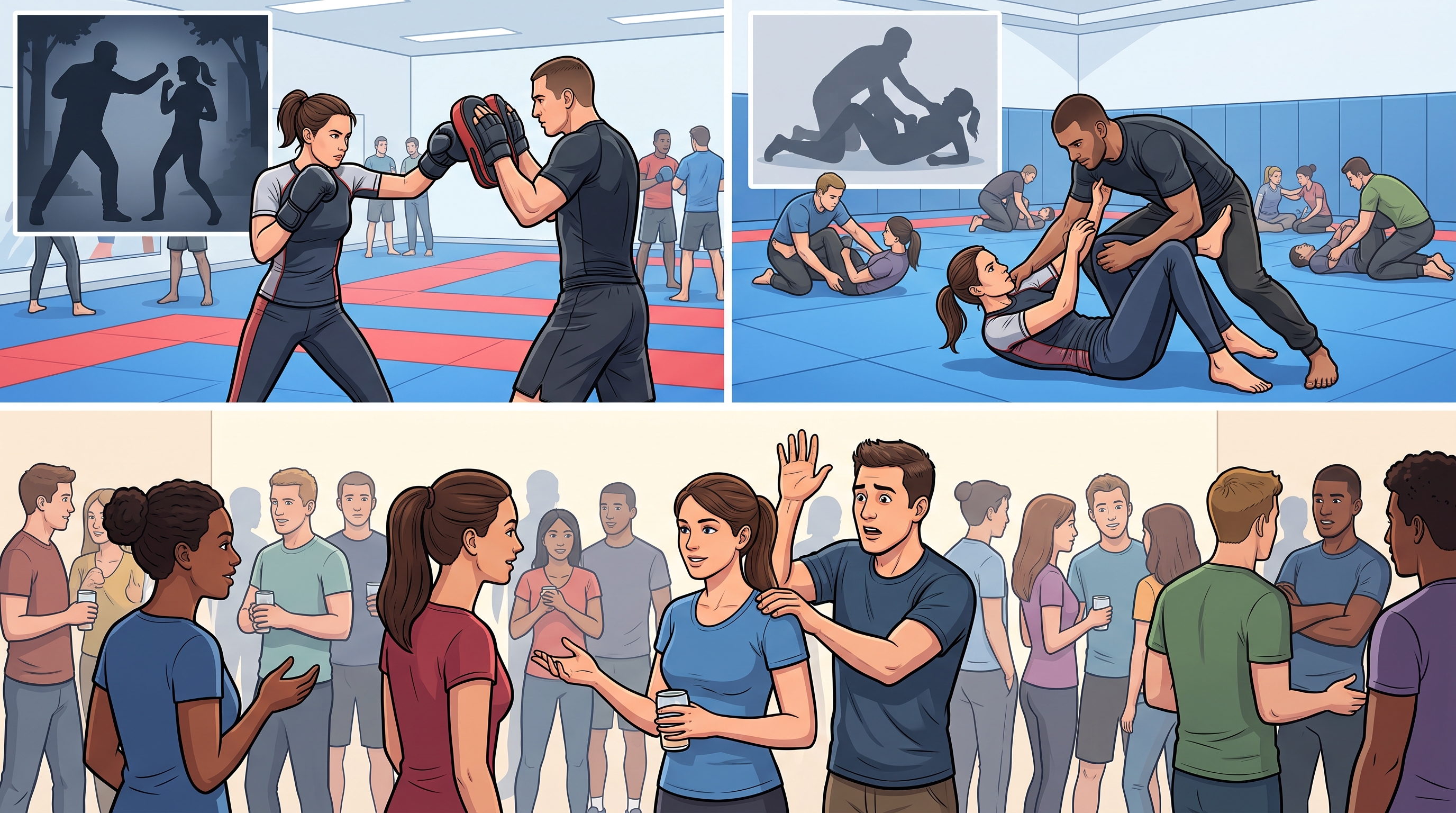
If what keeps you up at night is a stand-up confrontation — being cornered, being swung on, needing to hurt someone and create distance and get out — then train the arts built on exactly that: kickboxing and Muay Thai, where you'll learn to strike with real power, manage distance, and stay composed while someone is trying to hit you. If a kickboxing bout is the fight you fear, train kickboxing.
But be honest about this: for most women, that isn't the fear. The fear — and the statistical reality of how violence against women actually happens, overwhelmingly at close range, overwhelmingly by someone attempting to grab, control, and pin — is being held down by someone stronger, and harmed.Sexually or otherwise.
If that's the fear, then the training has to contain the fear. You should train in an art where, within the safe and controlled limits of sport, training partners genuinely attempt to grab you, hold you down, and control you — and you learn, against full resistance, to escape, to defend, to reverse, and to win from underneath. That art is grappling. That art is BJJ.
This is why, after 27 years of watching women train everything we offer, I'll say it plainly: grappling tends to produce the most relevant self-defense capability for women— because it's the only training on earth where the nightmare scenario gets rehearsed, safely, hundreds of times, until it stops being a nightmare and becomes a position. A position with names, escapes, and answers your body knows in the dark. There is no version of the keychain that does that. No seminar does that. Only the mat does that.
And the capability doesn't only live in the catastrophic scenarios. It lives in the everyday gray zone, too. Picture something far more common than an assault: a group photo at an event, and a scumbag's hand drifts somewhere it has no business being. A woman with grappling training doesn't have to choose between freezing and making a scene. She digs an underhook — nonchalantly, a movement her body has done ten thousand times — and jacks his arm up and away, and the photo gets taken, and nobody's the wiser. She handled it with her body, on reflex, from a library of control skills the moment never knew she had. (And to be clear: handle the moment, then have the conversation. He doesn't get a pass because the underhook was smooth. The skill buys you control of the moment; it doesn't retire his accountability.)
That's what trained capability actually looks like in a woman's real life. Not a flying armbar in a parking garage. A hundred small moments of physical self-possession — and underneath them, the quiet, tested knowledge that if the worst moment ever comes, her body has been there before and knows the way out.
What to Walk Away From, What to Walk Toward
Let me make this as practical as I can.
Be skeptical of:
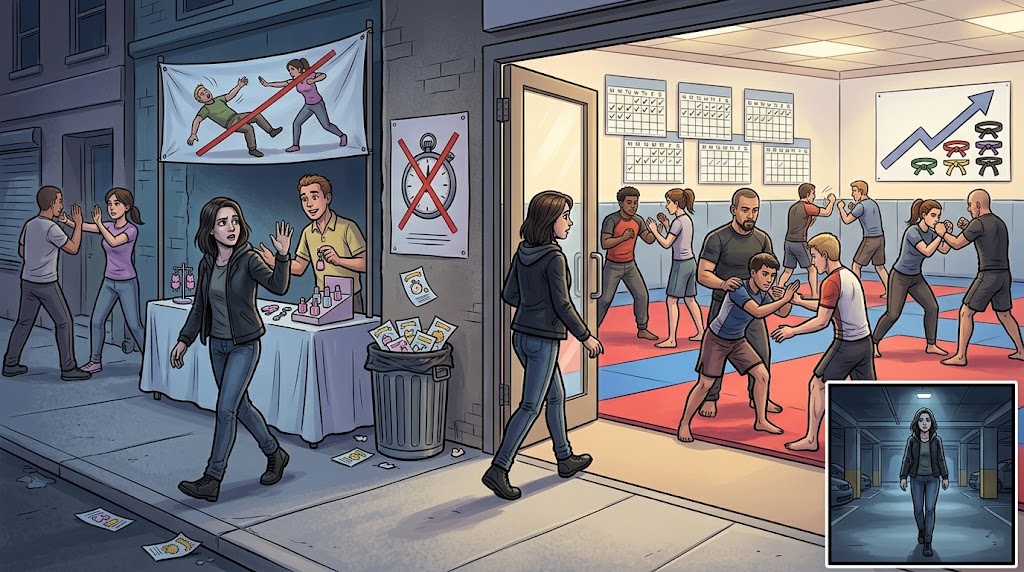
Any program measured in hours instead of months. Skills that matter are installed, not shown.
Any technique demonstrated only on a cooperative partner. If you never see it work against someone genuinely resisting, you have no evidence it does.
Any product sold on fear with no training requirement attached. A tool you haven't trained to deploy under stress is a purchase, not a plan.
Anyone who promises that size and strength don't matter. They matter enormously — that's the entire reason training has to be real.
Walk toward:
A gym where women train the full curriculum against full resistance — not a pink-gloves cardio corner, and not a "women's self-defense" side program that's really the seminar in weekly installments.
Grappling, if being grabbed, controlled, or pinned is the fear. Striking, if the stand-up confrontation is the fear. Both, over time, ideally — but start with the one that answers the scenario in your head.
A room with a real safety culture, where intensity is coached, partners are matched deliberately, and your "stop" stops everything, every time. (We've written at length about how to evaluate that in any gym, including ours.)
Time. Months, then years. Not because the industry's timeline is slow, but because your nervous system's timeline is non-negotiable — and because every month on the mat is compounding an asset no one can take from you.
One more thing, because the counselor in me won't let me end without it. Nothing in this post — not one word — implies that a woman who is attacked and couldn't fight off her attacker failed, trained or untrained. The responsibility for violence belongs to the person who commits it, entirely, every time. Training is not a moral obligation, and surviving however you survived is not a performance to be graded. What training is, is an option— the one option this industry keeps papering over with merchandise — to spend time now building capabilities that tilt a tilted field back toward you. You deserve the honest version of that option. That's all this post is.
The keychain costs fifteen dollars and asks nothing of you. The mat costs months and asks plenty. One of them is a transaction, and one of them is a transformation — and only one of them is still with you, installed in your body, at two a.m. in a parking garage, in a crowded photo, for the rest of your life.
Come try the real thing. The first class is the hardest part, and we've built an entire gym culture around making it not be.
Knoxville Martial Arts Academy has spent 27 years training women in Muay Thai, kickboxing, BJJ, and MMA — full curriculum, full resistance, real capability — in the largest and most successful MMA facility in Tennessee. Come watch a class. Ask the women on our mats what they'd tell you about the seminar they took before they found KMAA.
