What Your Coach Sees in Your First 30 Seconds on the Mat
What Your Coach Sees in Your
First 30 Seconds on the Mat
Let me tell you what you think I'm looking at.
You think I'm looking at your body. Whether you're in shape. Whether you're carrying weight. Whether you look like you belong in a fight gym or look like someone who wandered in from the parking lot on a dare. You've been rehearsing this moment in your head for weeks — maybe years — and in every rehearsal, a coach is standing at the edge of the mat with his arms crossed, sizing you up, and quietly filing you under not one of us.
It sounds like that fear is a big part of why you haven't walked in yet. And it sounds like even if you have walked in, that fear is standing next to you your entire first class, narrating.
So let me do something coaches almost never do: let me show you exactly what's actually happening behind my eyes in your first 30 seconds on my mat. All of it. Because after 27 years of standing at the edge of that mat, I can tell you the truth about what a real coach reads in a beginner — and I can promise you that your fitness, your weight, and your athletic talent are not on the list. Not at the bottom of the list.Not on it.
What I'm actually reading is far more interesting. And once you know what it is, I think that fear loses most of its teeth — because you'll realize the test you're terrified of failing isn't the test being given.
The Mat Tells the Truth
First, you need to understand the tool I'm using, because it's not my eyes exactly. It's the mat itself.
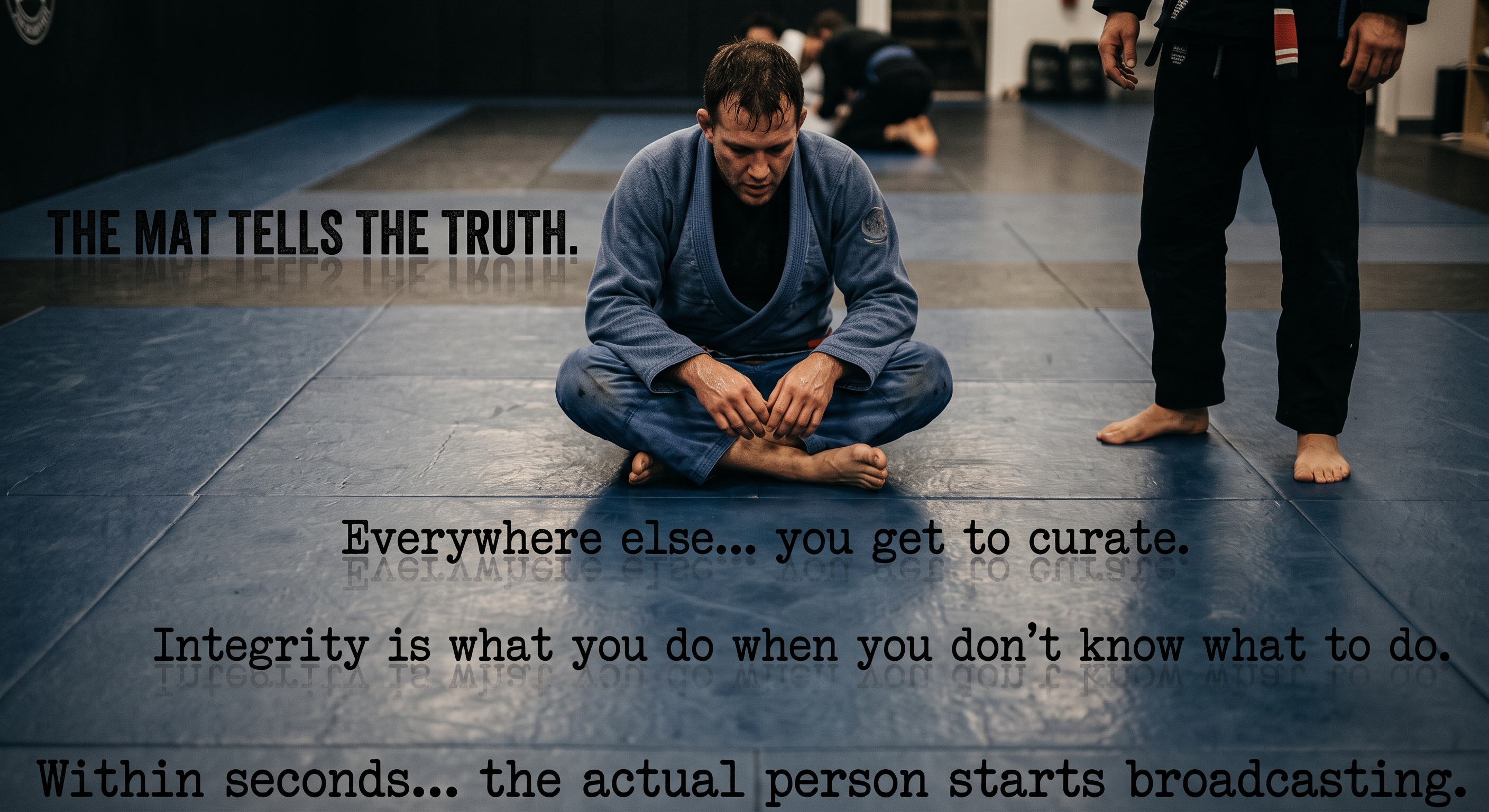
I say this constantly, to coaches, to counseling clients, to anyone who'll listen, because 27 years have made it the closest thing I have to a professional creed: the mat tells the truth.
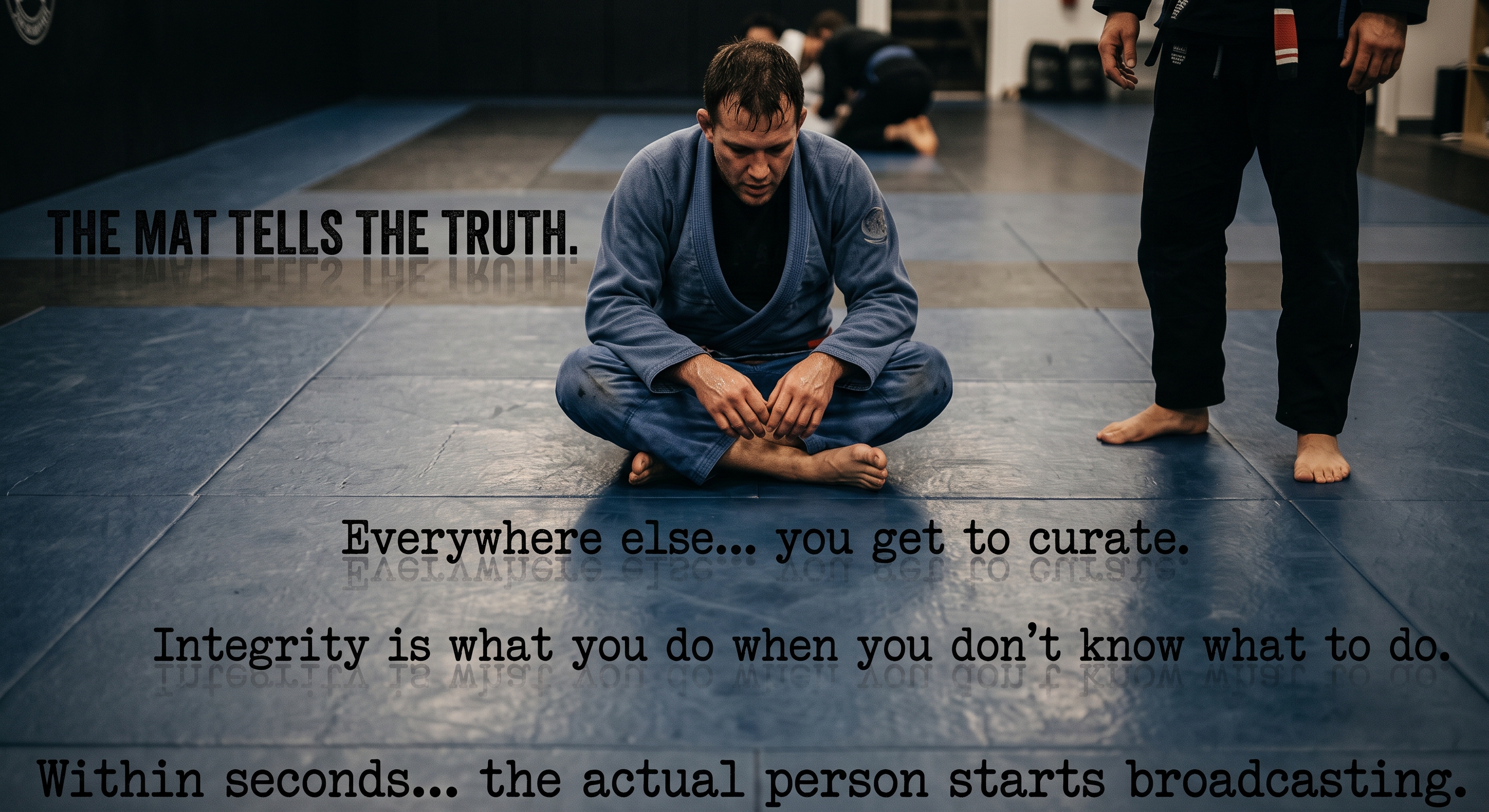
Everywhere else in your life, you get to curate. You choose the angle, the outfit, the words, the version of yourself that goes out the door. Modern life is a performance with excellent production values, and we're all quite good at it. But the mat strips production value. There's nowhere to stand that isn't visible, nothing to hide behind, no script that survives contact with fatigue and unfamiliarity. Within seconds— not minutes, seconds— the curated self thins out, and the actual person starts broadcasting.
Pair that with the other line I've built a career on: integrity is what you do when you don't know what to do. That's the whole diagnostic, right there. Anyone can execute their prepared self in prepared situations. But a first class is, by design, a long chain of moments where you don't know what to do— new movements, new rules, new people, new sensations. And what a person does in those exact moments, before they've had time to compose an answer, is the truest data about them that exists.
What you do and what you don't do. How you act and how you don't act. What you say and what you don't say. On the mat, all of it is signal. It's the closest thing I've found to a crystal ball that sees straight into who someone actually is — and in 27 years of reading it, I've rarely, if ever, been wrong.
So yes: you're right that you're being read. Your instincts weren't lying to you about that. You were just wrong aboutwhat's being read. So let me open the book.
What I'm Actually Reading
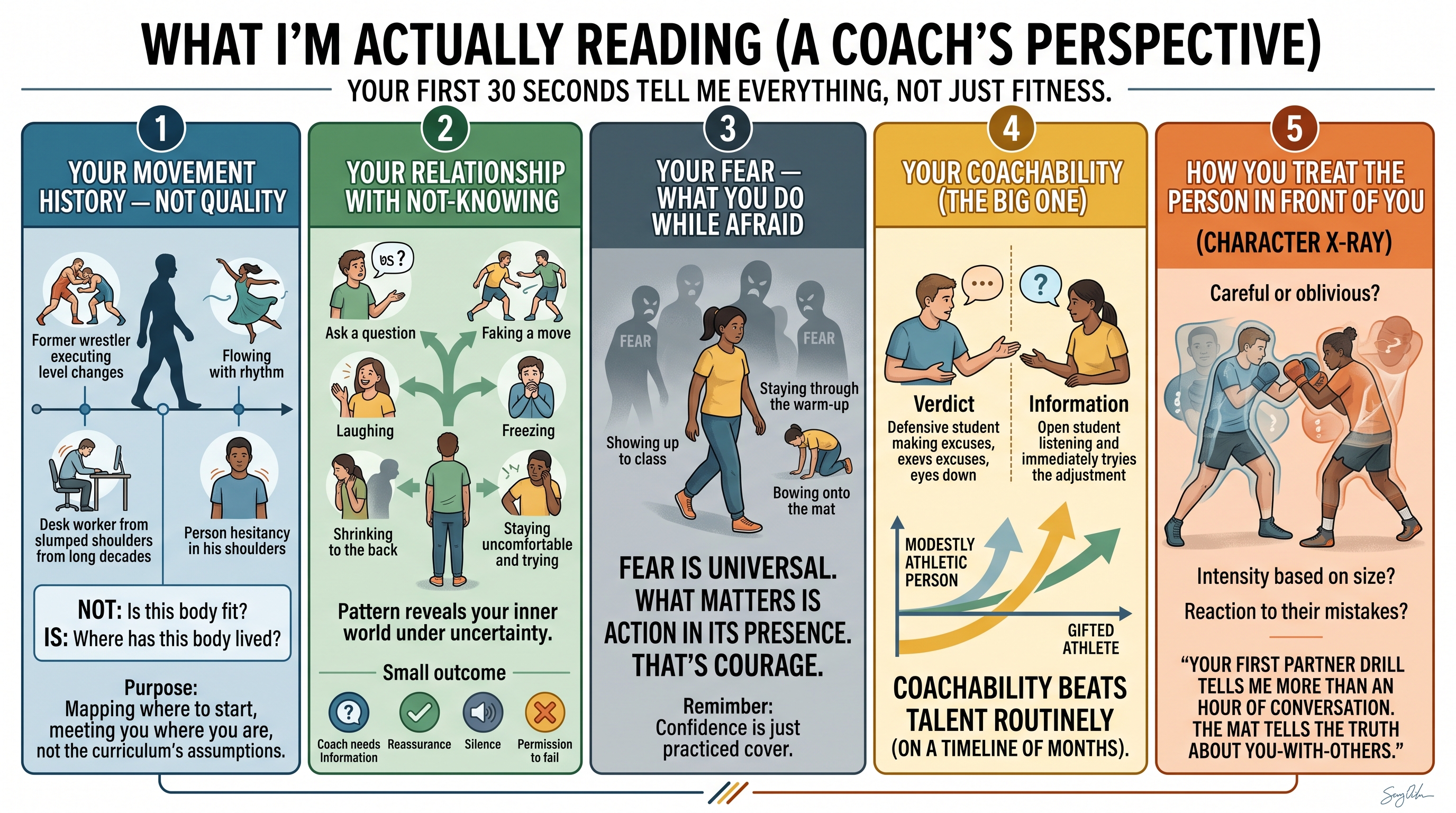
1. Your movement history — not your movement quality.
In your first 30 seconds, your body tells me its autobiography. Not whether it's fit — whether it'slived somewhere. The former wrestler shows me level changes he doesn't know he's doing. The dancer shows me rhythm and spatial awareness. The desk worker shows me exactly which decade the desk arrived. The person who was told their whole life they were unathletic shows me hesitancy that lives in the shoulders before it lives anywhere else.
None of this is grading. It'smapping. I'm not asking "is this body good?" I'm asking "where has this body been, and therefore where do we start?" A coach who reads your movement history correctly can meet you exactly where you are on day one instead of where the curriculum assumes you are. That read, in the first half minute, is the difference between a first class that builds you and a first class that buries you.
2. Your relationship with not-knowing.
Here's where "integrity is what you do when you don't know what to do" goes to work — because a first class hands you not-knowing on a conveyor belt, and I'm watching what you do with each one as it arrives.
When the movement doesn't make sense, do you ask, or do you fake it and hope? When you get it wrong in front of people, do you laugh, freeze, apologize, spiral, or reset and go again? When everyone else seems to get it, and you don't, do you shrink toward the back of the room, or do you stay in the uncomfortable spot and keep swinging? There's no correct answer on that list, by the way — I've coached champions from every one of those starting points. But the pattern tells me precisely what your inner world does under uncertainty, and that tells me how to coach you: who needs more information, who needs more reassurance, who needs more silence, who needs permission to be bad at something for the first time in twenty years.
3. Your fear — and more importantly, what you do while afraid.
Every beginner is afraid. Every single one, in 27 years, no exceptions — the confident-looking ones have just practiced their cover more. So fear itself tells me nothing. What tells me everything is the second layer: what you do while the fear is happening. You showed up afraid. You stayed afraid. You bowed onto the mat afraid. Do you understand what that pattern is? That's courage — the literal definition of it, action in the presence of fear rather than the absence of it — and you demonstrated it before the warm-up ended, while privately believing you were failing some fitness inspection that was never occurring.
4. Your coachability.
This is the big one. If I could only keep a single read from the first 30 seconds, it's this: when I offer you a correction, what happens? Do you hear it as information or as verdict? Do you try the adjustment immediately, even badly, or do you defend what you were doing? Do your eyes come up to learn or drop to absorb a blow?
Because here's what nearly three decades of developing everyone from day-one beginners to world-class professionals has taught me about talent: coachability beats it. Not occasionally — routinely. The modestly athletic person who metabolizes correction will pass the gifted athlete who can't, every time, on a timeline of months. So when I watch how you take your first correction, I'm not evaluating your ceiling as a fighter. I'm reading the single strongest predictor of your entire trajectory — and it's a trait that has absolutely nothing to do with the body you walked in with.
5. How you treat the person in front of you.
The mat doesn't only tell the truth about you-under-pressure. It tells the truth about you-with-others. Your first partner drill is a character x-ray: are you careful with your partner or oblivious to them? When you're paired with someone smaller, older, newer — what does your intensity do? When they make a mistake, what does your face do? I've watched thirty seconds of pad-holding tell me more about how a man treats people than an hour of conversation with him ever could — what he does and what he doesn't do, what he says and what he doesn't say, when he thinks nobody's grading it. That's exactly when I'm reading closest.
Notice What's Not on the List
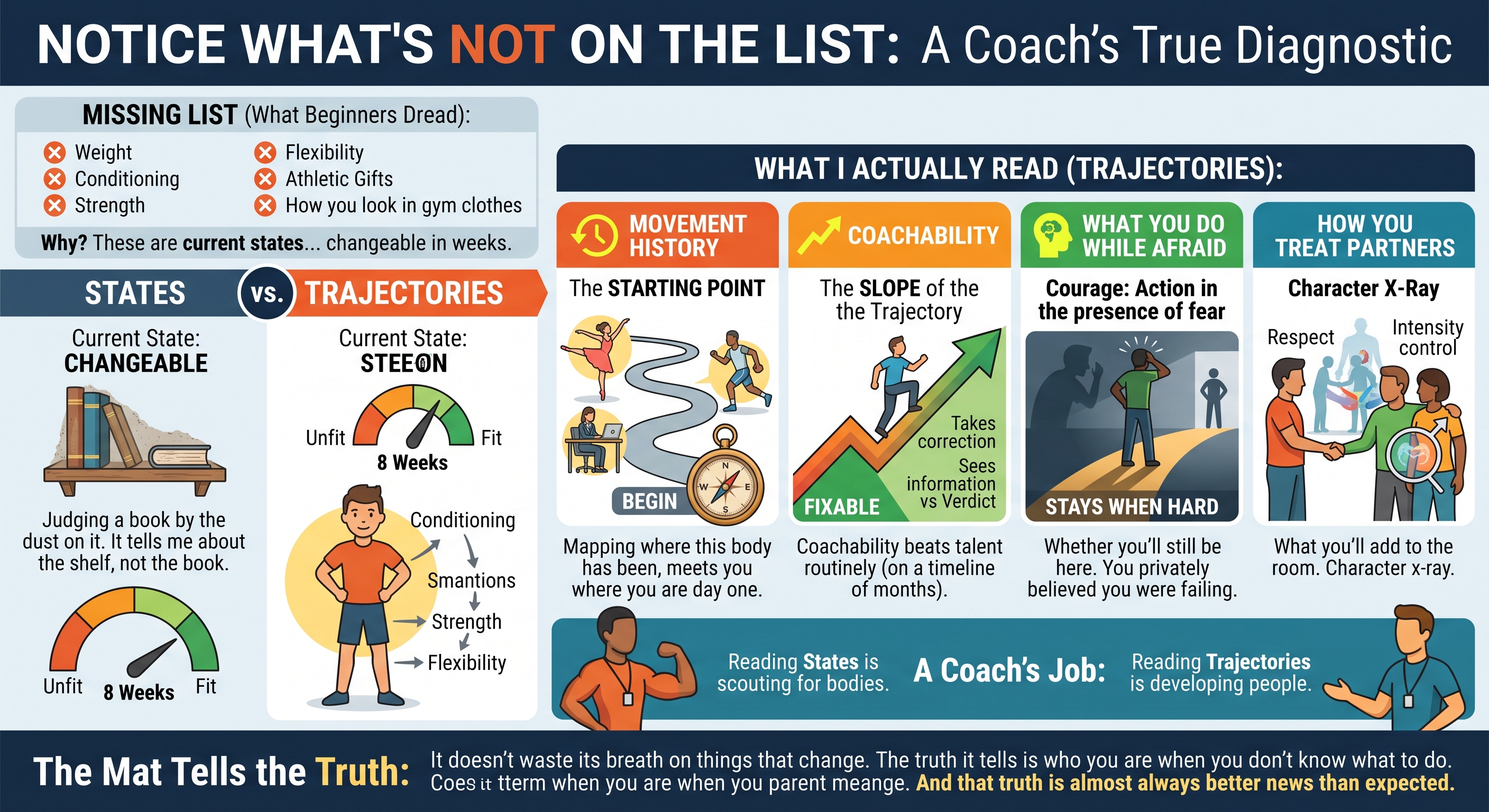
Read those five again and notice what never appeared: your weight, your conditioning, your strength, your flexibility, your athletic gifts, how you look in gym clothes.
It's not because I'm being polite. It's because those things are useless to me as reads — and here's the math on why. Everything on that missing list is a current state, and current states are the most changeable things about you. Conditioning transforms in eight weeks of showing up. Strength, technique, flexibility — all of it moves, predictably, with training. Reading a beginner's fitness is like judging a book by the dust on it. It tells me about the shelf, not the book.
But the five things I do read? Those are trajectories. Movement history tells me the starting point. Coachability tells me the slope. What you do while afraid tells me whether you'll still be here when it gets hard. How you treat a partner tells me what you'll add to my room. A coach who reads states is scouting for bodies. A coach who reads trajectories is developing people. And the entire reason the fitness inspection you're dreading doesn't happen is that it would tell me nothing worth knowing.
The mat tells the truth — but here's what beginners get wrong about that sentence. They think the truth it tells is "you're out of shape." The mat doesn't waste its breath on things that change in eight weeks. The truth it tells is about who you are when you don't know what to do. And that truth, in my experience, is almost always better news than the person expected.
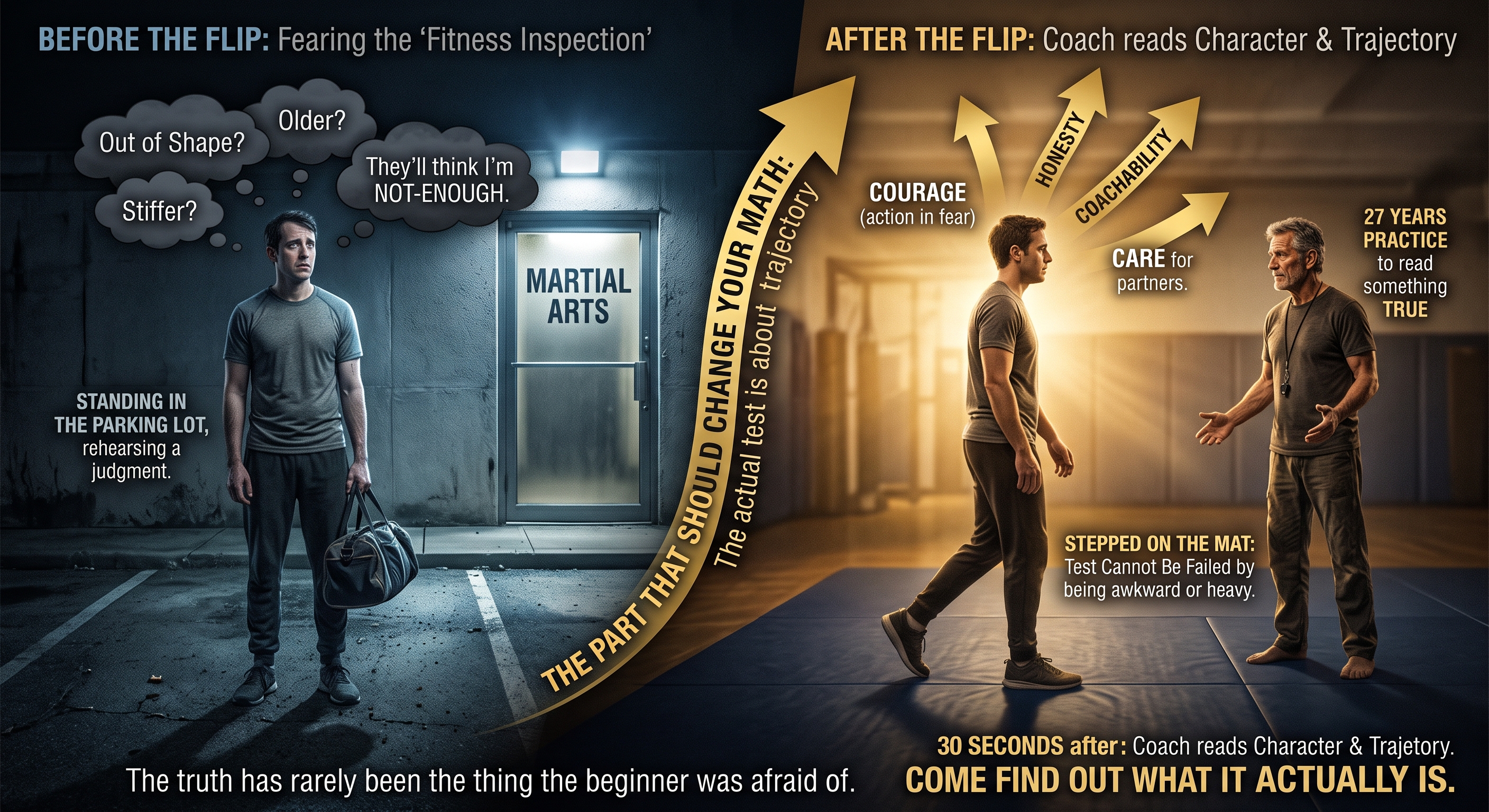
The Part That Should Change Your Math
Now flip this whole thing around, because there's a conclusion hiding in it that most beginners never reach.
If everything a real coach reads in your first 30 seconds is about character and trajectory rather than fitness and talent — then the test you've been afraid of failing cannot be failed by being out of shape. It can't be failed by being older, heavier, stiffer, or more awkward than everyone else in the room. The only way to fail the actual test is to never take it — to keep standing in the parking lot of this decision, rehearsing a judgment that was never going to happen.
And one more thing, from the counselor's chair rather than the coach's: that voice telling you a room full of strangers will immediately see you as not-enough — how long has that voice been narrating? Because I'd gently bet it didn't start with martial arts, and I'd bet the mat isn't the only room it's kept you out of. Here's what I can offer you against it: a room where the man reading you has 27 years of practice, has rarely, if ever, been wrong, and is reading for courage, honesty, coachability, and care. Thirty seconds after you step on my mat, I will know something true about you.
In 27 years, the truth has rarely been the thing the beginner was afraid of. Come find out what it actually is.
Knox Martial Arts Academy has spent 27 years reading first steps on the mat — and building everyone from terrified day-one beginners to world-class professional fighters in the largest and most successful MMA facility in Tennessee. The mat tells the truth. It's kinder than you think.
