
You're Not Too Old, Too Out of Shape, or Too Late
You've already had the conversation with yourself.
Probably more than once. Probably in the car, sitting in the parking lot of some errand you didn't want to run, watching a UFC highlight on your phone and feeling something stir that you immediately talked yourself out of.
It sounds like part of you has wanted to do this for years. And it sounds like every time that part of you speaks up, another voice shows up right behind it with a clipboard and a list of reasons why not.
I know that list. I've heard it thousands of times over 27 years of coaching. I've heard it from 19-year-olds and 61-year-olds, from former athletes and people who've never thrown a punch, from folks who could run a mile in six minutes and folks who got winded walking to their mailbox.
The list always has the same three items on it:
I'm too old. I'm too out of shape. It's too late for me.
You're probably expecting me to tell you those objections are silly. That you should just push past them. "No excuses," flex emoji, motivational poster with an eagle on it.
I'm not going to do that. Because here's the truth: those objections aren't silly. They're reasonable. They're your brain doing exactly what it evolved to do — protecting you from embarrassment, injury, and wasted effort. Your brain is not your enemy here. It's just working with bad data.
So instead of dismissing your objections, let's do something more useful. Let's take each one seriously, put it on the table, and look at what's actually true. And then let's talk about who you're going to be 90 days from now — because that person already exists, and the only thing standing between you and them is the next ten minutes of reading.
Fair enough?

Objection #1: "I'm Too Old"
Let me guess what this actually sounds like in your head.
"Everyone in there is going to be 22 years old with a six-pack. I'm going to be the old guy. The old lady. The one everybody has to slow down for. The one people feel sorry for."
It sounds like you're worried you'll be a burden. It sounds like you're worried about being the odd one out. And underneath that, it probably feels like the window for becoming a physical person — a capable person, a dangerous person in the best sense of that word — closed somewhere in your twenties and you missed it.
Here's what 27 years on the mats has taught me about that window: it doesn't exist.
Let me give you the actual data from our gym floor, not a theory.
The average age of a new adult member at KMAA is not 22. It's mid-thirties. We have members in their forties, fifties, sixties, and seventies training every single week. Some of our most consistent, most improved, most respected people on the mat started after 40. Not despite their age — in many cases, because of it.
Here's what nobody tells you about training as an adult: you have advantages the 22-year-old doesn't.
You have patience. The young guy wants to win every round of sparring; you're willing to learn. You have body awareness built from decades of living in your body. You have discipline — you show up when you say you will, because you've spent 20 years showing up to jobs and families and obligations. You know how to be a beginner at something, because you've started over before. The kid hasn't.
And here's the math on aging, because let's be blunt about it:
You're worried that starting at 45 is too late. Okay. Run the numbers with me. If you live to 85, you have 40 years left. Forty. If you start training now, in ten years you'll be a 55-year-old with a decade of martial arts under your belt — mobile, strong, confident, capable. If you don't start now, in ten years you'll be a 55-year-old who's been thinking about it for eleven years instead of one.
Either way, the ten years pass. The only question is which version of you is standing there when they do.
"Too old" isn't a fact about your body. It's a story about your identity. And the beautiful, brutal truth about identity is this: it changes the moment your actions change. The first time you wrap your hands, you're not "someone who's too old for this." You're a martial artist who started late. Those are completely different people, and only one of them exists in reality.
You get to pick which one.
Objection #2: "I'm Too Out of Shape"
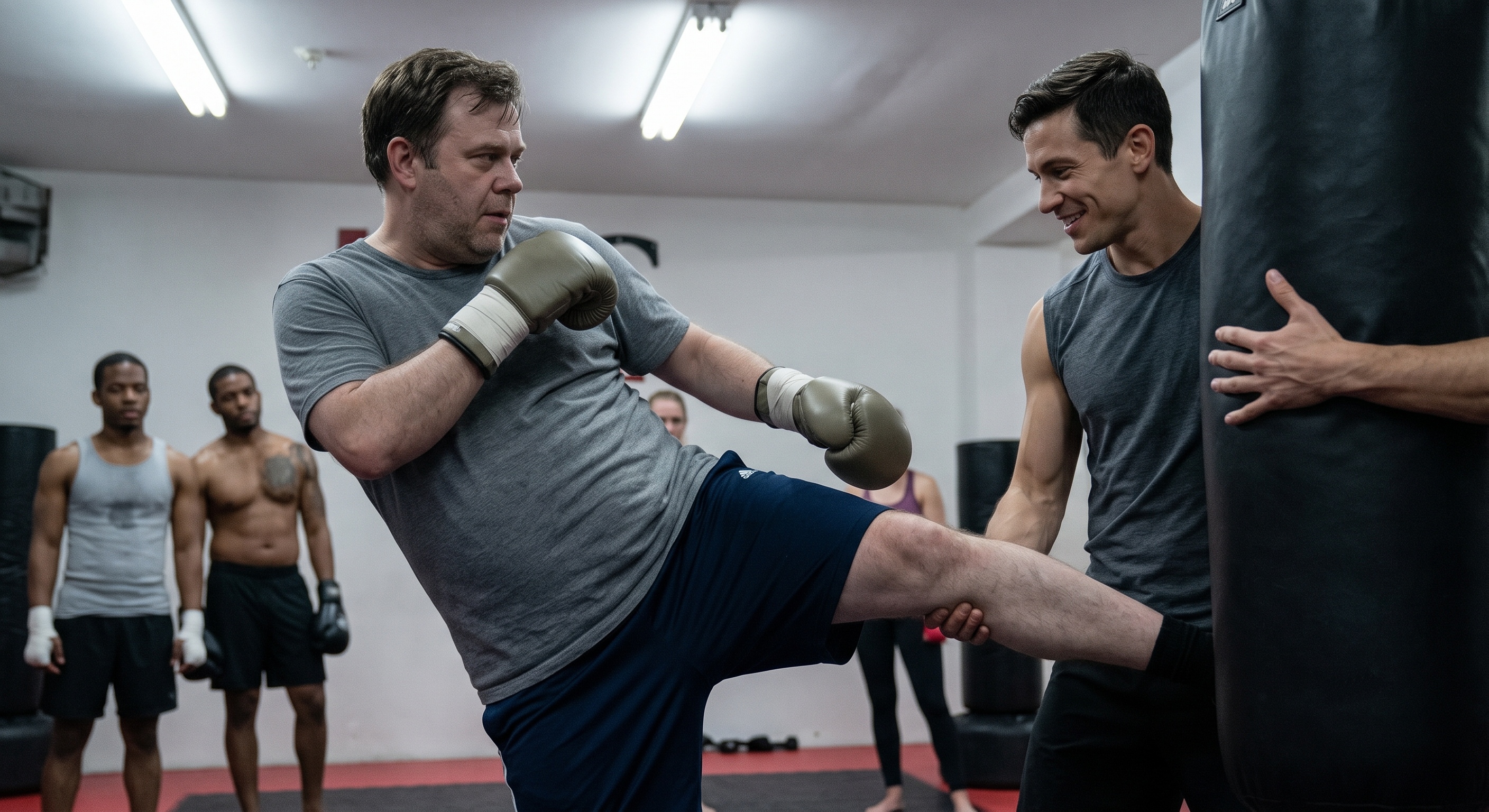
This one is my favorite, because it's the most backwards piece of logic in all of fitness, and almost everyone believes it.
Say it out loud and listen to it: "I need to get in shape before I start doing the thing that gets people in shape."
That's like saying you need to learn Spanish before you take the Spanish class. It's like cleaning your house before the housekeeper comes. I understand why you feel it — you're picturing yourself gassed out in the first five minutes while everyone watches, and that picture is genuinely unpleasant.
So let me replace that picture with what actually happens, because it seems like nobody has ever told you what a first class really looks like.
Nobody is watching you.
I mean that literally. The people in that room are focused on their own breathing, their own technique, their own private war with the pads in front of them. The advanced people? They remember their first class vividly — the gasping, the confusion, the noodle arms — and the only thing they feel when they see a beginner is respect, because you did the thing they know is hardest: you walked through the door.
And here's what your coach sees when an out-of-shape person walks in: the easiest wins of their career. You are the person who will make the most dramatic progress in the shortest time. The person who's already fit improves in inches. You improve in miles. Every week, something gets measurably better — you recover faster, you last longer, your shoulders stop screaming during the third round. Progress is the most addictive substance on earth, and beginners get the purest supply.
Now let's do the math on this one too, because the numbers are absurd when you actually look at them.
You could possibly be embarrassed about roughly the first one to two classes. That's it. That's the entire cost. One to two hours of your life feeling awkward and winded. Two hours — against decades of return: a stronger heart, a body you trust, stress that has somewhere to go besides your bloodstream, and the quiet, unshakeable confidence of a person who knows they can handle themselves.
Two hours of discomfort for decades of payoff. If someone offered you that trade in any other area of your life — two awkward hours for a permanently upgraded existence — you'd sign before they finished the sentence.
The shape you're in right now is not a barrier to entry. It's the starting line, and the starting line is exactly where beginners are supposed to stand. There is no version of this where you skip the beginning. The people you admire didn't skip it. They just started it sooner.
Which raises the last objection.
Objection #3: "It's Too Late for Me"
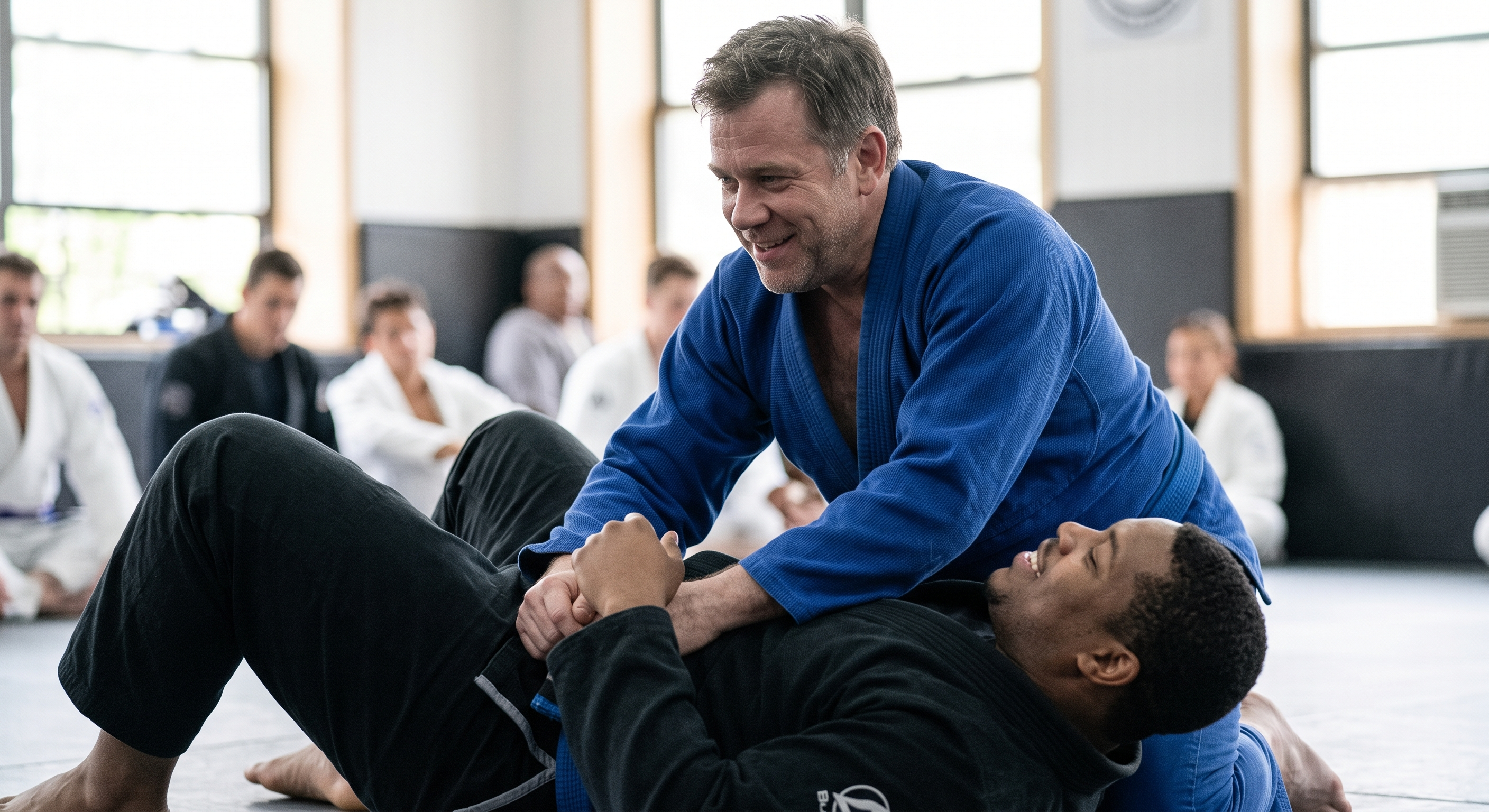
This is the quiet one. The other two are about your body; this one is about your story.
It sounds something like: "If I was going to be that kind of person, it would have happened by now. Fighters start young. That ship sailed. This is who I am, and people like me don't do things like that."
I want to sit with this one for a second instead of rushing past it, because it deserves a real answer.
You're right that the ship sailed on one thing: you are probably not going to be a UFC champion if you start training in your mid 40s. Neither am I. Neither are 99.9% of the people who train martial arts anywhere on this planet. If "too late" means "too late to headline a pay-per-view," then yes. Too late. Congratulations, you've correctly assessed one career path.
But is that actually what you wanted?
Or did you want to feel strong? Did you want to walk into a room and feel calm instead of small? Did you want to be the parent your kids see doing hard things, so they grow up believing hard things are normal? Did you want an hour a day where your phone doesn't exist, your job doesn't exist, and the only problem in the entire world is the person in front of you holding pads?
Because it is not too late for a single one of those things. It's not even close to too late. Those things are available to you starting this week.
Here's what "too late" actually is, mechanically: it's your brain protecting your current identity. Changing who you are is expensive — it costs effort, risk, and the discomfort of being new. So your brain runs a cost-avoidance script that sounds like wisdom: "that ship has sailed." It's not wisdom. It's inertia wearing wisdom's clothes.
And I'll tell you the thing that 27 years of coaching has made impossible for me to ignore: the people who tell themselves it's too late at 35 tell themselves the same thing at 45, and 55, and 65. "Too late" is never a conclusion you reach once. It's a subscription. It renews automatically every year, and it charges you the same thing every time: another year of being the person who almost did it.
The only way to cancel the subscription is to make it factually untrue. And it becomes factually untrue the moment you take your first class. Not when you get good. Not when you get promoted. The first day. Because on that day, "people like me don't do things like this" collides with the unignorable fact that you are, at that moment, doing it.
Your brain can't argue with evidence. So give it some.
Now Let's Talk About Who You Are in 90 Days
Close your eyes for a second after you read this paragraph, and actually do this. Don't skim past it. This is the part that matters.
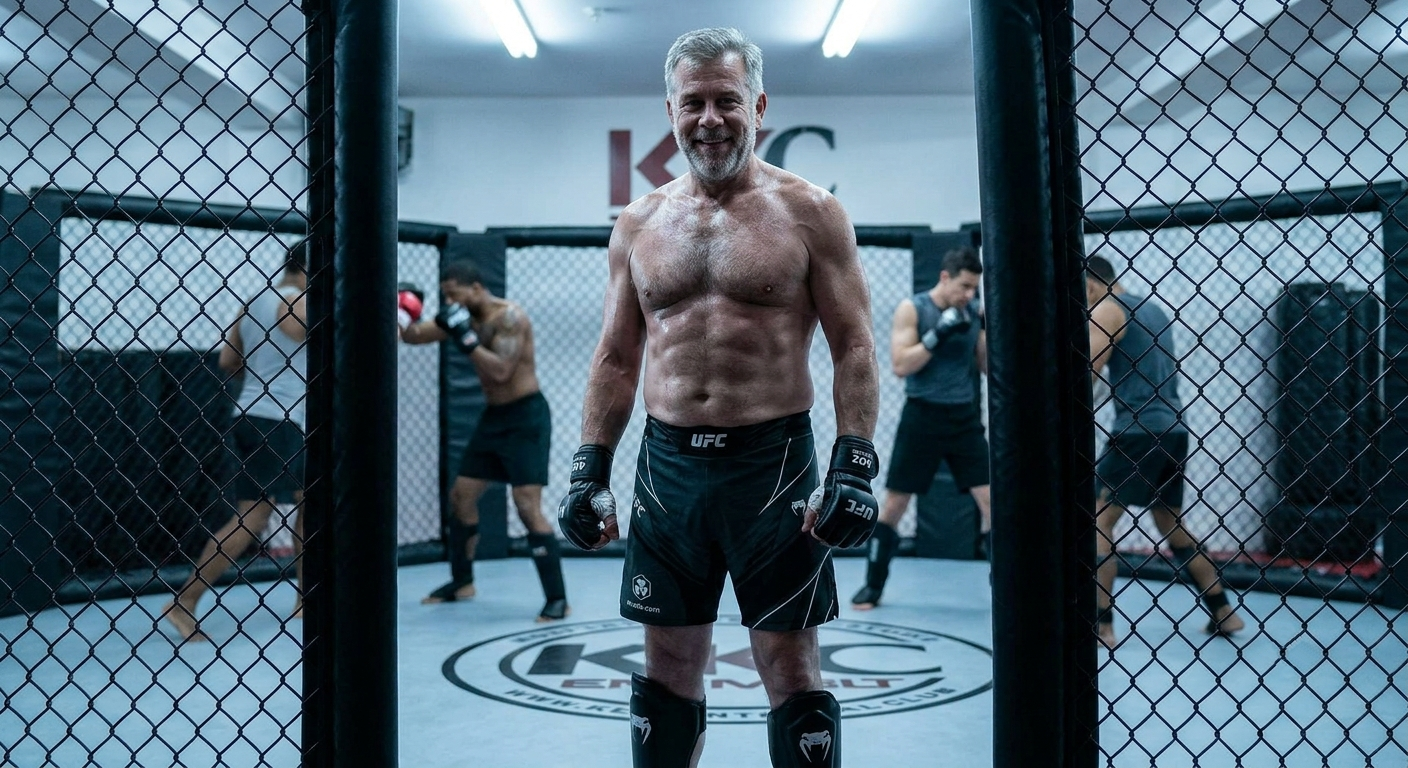
It's a Tuesday evening, about 90 days from now. Mid-October. You're walking out of the gym into the cool air and your shirt is soaked through and your legs are pleasantly heavy and your mind is completely quiet — the kind of quiet you used to need a vacation to find. You just did twelve rounds of bag work and partner work that would have ended you in week one, and tonight it was just... Tuesday. Your coach called out a correction mid-round and you made it without thinking, and something in your chest registered: I'm getting good at this.
Your clothes fit differently. Not dramatically — 90 days isn't a magazine cover — but your shoulders sit back now, and you noticed last week that you stopped avoiding mirrors. You sleep like you've been drugged. The afternoon energy crash that used to run your life has mostly disappeared. Someone at work asked what you've been doing differently, and you got to say the sentence — "I train Kickboxing" — and you watched their eyebrows go up, and you'd be lying if you said that didn't feel incredible.
But here's the part you couldn't have predicted 90 days ago: it's not really about the fitness anymore. It's the people who know your name when you walk in. It's the fact that you've done something hard three times a week for three months, and that fact has quietly started leaking into everything else — how you handle stress, how you speak up in meetings, how you carry yourself in a parking garage at night. You're not a different person. You're the person you always suspected you were, minus the excuses.
Now open your eyes and answer one question:
What did that version of you do that you haven't done yet?
One thing. They took a first class. That's the entire difference between you and them. Not genetics, not free time, not age, not fitness. One decision, followed by showing up.
Here's Exactly What Happens Next
I'm not going to end this with vague inspiration, because vague inspiration is how you ended up reading articles about training instead of training. Let's be concrete.
Here's what your first class at KMAA actually looks like: You show up 15 minutes early. A coach — not a salesperson, a coach — meets you, learns your name, and asks about you: your goals, your body, any old injuries, what you're worried about. You warm up with the class at your pace, because we scale everything to the person in front of us — it's literally the foundation of how we coach. You learn real technique from day one, not watered-down cardio theater. You will be tired. You will probably laugh at least once. Nobody will ask you to spar. Nobody will make an example of you. And when it's over, a coach will check in with you personally, because how your first day goes matters to us — we've built 27 years and 25,000 square feet on people's first days.
Here's what it costs you to find out if this is for you: a couple of hours, a few bucks, and the willingness to be a beginner. That's the whole bill.
And here's what it costs you to keep thinking about it instead: another 90 days. Which becomes another year. Which becomes the subscription we talked about — the one that renews quietly every birthday.
You've read 2,500 words about the three reasons you haven't started. Would it be ridiculous to spend one class finding out whether any of them survive contact with reality?
They won't. They never do. In 27 years, I have never once — not one single time — heard a student say, "I'm so glad I waited until I was older, more out of shape, and further behind."
But every week, I hear the other sentence. You already know what it is, because part of you is saying it right now, in the parking lot of your own life, before you've even started:
"I wish I'd done this years ago."
You can't fix years ago. You can fix now.
Your first class is waiting. Book it before the clipboard voice talks you out of it — and 90 days from now, thank yourself for reading all the way to the end.
Knoxville Martial Arts Academy has been building capable, confident people in Knoxville for over 27 years — from first-day beginners to world-class professional fighters, in the largest and most successful MMA facility in Tennessee. Everyone on our mats was a beginner once. Including the coaches.
